
A growing interest in artisanal Mexican rum surges just as many of the country’s aguardiente traditions are on the brink of distinction. Manlio Peña explores the history, cultural significance, and economics of Mexico’s cane traditions.
A quiet irony is at work in the Mexican sugarcane countryside. At the precise moment when specialized markets in France, the United States, and Japan turn to look at Mexico as the new frontier of cane spirits—a territory of authenticity and unexplored complexity—the country seems determined to turn its back on the very knowledge that makes that fascination possible. The asymmetry is not only commercial. It is also cultural, and it runs deep. For decades, the country invested in cataloging, protecting, and narrating agave as a national emblem, while sugarcane was relegated to the category of industrial raw material (a single, small Denomination of Origin was born years later). It is not that there is a lack of history behind the aguardiente; it is that no one took the trouble to tell it—a distillate that shares a common historical origin with other drinks on the continent, from Brazilian cachaça and Colombian tapetusa and viche to Guatemalan and Cuban rum.

The last trapiches
Driving along certain highways in Veracruz, Michoacán, and Morelos, you can spot a structure lost in time that almost goes unnoticed: a tin or tile roof, a rusted mill, and an unmistakable sweet smell in the air.
It’s the trapiche, the small rural sugar cane millsthat for centuries have produced piloncillo (brown hard sugar), aguardiente (cane spirit), and other sugarcane derivatives. At its center sits the mill—hydraulic, animal-powered, or diesel, depending on the region and style— and around it an ecosystem of labor takes shape that’s rarely talked about, even though it shaped much of the economy in Nueva España and in modern Mexico.
It’s worth being clear that, despite certain similarities—and their shared relationship to cane—the trapiche is different from the ingenio (sugar mill), which handles volume with industrial capacity. The trapiche, by contrast, keeps to a more human, family-based, almost domestic scale, sustained by its communities.
At first, production was limited to sugar and piloncillo, but the versatility of these products opened a door: Indigenous peoples and communities, Afro-mestizos, mestizos, and others began experimenting with sugars, enriching fermentations of pre-Hispanic origin. From this came a fusion that quickly became part of daily life: drinks like tepache, with its piloncillo, spices, and pineapple rinds, were common in everyday consumption. Yet like any fermented drink, it had to be consumed within the first few days, or else it would turn to vinegar or spoil.
The arrival of copper stills from Europe and the Filipino-style still from Asia created the potential to develop spirits from the available raw materials: coconut palm, agave, and cane. Aguardiente, a clear, high-proof liquid, could be kept for years without spoiling. Rather than going to waste, the byproducts of the fledgling industry could even be used to boost the alcoholic strength of other drinks.
Chinguirito—as cane aguardiente was known—was soon outlawed, and the prohibition lasted two centuries, upheld by a Castilian morality that had little to do with how the people of Nueva España actually lived—or drank. Behind the moral argument was, as almost always, an economic calculation: every shot of chinguirito sold in the colony was a shot of Spanish wine or liquor that went unsold.
Change came with the Bourbon Reforms (1750-1808), when a Spain worn down by decades of conflict in continental Europe concluded it was more profitable to tax the drink than to keep persecuting the industry. —Despite the ban, cane spirits remained the most consumed beverage among the local population, so taxation turned a problem into an opportunity.
The aguardiente and piloncillo industry reached its peak during the Porfiriato, (1867 -1911) especially in states like Veracruz, Michoacán, Jalisco, and Morelos. Each trapiche already had its own integrated distillery, and aguardiente distribution networks expanded with the railway system. Over the years, however, production formats kept changing: industrialization, and the arrival of spirits from other regions reshaped how the drink was perceived. Sometimes, the industry adapts to economic pressures and shortages through bad practices: industrial alcohol with additives to give it color and flavor, masking defects and unwanted tastes in order to reduce production costs. Bit by bit, these batches came to dominate sales due to their low cost, largely ruining the drink’s reputation. What had once been the most popular beverage was relegated to the margins, associated with the lower classes within an increasingly narrow scope. Those prejudices persist to this day, particularly in its places of origin.


Don Toño’s trapiche
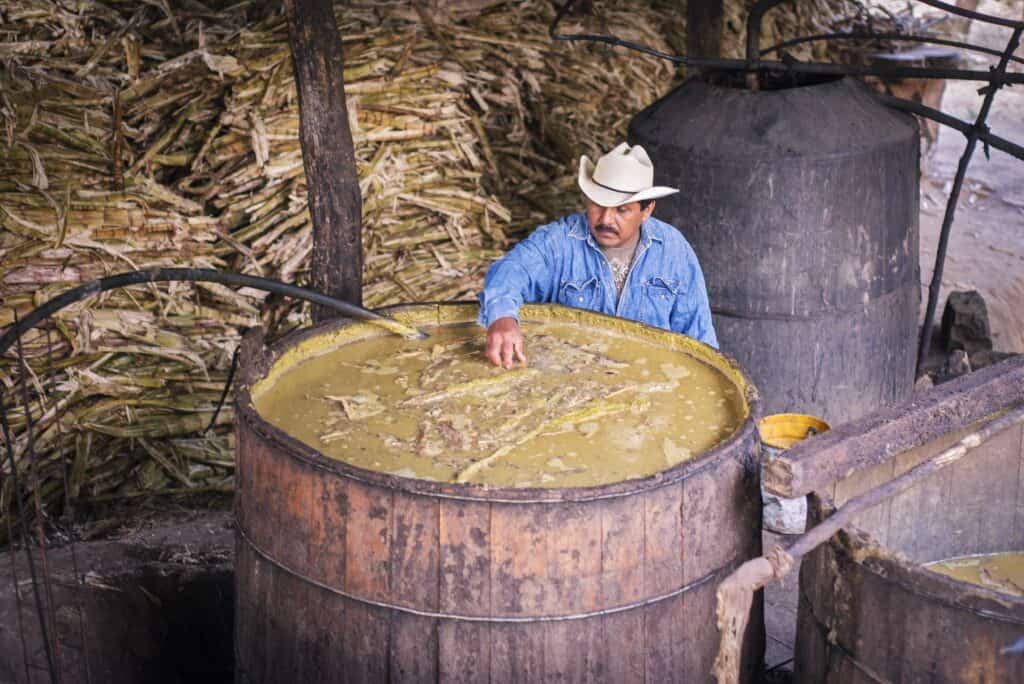
Life at the trapiche begins before sunrise, around two or three in the morning. There, a peculiar squad gathers: Toñito, the son of Don Toño; a couple of young men glued to their phones; a migrant who returned home with his mornings free; and a retiree who boasts of cutting sugarcane faster than any boy.
Between the noise of the old hydraulic mill and the heat of the boiler stoked with bagasse, this mixture of generations keeps alive a trade that refuses to disappear.
Don Toño Ruiz has been a trapiche worker since childhood, in Los Otates, Nuevo Urecho. He watches with bitterness as his guild shrinks. “El trabajo de la caña es solo para hombres de Castilla,” he says, while young people leave for the berry and avocado fields for better pay. His trapiche—founded by his father decades ago—resists. After breaking his wooden trough, he stopped producing piloncillo for two years; this season he inaugurates a new one and keeps grinding. He sells melado and piloncillo to locals, and sugarcane juice to producers like Enrique and Manuel from Rudiment, Miriam Pacheco from Charanda Uruapan, and Emilio Vieyra from Danza de Lobos.
The cañaverales that once defined the landscape of Michoacán’s transition zone—where the Sierra Neovolcánica descends toward the Tierra Caliente and the Balsas depression—have been quietly disappearing. In their place: avocado groves and berry fields. The economic logic is brutal and simple. One hectare of berries offers a short-term return that sugarcane, destined mainly to the sugar mill or the trapiche, cannot match today. For agricultural families, the equation has ceased to be viable, due to factors ranging from rising agricultural production costs—driven by its proximity to the competitive avocado and berry export belt—and low domestic sugar prices, to the pressure of extortion and cartel fees.
Artisanal cane spirits require a quality of raw material that industrial production standards rarely reach, but the contemporary market rewards volume over quality. Small producers have been forced to abandon their trapiches or redirect their labor toward the packing companies and cutting operations of regional agribusiness, simply to survive.
The substitution has not been painless. It has arrived accompanied by violence, territorial dispossession, and an economy structured around extortion. Some of the states with the highest sugarcane production in Mexico—among them Michoacán, Veracruz, and Jalisco—are also among those hardest hit by organized crime. Extortion, cobro de piso (extortion payments), and kidnapping have become common elements of the rural economy, and their cumulative burden has pushed entire communities to abandon not only their crops but their homes completely; a forced displacement that empties out whole towns, leaving not just empty homes behind, but generations of culture and tradition.
The alchemist of La Magdalena
Fifteen minutes from Uruapan, in the barrancas of Caracha in the municipality of Ziracuaretiro, Enrique Reyes ferments, distills, and teaches in a small distillery he built next to an affluent of the El Ortigal spring. He is a man of many trades: plumber, stonemason, agronomist, chemist. He learned from his father, José Reyes, who inherited the knowledge from his own father, who learned it from Crescencio Altamirano, an old alambiquero (master distiller) from the haciendas of Caracha and Patuán.
His story is one of return. After years working in aguardiente distilleries in Uruapan and distilling clandestinely in the back of his childhood home, Enrique had left the trade behind. He belonged to a generation of alambiqueros who watched as an industry that had sustained their families for decades evaporated. Throughout the late 1990s and into the 2000s, most of the sugarcane-spirit distilleries in Michoacán closed, unable to compete under the economic conditions that followed NAFTA: cheaper imported alcohols, shrinking margins, and a market that did not reward artisanal production.
For Enrique, as for many others, leaving it behind was not a choice: the trade he had learned from his father simply ceased to be able to sustain a life… It was not until his alliance with Manuel López that he decided to reactivate the aguardiente tradition. That alliance was born out of a search. Manuel López had set out to create a liqueur from nurhitini, a wild herb with medicinal uses among Purépecha communities, harvested from the ravines of the Tancítaro and Paricutín volcanoes. He first tried working with some local charandas, but he couldn’t achieve the quality he was looking for; by the early 2010s, most of the region’s charanda production had become dependent on additives to mask what the raw material could no longer provide on its own.
A colleague from the small cooperative was the bridge that brought Manuel and Enrique together. That meeting marked the beginning of the real search: tracking down the last trapiches still producing piloncillo the traditional way, and subsequently, working through the trial and error of building a still and a proper oven from scratch. After a failed attempt in the Sierra of the Meseta Purépecha —where water was scarce—they returned to their family origins, advised by José Reyes, and built a kind of laboratory-workshop: a refuge where today they capture the essence of the region, rescue flavors displaced by generic alcohol, and teach the art to a new generation of alambiqueros.
In Enrique and Manuel’s work there is much more than a trade. There is knowledge of the territory, of life in the countryside, of plants and animals. There is a scientific precision that requires no tables or calculators. There is tradition, community bonds, identity—liquid culture, and the safeguarding of something that cannot be reconstructed from a manual once it is gone.
Genealogies of sweetness
While the Mexican state has historically promoted the genetic crossing of cane varieties in pursuit of yield and standardization for the sugar industry, at the margins of that model another reality survives—and increasingly, thrives. Small and medium distilleries have begun to revalue ecotypes and heirloom varieties, betting on something agribusiness discarded decades ago: that the genetic diversity of sugarcane is precisely where the deepest potential of the Mexican distillate resides.
For example in the Sierra de Tlalixtac, Oaxaca, the Krastel brothers have spent years working with the Java varietal. That choice, combined with their family tradition, produces rums capable of expressing the identity of their territory with unusual clarity. This dynamic is crystallized in the collaborative synergy forged with Jason Paul Cox through the Alambique Serrano rum series. Thanks to a select barrel management program, this partnership has generated a wide range of limited batches that are highly differentiated from one another. Thus, the project has successfully brought together distinct production styles, ancestral wisdom (saberes), and regional flavors (sabores) within a single catalog, all without losing their core essence.
At another latitude of Oaxaca, Paranubes has become an essential reference for cane spirit enthusiasts. Producer Jose Luis Carrera and his family work with four heirloom varieties of cane (Caña Dulce, Caña Morada/Negra, Caña Dura y Caña Amarilla/Criolla). Long fermentations with mesquite bark and distillation in a six-plate copper column generates organoléptic profiles of such complexity that many mistake the aguardientes for ancestral mezcals. Notably, the label of “aguardiente” or “ron” has not worked against them, but has placed the category on the radar of aficionados: a fortune that, unfortunately, most traditional sugarcane distillates in the country do not share.
Paranubes’ visibility didn’t happen by accident. Judah Kuper—already a familiar name among mezcal drinkers through Vago—took an early interest in Jose Luis’s work, and his backing gave Paranubes a kind of credibility that few sugarcane distillates had managed to earn on their own. It helped position aguardiente, still an unfamiliar category to most palates, as something worth paying attention to.
This phenomenon demands a closer look at what is beginning to happen with the varietals of Charanda Uruapan (One of the earliest Mexican sugarcane spirit brands to venture into the North American and European markets). The Pacheco-Murguía family began a micro-zonification project across a handful of parcels, mapping the different sugarcane varieties present in the Ziracuaretiro-Taretan region.
The project took shape almost in parallel with the founding of the denomination of origin itself, starting with the selection of distinct genetic materials and their establishment in the clay-heavy soils that give the denomination its name. Five cane profiles (Criolla, Mayari, Mexicana, Cristalina y Morada) that differ radically from one another, and that, when crossed with different distillation practices—the copper pot still, the Filipino-type alambique—open a sensory range that is barely beginning to be explored. A purple cane processed in a Filipino alambique and presented at 63% ABV is an experience that has nothing to do with the standardized commercial versions at 46%.
The richness of these spirits lies in their origin, in the audacity of sustaining high proofs, and in the refusal to smooth over what the territory has to say. And this is just the tip of the iceberg; there are still many distilleries—more than a hundred distilleries across Veracruz, Jalisco, Oaxaca, Hidalgo, and Michoacán—with distinct cultural practices, varietal selections, and interactions with their communities, where aguardiente holds a powerful ritual presence. There is still a long road ahead: distilleries yet to be discovered, flavors and identities that remain unnamed, knowledge and traditions that continue to run, quietly, through tropical Mexico—waiting for someone to stop and listen.
What burns when an alambiquero disappears
The rupture of the generational chain is not an accident of modernity. It is the result of a deep wound in the social fabric of the producing zones. The lack of economic incentives and the marginalization of the trade have pushed younger generations toward migration—a migration increasingly dictated by survival. The apprentice who once memorized the art of distillation from childhood now crosses a border where they are not well received, or flees to the periphery of cities, abruptly interrupting centuries of oral tradition.
When an alambiquero is forced to retire or dies without having trained a successor, an entire library of empirical knowledge disappears with them. A living science that exists in no manual vanishes: the instinctive reading of climate to adjust a fermentation, the recognition of the must’s exact point by the sound of its bubbling, the precise touch to control copper temperature during condensation. Traditional methods of good work that, once lost, cannot be replicated with the same authenticity.
What is at risk of extinction is not a catalog of spirits. It is a liquid cultural identity. Each drop of these traditional distillates is an archaeology of flavor that contains the memory of the soil, the resilience of agricultural communities, and the expression of their environment.
The market and its promises
A new consumer has emerged at the exact moment this crisis unfolds—one who seeks what the agribusiness model destroys: traceability, native fermentation, the rescue of ancestral technique, and a direct social impact on the producing community. But this consumer is not emerging uniformly. In the United States and other specialized markets, years of education around tequila and mezcal have already trained palates to look beyond the label and ask for the master distiller, the region, the still. That same curiosity is now turning toward aguardiente and Mexican rum, backed by better access to information and, frequently, better access to the quality itself—small-batch bottles that reach American bars long before they ever hit Mexican shelves.
In Mexico, the shift is real but slower and uneven. Habits are changing, but the market still overwhelmingly rewards scale and brand recognition over origin: massive generic brands dominate shelf space, and even in categories with far more institutional protection and narrative—mezcal, tequila—the majority of local consumers still opt for spirits built on additives and diffusers, disguised with flashy names and clever packaging instead of a transparent origin. Information about producers, methods, or even the existence of denominations of origin rarely reaches the average buyer. Mexican cane spirits are being discovered abroad faster than they are being understood at home.
Artisanal Mexican rum and aguardiente in the international market represents one of the most compelling reevaluations in contemporary mixology. What for decades was perceived locally under a stigma of marginal consumption is today celebrated in top US bars as a true gem of authenticity. Content creators and educators like Lucas Assis, Arminder (Rum Revival), and the duo of John Gulla and Will Hoekenga (The Rumcast) have been instrumental in this paradigm shift. Through coverage focused deeply on transparency and origin, they have guided North American consumers beyond mezcal, opening the doors to a new wave of cane spirits. In this geography of discovery, rums from the Oaxacan highlands served as the spearhead, closely followed by Michoacán’s distillates, such as Charanda. Ultimately, what these tastemakers have uncovered is not just a new flavor profile for mixology, but the rescue of ancestral techniques, native sugarcane varieties, and the dignity of producing communities that are finally finding the resonance they deserve.
This demand for authenticity extends beyond beverages and food, reflecting a structural transformation in global consumption habits. The current market dictates ethical imperatives that have driven the emergence of small-scale, specialized enterprises. These alternatives aim to mitigate environmental degradation by discouraging disposable packaging, upholding the rights of both workers and animals, and centering their operations around the empowerment and visibility of minority and women producers.
Mexican cane spirits have every element needed to enter this wave of more deliberate consumption. But the question no label design or marketing strategy can answer on its own is this: who captures the value when the spirit reaches the shelf?
The history of artisanal spirits in Mexico is also a history of extractivism — of intermediaries who exploit the image and tradition of a community as exotic added value, who buy in bulk at punishing prices, who leave products on consignment and sometimes never return to settle the deal. The danger is not that premiumization fails to arrive. The danger is that it arrives and leaves the master distiller exactly where they started.
It is imperative to rethink the production model: the solution to the crisis is not in competing by volume or in lowering costs, but in radically betting on quality, identity, and narrative.
Mexican cane spirits must be bottled, communicated, and defended as what they truly are: complex spirits endowed with a deep sense of terroir, crafted by master artisans whose knowledge is the result of centuries of interaction with their trade, their territory, and their community. The name of the alambiquero, the variety of sugarcane, the region of the trapiche, and the distillation method must become the primary value on the label — the main tool for differentiation against industrial homogeneity.
Saving Mexico’s native cane varieties and their traditional distillates is not nostalgia. It is an economic strategy: to diversify agriculture, offer dignified conditions to rural families, and protect a liquid heritage that, once the copper stills go cold, can never be recovered. It reminds me of and resonates with Don Toño’s promise: when he passes away, he wants them to bring the mariachis and play for him, just a few short steps down from the trapiche.
His resistance is not only economic. In Don Toño’s knowledge—his reading of the harvest cycle, his instinct for the boiler’s heat, his stubbornness—lives a form of Mexican cultural heritage that no denomination of origin and no agricultural policy has managed to adequately protect.
References
Rumporter. (s. f.). Focus terroir: Mexico, the new frontier for rum? https://rumporter.com/en/focus-terroir-mexico-the-new-frontier-for-rum/
Comisión Nacional para el Conocimiento y Uso de la Biodiversidad. (2021). Patrimonio biocultural. Biodiversidad Mexicana. https://www.biodiversidad.gob.mx/diversidad/patrimonio-biocultural
Diario de Xalapa. (2024, 24 de febrero). ¿Caña en trapiche? En Tlaltetela elaboran aguardiente de manera artesanal. Organización Editorial Mexicana. https://oem.com.mx/diariodexalapa/
Fuente, J. de la. (2008). Monopolio de aguardiente y alcoholismo en Los Altos de Chiapas: Un estudio “incómodo” (1954-1955) (M. Sosa Suárez, Coord.; S. E. Lewis, Ed.). Instituto Nacional de los Pueblos Indígenas. https://www.inpi.gob.mx/acervos/libros/monopolio_de_aguardiente_en_chiapas_estudio_julio_de_la_fuente_1954_55_fd_bjr.pdf
Instituto Mexicano de la Propiedad Industrial. (2016). Denominaciones de origen: Orgullo de México. Editorial Pax México; Gobierno de México. https://www.gob.mx/cms/uploads/attachment/file/104879/DO_Orgullo_de_Mexico.pdf
Lozano Armendares, T. (2005). El chinguirito vindicado: El contrabando de aguardiente de caña y la política colonial (Historia Novohispana 51). Instituto de Investigaciones Históricas, Universidad Nacional Autónoma de México.
Mezcal Reviews. (s. f.). Uruapan Charanda by Casa Tarasco Spirits. https://www.mezcalreviews.com/uruapan-charanda-by-casa-tarasco-spirits/
Paranubes. (s. f.). Proceso. https://www.paranubes.com/proceso
Beverage Trade Network. (4 de febrero de 2025). Premiumization in the U.S. Spirits Industry: Still Thriving or Reaching Its Peak? Bartenders Business. https://bartendersbusiness.com/en/articles/insights-1/premiumization-in-the-u-s-spirits-industry-still-thriving-or-reaching-its-peak-609.htm
Alejo Santiago, J. (25 de marzo de 2016). El charanda: identidad en revaloración. Milenio. https://www.milenio.com/cultura/el-charanda-identidad-en-revaloracion_2
Janzen, E. (1, de octubre de 2019). Charanda: A Storied Mexican Spirit at Risk. Imbibe Magazine. https://imbibemagazine.com/charanda/
Casa Tarasco Spirits. (s. f.). Productos. Charanda Uruapan. https://charandauruapan.mx/productos/
Rumporter. (2026, March 2). Interview – Juda Kuper, the man who discovered Paranubes and brought it to the attention of the general public. Rumporter. https://rumporter.com/en/interview-juda-kuper-the-man-who-discovered-paranubes-and-brought-it-to-the-attention-of-the-general-public/
Rumporter. (2026, March 2). Mexico: Some iconic distilleries. Rumporter. https://rumporter.com/en/mexico-some-iconic-distilleries/
Andrei Velasco, J. (2015). Reseña de Las reformas borbónicas, 1750-1808, coordinado por Clara García Ayluardo. Memoria y Sociedad, 19(38), 90-93. http://www.scielo.org.co/scielo.php?script=sci_arttext&pid=S0122-51972015000100007
Cárdenas Ayala, E. (2016). El porfiriato: una etiqueta historiográfica. Historia Mexicana, 65(3), 1051-1077. https://www.scielo.org.mx/scielo.php?script=sci_arttext&pid=S2448-65312016000301405






Leave a Comment