Is Charanda rum? Short answer: yes, but it’s complicated. Michoacán native Manlio Peña gives you the lowdown on this unique spirit.
An emblematic Mexican spirit from the state of Michoacán, charanda is protected by a Denomination of Origin (DO). Charanda is an expression of Mexican sugarcane, with a unique identity that distinguishes it from industrialized rums. The spirit enjoyed widespread popularity in Colonial Mexico, where it was commonly known as chinguirito. Its production was illegal because it competed with spirits from the Iberian Peninsula–a policy that unfortunately contributed to the negative reputation the drink held at various times.
What does charanda mean?
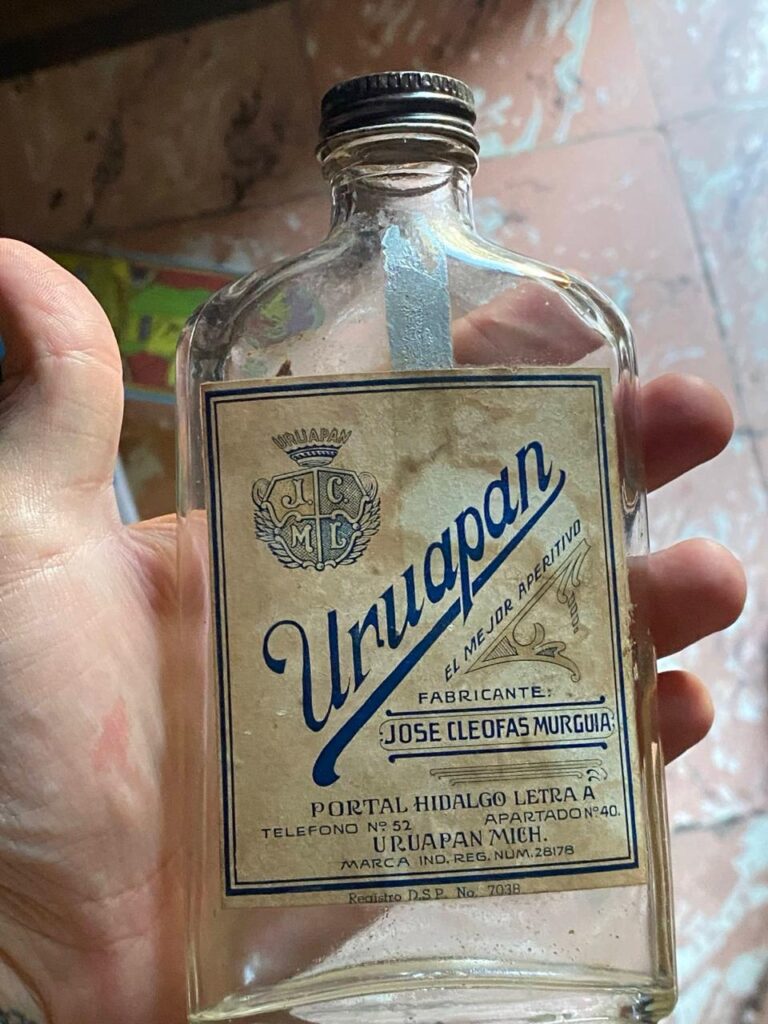
Charanda is a regional alcoholic beverage obtained from the fermentation and distillation of musts made from fresh sugarcane juice or its derivatives, such as melado (cane syrup), piloncillo, or molasses. Its name comes from the Purépecha word for “red soil.” The region’s most famous distillery was built at the base of its namesake mountain, the Cerro de la Charanda.


Artisanal charanda seeks to preserve the primary expression of the cane, which varies depending on the raw material, resulting in an honest distillate where the sugarcane truly expresses itself.
Is charanda rum?
Defining charanda often sparks a debate even more complex than its distillation process. If you put the question to a group, the answer will vary drastically depending on who you ask. It is a phenomenon similar to what occurs with Brazilian cachaça: the eternal crossroads between adopting the term “rum” to facilitate global understanding or fiercely defending the native category.
On one hand, the institutional weight of the Denomination of Origin (DO) dictates a rigid stance. As the DO is geographically small, the majority of current production—and, therefore, the visible face of the ecosystem—is concentrated within one family nucleus: Casa Tarasco Spirits. For this group, which houses multiple brands under its umbrella, the “rum” label is largely dismissed (except for export purposes) as a matter of corporate pride and identity: It is charanda.

However, the periphery of the DO tells a different story. Those distilleries operating outside the official boundaries are not only dealing with geographic borders but also with the historical stigma that local aguardientes and charandas are “cheap” products. To distinguish themselves, some producers have opted for a technical taxonomy similar to that of brandy or whiskey: if the spirit emerges crystal-clear from the still, it is formally labeled aguardiente de caña; if it passes through the filter of time and oak, it is named “rum”
In the realm of roots and popular culture, charanda is, indisputably, an aguardiente de caña, regardless of whether or not the barrel has touched the liquid. But in the arena of the global market, rigidity can lead to isolation. At times, commercial honesty requires simplification so that one may deepen the narrative later. By presenting charanda as a rum with a Denomination of Origin, we are not erasing its identity; we are building a bridge of trust. It is the necessary hook that allows the consumer to cross the threshold of unfamiliarity. Once the spirit is in the glass, the origin, the sugarcane, and the history of Michoacán can finally take the center stage they truly deserve.

Where is charanda produced?
Charanda is crafted exclusively in the state of Michoacán. The legal protection zone covers 16 municipalities located in the central part of the state, with Uruapan the center of origin and identity. This is a transition zone between the Tierra Caliente and the Purépecha Meseta regions, characterized by volcanic activity and young extinct volcanoes.
The authorized municipalities are: Ario, Cotija, Gabriel Zamora, N. Parangaricutiro, Nuevo Urecho, Peribán, Los Reyes, S. Escalante, Tacámbaro, Tancítaro, Tangancícuaro, Taretán, Tocumbo, Turicato, Uruapan, and Ziracuaretiro.
Despite not being included, the Lake Pátzcuaro region and Morelia were the first areas to use the name charanda interchangeably. It is worth noting that in Erongarícuaro and Morelia, there is currently a small-scale production of aguardiente de caña (sugar cane spirit) at the hands of master mezcaleros.
Raw material: regional sugarcane
What makes Charanda unique is its raw material: sugarcane grown in volcanic soils rich in mineral components, at altitudes ranging between 800 and 1,600 meters above sea level. These special agroclimatic conditions provide a higher concentration of sugars, sucrose, and iron to the cane—flavors that transfer directly to the final distillate.

How is the cane milled?
After the harvest—which can involve the zafra (burning and cutting) or direct fresh cutting—the cane can be milled in different ways.
- Industrial: Processed at a large sugar mill (ingenio) that separates the bagasse from the juice; the juice is then heated and centrifuged to separate sugar from molasses.
- Artisanal: Varies depending on the trapiche (the milling unit). This can be:
- Hydraulic traction: Water mills powered by the region’s irrigation ditches and rivers. (This is the most common method of artisanal milling.)
- Animal traction: Mules or horses pull a long wooden arm in circles to rotate iron or wooden rollers that crush the cane.
- Mechanical: Using diesel engines to power the trapiche, in place of animals.
Note: Both of the latter traction methods are uncommon.
In traditional processes, the juice—known as guarapo—is typically filtered through mesh or cloth into a vat (batea) to remove bagasse residue.

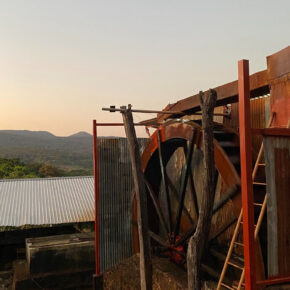
Trapiches de agua: The hydraulic trapiche (sugar mill) stands as a prime example of technical adaptation to the topography of Michoacán. For decades, this was the preferred model for small and medium-scale operations within piloncillo haciendas. The technology survived the collapse and fragmentation of the hacienda system in the early 20th century to remain the engine that drove the regional sugarcane economy.
The hydraluic trapiche was a model of natural efficiency: irrigation ditches—acequias—were engineered to channel water toward a hydraulic wheel. This wheel, in turn, transmitted mechanical movement to the grinding rollers.
The highest concentration of this infrastructure was found in the intermontane valleys, the strip of land where the Trans-Mexican Volcanic Belt descends into the Tierra Caliente. The steep terrain and abundant water allowed for a constant flow through the channels, while the transitional climate fostered a sugarcane cultivation cycle with optimal maturation levels.
Today, these trapiches have fallen into disuse. The arrival of industrial machinery, the decline in sugar prices, and the centralization of production displaced this model, leaving behind old wheels and mills integrated into the landscape. These stone structures and semi-buried canals stand as vestiges of an era when every river served not only as a source of irrigation but as the heart of an industry that defined the identity of our communities.

How is charanda made?
The process varies depending on the desired profile:
- Harvest and Extraction: Cane is cut and milled to obtain guarapo, or processed into piloncillo or molasses.
- Fermentation: Musts ferment naturally or are inoculated, typically in wooden vats, food-grade plastic, or stainless steel tanks.
- Distillation: Traditional methods include a double distillation in copper pot stills and Michoacán-style Philippine still (discontinuous distillation). (At the Pacheco family distillery, a custom, continuous distillation tower is used; it is smaller than standard models and features local modifications to the number and distribution of its plates.)
- Maturation: The spirit may rest in oak barrels, acquiring woody, spicy, or fruity nuances. Certain special Charanda batches age in former cachaça casks made of Brazilian tropical wood.
Frequently Asked Questions and other details:
- What is the difference between charanda and rum? Charanda is a local sugarcane spirit. While some “charandas” sold as souvenirs use cane alcohol from outside the DO and additives to simulate barrel aging, many legitimate charanda brands maintain a more frank personality with less intervention than industrial rum. The mineral content of Michoacán’s volcanic soils and local cultural practices grant it a more intense aromatic and organoleptic profile.
- What does “charanda” mean? It means “red soil” in Purépecha. While it began as a specific brand name from a factory near Uruapan, after the factory closed, “charanda” became a generic term for sugarcane spirit in the region.
- Why Michoacán? Michoacán was one of the great centers of sugarcane spirit production. By the early 20th century, Uruapan and Tacámbaro were the municipalities with the highest output. Sugarcane spirit was the state’s most produced alcoholic beverage, driven by the boom of piloncillo haciendas and the direct and indirect exploitation of populations—primarily of Sub-Saharan origin—resulting from slavery within the sugarcane sector. In fact, most of the processing of sugarcane and spirits was under the care of Mulatto and Afro-Mestizo hands. Piloncillo (unrefined cane sugar/hard brown sugar) could be transported to latitudes where sugarcane cultivation was not optimal but where water resources were abundant for small and medium-scale industry.
- How is charanda different from tequila? Tequila is made exclusively from blue agave, whereas charanda is a sugarcane distillate. Sugarcane was introduced to Michoacán in the late 16th century, and production consolidated around sugarcane haciendas.
- What does charanda taste like? It varies by raw material, ranging from sweet and spicy to fresh and herbal notes. In the mouth, charanda presents clear notes of fresh cane, ripe fruit, vanilla, and spices, with a clean and persistent finish.
- What is its alcohol content? According to the official standard (NOM), it must be between 35% and 55% ABV.
Classification and types of charanda
Charanda is divided into four categories based on the finishing process:
- Blanco (White/Silver): Young, unaged, bottled directly after distillation.
- Dorado (Gold): A result of blending white with rested or aged spirits; can be mellowed (abocado).
- Reposado: Aged for a minimum of two months in oak barrels.
- Añejo (Aged): Matured for at least 12 months in wooden containers.
What is the best way to drink charanda?
To appreciate the complexity of, drink it neat or on the rocks. However, its versatility makes it an excellent substitute for Caribbean rum in classic cocktails like the Daiquiri or Hemingway Special.
Editor’s note: Interested in learning more about charanda? Check out some of our previous pieces on the topic: Demystifying Charanda and Is Mexican rum finally trending? What to know about caña and charanda.
Sources:
Sánchez, Gerardo,2017, La Caña de azúcar en Michoacán. Continuidades y cambios tecnológicos, siglos XVIII Y XIX, available at: https://doi.org/10.35830/cn.vi71.382
Avila Val, A. (2021, marzo). Vidas y bebidas temporada 2: Charanda – Episodio 5, Canal 44. available at: https://www.youtube.com/watch?v=o3RuQtfK7MM&t=390s
Instituto Mexicano de la Propiedad Industrial. (2016). Denominaciones de origen. Orgullo de México. Editorial Pax México. available at: https://www.gob.mx/cms/uploads/attachment/file/104879/DO_Orgullo_de_Mexico.pdf
Lozano Armendares, T. (2005). El chinguirito vindicado: El contrabando de aguardiente de caña y la política colonial (Historia Novohispana 51). México: Universidad Nacional Autónoma de México, Instituto de Investigaciones Históricas.
Uribe Salas, J. A., & Cortés Zavala, M. T. (2008). Caña, azúcar y aguardiente de charanda: Denominación de origen y patrimonio cultural en Michoacán, México Seminario Patrimonios Agroindustriales Paisajes Culturales del Vino, el Pan, el Azúcar y el Café. Mendoza, Argentina.
Patrimonio biocultural. (2021) Biodiversidad mexicana. available at: https://www.biodiversidad.gob.mx/diversidad/patrimonio-biocultural
Ramos Chávez, S. (2004). “Era propiedad de don Eduardo Chávez La Fábrica de Aguardiente La Charanda.” Revista Tiempo del Cupatitizio
Guzmán Ávila, J. N. (2023) Tradición oral, memoria y relatos de la fábrica en las faldas del cerro de la Charanda [Intervención oral]. Conversatorio Tierra Colorada, Uruapan, Michoacán, México.





Leave a Comment