
Mezcal producers in different communities use the name jabalí for plants that may correspond to several agave species. Omar Muñoz takes a deep dive into the implications of these lingustic, cultural, and genetic differences and goes on to explore the history of jabalí mezcal and why mezcaleros consider these tricky maguey a worthwhile challenge.
For many of us who live in cities, nature has become background scenery: it is there, but we barely notice it. Our relationship with the natural world has not disappeared, but it has weakened. Scientific literature calls this progressive loss of everyday contact with biodiversity the “extinction of experience,” a process associated with urbanization, shrinking natural spaces, and the declining transmission of environmental knowledge between generations (Soga & Gaston, 2016; Beery et al., 2023).
This disconnection is especially noticeable with plants. Most of us find it much easier to tell a dog from a coyote or a cow from a deer than to distinguish two similar plant species. Experiments have shown that our visual attention detects and remembers animals more readily than plants. Initially called “plant blindness,” this phenomenon is now often described as “plant awareness disparity,” a tendency not to notice plants, to know less about them, and to regard them as less interesting or important than animals (Parsley, 2020, 2022). This does not mean we are biologically incapable of recognizing plants; rather, our attention, education, and urban culture rarely teach us to observe their differences.
The problems of plant identification extend into the disciplines built upon the process. This is particularly evident in the realm of agave. Even botanists and mezcal producers may considerably disagree about where one kind of agave ends and another begins. Jabalí maguey makes this problem specially visible because botanically different plants may receive the same local names. This leads to a central question: What exactly do we mean when we call a plant a “species,” and does the colloquial name “jabalí” refer to one species or to several?
Even after we learn to observe, a deeper problem emerges: what does it mean for two organisms to belong to different species? We belong to Homo sapiens, yet human beings come in an enormous range of heights, skin colors, features, proportions, and appearances. Despite these visible differences, we remain members of the same species. Conversely, two plants that look virtually identical to a nonspecialist may represent separate evolutionary lineages. External resemblance on its own is not enough to define the boundaries of a species.
Biologists have long proposed different definitions. A species might be delimited by appearance, the ability to reproduce, reproductive isolation, evolutionary history, genetic differences, or a set of unique diagnostic traits. The problem is that these criteria do not always arise at the same time and may produce different classifications.
The unified species theory
Kevin de Queiroz sought to reconcile these differences through the concept of “unified species.” From this perspective, a species is a lineage of populations that evolves separately from other lineages and maintains its own evolutionary trajectory. Reproductive isolation, morphological differences, ecological separation, and genetic divergence are not competing definitions; they are different forms of evidence for evolutionary separation. A species therefore need not display complete reproductive isolation, perfect monophyly, or fixed morphological differences in order to be recognized (De Queiroz, 2007, 2025).
In flowering plants, or angiosperms, a species can be understood as a lineage of populations that maintains an independent evolutionary trajectory and can be recognized through a combination of morphological, genetic, geographic, ecological, phenological (life-cycle), and reproductive evidence. This approach is especially useful because species boundaries in plants are not always clear. Recognized species may interbreed; chromosome sets may duplicate through polyploidy; plants may reproduce asexually or without fertilization through apomixis; environmental conditions may alter their appearance; and different species may retain similarities inherited from common ancestors. Identifying and delimiting a plant species therefore usually requires comparing several kinds of evidence rather than relying on a single trait.
Two plant species can exchange some genes and still remain evolutionarily distinct lineages. The ability to produce hybrids does not, by itself, prove that they belong to the same species. This distinction is particularly important in hybrid and polyploid complexes, whose boundaries must be evaluated using genetic, morphological, geographic, ecological, and reproductive evidence together (Hörandl, 2022).
Gentry, DNA, and changes in agave classification
This framework is especially important for agaves. Individuals of the same species can look strikingly different: they may vary in shades of green, size, and even leaf form depending on climate, soil nutrients, stress, and other environmental conditions.
Their populations may reproduce sexually, spread through offsets, and even hybridize with closely related species. Two different magueyes may therefore share one common name, while plants grouped by botanists into a single species may be recognized by communities as separate varieties or categories. Classifying an agave is not simply a matter of appearance. It requires reconstructing its biological history while also listening to the people who have learned to distinguish, manage, and name it over generations.
There is no single, immutable way to classify plants. Classifications are scientific hypotheses built from the available evidence, and they can change when new information emerges.
In his monumental 1982 book, Agaves of Continental North America, Howard Scott Gentry revisited an earlier proposal by Alwin Berger and divided the genus Agave into two large subgenera: Agave subg. Agave and Agave subg. Littaea. Their principal difference was the form of the flowering stalk, or “quiote” (Gentry, 1982).
Later molecular studies provided compelling evidence for reconsidering that arrangement. DNA showed that agave evolutionary history is more complicated than outward appearance suggests: genera once treated separately, including Manfreda, Polianthes, and Prochnyanthes, fall within the Agave lineage. It also showed that branched, panicle-like inflorescences and narrow, spike-like inflorescences evolved more than once and do not always represent two cleanly separated evolutionary branches (Bogler et al., 2006; Jiménez-Barrón et al., 2020).
One widely accepted framework for classifying angiosperms is the APG system, developed by the Angiosperm Phylogeny Group. It primarily organizes flowering plants into orders and families. Under this system, the former family Agavaceae was placed within Asparagaceae as the subfamily Agavoideae (Angiosperm Phylogeny Group, 2016).
Even so, I remain very fond of Gentry’s classification because it is extraordinarily visual and still useful as a first approach in the field. It does not perfectly represent the evolutionary tree reconstructed from DNA, but it remains a valuable descriptive and teaching tool. Agaves in subgenus Agave have branched inflorescences whose arms resemble a candelabrum or open umbrellas; those in subgenus Littaea have spike-like inflorescences, or branches so short that the entire structure resembles a single spike. Gentry’s system therefore retains value for recognizing visible forms, provided it is not treated as the final word on evolutionary relationships among agaves (Gentry, 1982; MacNeill et al., 2023).
Agave classification: botanical taxonomy vs. ethnovarieties
Through generations of observation, management, and use, farmers and traditional producers have developed their own systems for recognizing, naming, and classifying plants. These systems are not based on appearance alone. They also consider where a plant grows, how it reproduces, when it flowers, how it is used, and the qualities of its fibers or distilled spirits. Studies in Zapotec and Mixtec communities show that these systems integrate morphological, ecological, cultural, and practical information. They are complex forms of biological knowledge, not merely translations of scientific nomenclature (Aparicio et al., 2021; Luna-José & Rendón-Aguilar, 2012).
Zapotec and Mixtec names for agave
This diversity is also expressed in Mesoamerican languages. Zapotec languages use terms such as doba, dob-lé, dob-lá, and doba-yej; Mixtec records include yavi, yavi-cuan, yavi-incoyo, and yaabendisi. These words do not always correspond exclusively to one botanical species. They may also indicate varieties, geographic origins, developmental stages, or plants selected for particular uses (Alducin-Martínez et al., 2023; Comisión Nacional para el Conocimiento y Uso de la Biodiversidad [CONABIO], 2021).
The many names of Agave karwinskii
Agave karwinskii offers a striking example. Although botanical taxonomy recognizes it as one highly variable species, people in southern Oaxaca distinguish at least eleven ethnovarieties, or locally recognized names: cachitún, cirial, cuishe, bicuishe, espina negra, sierrudo, tobasiche, madrecuixe, marteño, tripón, and San Martín. These traditional categories draw on traits such as the presence and height of a trunk, the size and color of the rosette, leaf shape, and the abundance or thickness of marginal teeth (Vázquez-Pérez et al., 2020).
Residents also group some of these ethnovarieties into broader morphological categories. Bicuishe, tobasiche, sierrudo, cirial, and marteño are considered “long magueyes” because they develop trunks that may reach approximately 5 to 10 feet (1.5–3 meters). San Martín, tripón, and madrecuixe are grouped as “barrels” because their trunks are generally shorter than 5 feet (1.5 meters), giving the plants a more compact appearance (Vázquez-Pérez et al., 2020).
Traditional maguey names as capsules of biocultural information
The complexity of this nomenclature should not be dismissed as confusion. It is evidence of a local classification system capable of recognizing morphological, ecological, and productive discontinuities within what botany groups under a single species. Each ethnovariety embodies generations of observation, selection, and management, along with knowledge of how the plants behave in the field and in the palenque, the traditional mezcal distillery.
Local classifications should therefore not be understood as incomplete versions of scientific taxonomy. They are knowledge systems built for different purposes. Botanical taxonomy seeks to identify evolutionary lineages and establish universal names; local systems organize diversity through experience, territory, use, and each community’s cultural relationships. Sometimes the two systems coincide. In other cases, communities distinguish varieties and forms that science continues to group under one name (Vázquez-Pérez et al., 2020). Both organize diversity, but they do so for different reasons and draw their boundaries in different places.
Traditional maguey names are therefore small capsules of biocultural information. A single word may preserve knowledge about a plant’s form, origin, ecology, uses, and the history of the community that named it.
The difference between maguey and agave
At this point, it is worth pausing over the difference between “agave” and “maguey.” I often hear city-trained experts claim that the two words are synonyms. If we are merely pointing to a plant, they may function as equivalents; culturally, however, they do not mean the same thing. Treating the words as perfectly interchangeable erases a fundamental part of the historical relationship between communities and these plants.
“Agave” is the scientific name of the genus established by Linnaeus in 1753. It comes from the Greek agauós, associated with what is admirable, noble, or illustrious. Its function is taxonomic: it allows botanists in different countries to refer to the same genus through a universal nomenclature. The word does not tell us how a plant is used, what it represents to a community, or what knowledge has developed around it.
“Maguey,” by contrast, belongs to the historical and biocultural realm. The word originated in the Caribbean (often attributed to Taíno) and entered colonial Spanish at an early date (Real Academia Española, n.d.). Its movement from the Caribbean into Mesoamerica is documented in Hernán Cortés’s “Second Letter,” where he wrote that the plants were called “maguey in the other islands,” even as he described the market at Tlatelolco in central Mexico (Cortés, 1520/2005). Over time, the term spread through New Spain and partially overlapped with names already present in Mesoamerican languages, including metl in Nahuatl, doba in various Zapotec languages, yavi in Mixtec, and uadá in Otomí (Vela, 2020). Far from disappearing, these words remain in use and continue to form part of local systems for identifying and classifying magueyes, as contemporary records of Zapotec and Mixtec names associated with different Agave species also demonstrate (Alducin-Martínez et al., 2023; CONABIO, 2021).
“Agave” and “maguey” may point to the same plant, but they do not carry the same information. Agave marks a position within a scientific system created to compare and organize lineages; maguey belongs to a historical and biocultural relationship with the plant. When a community uses names such as madrecuixe, bicuishe, cirial, or tobasiche, it may simultaneously communicate differences in form, origin, management, and productive value that a scientific name is not designed to contain. Neither system is inherently superior: they answer different questions. The problem begins when we assume that a scientific name can completely replace a farmer’s name (Aparicio et al., 2021; Luna-José & Rendón-Aguilar, 2012; Vázquez-Pérez et al., 2020).
The complicated case of jabalí or jabalín maguey
An even more complex case is the maguey known as jabalí or jabalín, a name used in San Luis Amatlán in the Miahuatlán district of Oaxaca, among other places. Unlike a scientific name, “jabalí” does not necessarily designate a single botanical entity. It is a traditional name that may be applied to similar, but not identical, plants in different communities of Oaxaca and Puebla.
Although no historical etymology has been conclusively established, many producers connect the name jabalí (Spanish for “wild boar”) with the plant’s difficult, “dirty,” or “untamable” character during processing. This interpretation is consistent with its ability to produce abundant foam, a phenomenon associated with compounds in the saponin system. It should, however, be presented as an ethnobotanical explanation supported by contemporary testimony rather than as a definitively proven etymology (González-Martínez, 2023; Palma-Cruz, 1991).
Contemporary literature associates jabalí primarily with Agave convallis, but a study of magueyes used in Sola de Vega identified it as Agave kerchovei. That article even contains an apparent internal contradiction: one section refers to jabalí as A. convallis, while the results record it as A. kerchovei and assign it the lowest yield among the magueyes studied, 6.16 milliliters of mezcal per kilogram of maguey, or roughly 0.8 fluid ounces per 10 pounds (Caballero-Caballero et al., 2019). This example illustrates how easily a local name can be transferred to a scientific species without botanical specimens to verify the identification.
This double identification also has a historical explanation. In 1982, Howard Scott Gentry interpreted A. kerchovei as an extremely variable species and placed several previously described species under that name, including A. convallis and A. dissimulans. His concept of A. kerchovei encompassed populations from Hidalgo to southern Oaxaca. García-Mendoza (2011) later restored A. convallis as an independent species. After visiting historical localities and comparing wild populations with original specimens, Starr (2021) confirmed that separation and also restored A. dissimulans. A more recent revision again delimited the latter geographically and taxonomically through fieldwork, herbarium research, and examination of type specimens (García-Mendoza et al., 2025).
A warning for the botanically cautious
We are about to enter the thornier part of the story, literally. The following profiles examine five agave species that may be hiding behind the name jabalí, comparing their leaves, teeth, spines, habitats, and geographic distributions.
These details are important because they reveal why assigning a single scientific identity to jabalí is so difficult.
Readers who enjoy botanical detective work may proceed. Those who prefer mezcal, people, and stories to taxonomy, may skip ahead without fear: the essential point is that jabalí may not be one botanical species, but a shared name for several locally recognized plants.
See you on the other side!!
Our five agave species that may help explain the different plants called jabalí are: A. convallis, A. kerchovei, A. dissimulans, A. triangularis, and A. angustiarum. All belong to section Heteracanthae, and were treated within or near Gentry’s Marginatae group. These agaves have narrow, elongated inflorescences; generally rigid leaves; hardened margins; prominent marginal teeth; and strong terminal spines. Because their flowers are relatively uniform, the shape, color, and position of the leaves, the distribution of the teeth, and the plant’s habitat are often more useful for distinguishing them (Starr, 2021; Thiede et al., 2019). Their similarities explain the confusion, but they should not obscure the fairly clear differences visible among mature plants in their natural settings.
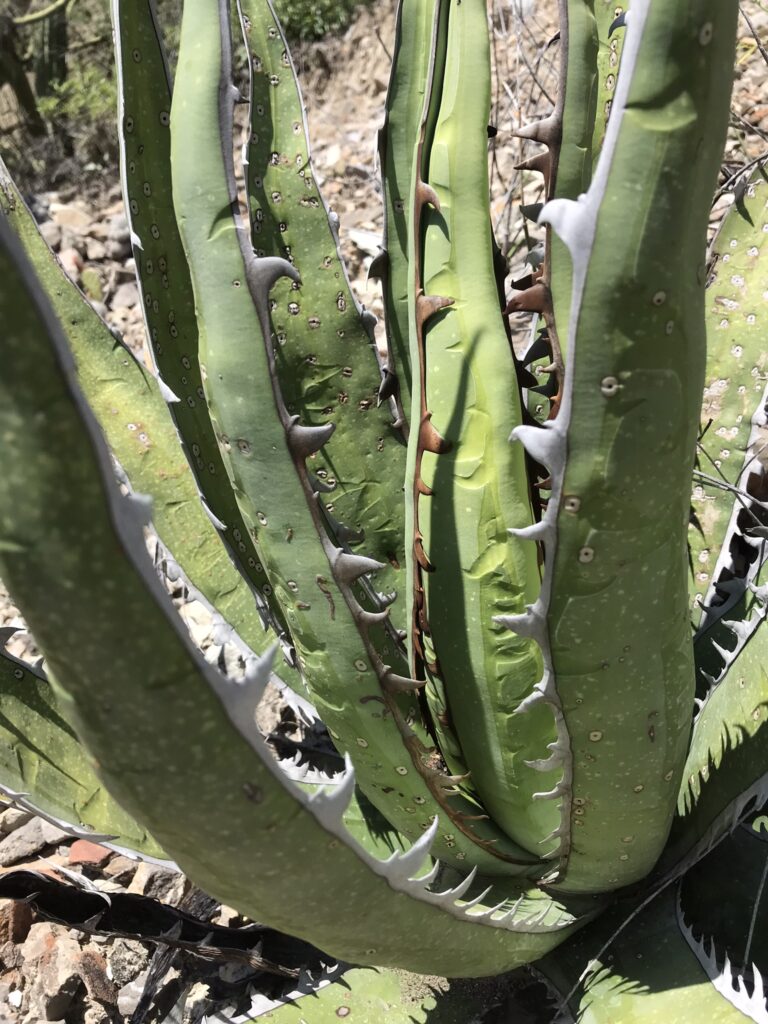
Agave convallis forms dense rosettes with leaves generally 20 to 39 inches (50–100 centimeters) long. Its leaves are shorter and broader than those of A. kerchovei and may be green, two-toned, or reddish. They often bear a paler longitudinal stripe and retain relatively small marginal teeth almost to the tip. The species occurs primarily in Oaxaca, in the districts of Cuicatlán, Huajuapan, Nochixtlán, and Teposcolula, at approximately 3,040 to 8,530 feet (927–2,600 meters) above sea level. It grows in xerophytic scrub, tropical dry forest, and oak woodland, usually on rocky slopes. It has the most consistent academic and commercial association with the name jabalí, and there is direct evidence of its use in mezcal production (Cruz-Vásquez et al., 2024; García-Mendoza et al., 2019a). Even so, the correspondence between name and species must be confirmed in each community.
Agave kerchovei, by contrast, has considerably longer, narrower, and more rigid leaves, often 39 to 59 inches (100–150 centimeters) long. Its teeth are large and more widely spaced; one of its most useful traits is that they usually disappear along the upper third or even upper half of the leaf. The plant is concentrated in southern Puebla and northern Oaxaca, especially in the Tehuacán–Cuicatlán Valley, where it grows at approximately 3,200 to 5,250 feet (975–1,600 meters) on rocky slopes and in semiarid scrub. It is also known as rabo de león (“lion’s tail”) and regionally as cacaya, although the latter word may refer to edible flowers rather than to a single species. The Sola de Vega study demonstrates that, in at least part of the mezcal literature, jabalí has been applied to plants identified as A. kerchovei (Caballero-Caballero et al., 2019).
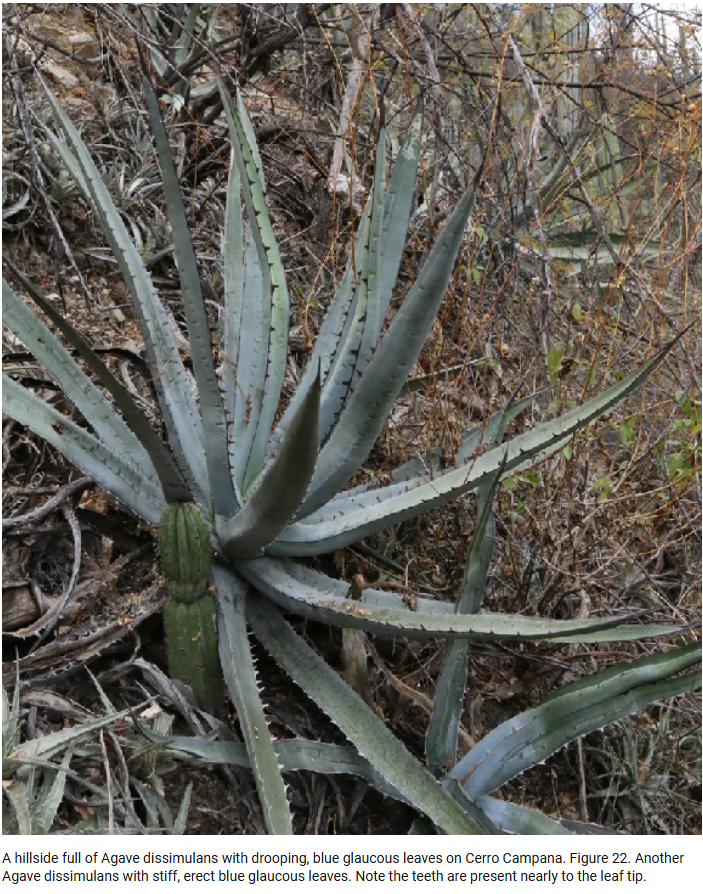
Agave dissimulans is probably the easiest of the five to distinguish visually and the hardest to connect geographically with all local records of jabalí. Its leaves are bluish or coated with a whitish bloom, spread broadly outward, and are often lax or hanging, although some individuals have more upright leaves. Unlike A. kerchovei, it retains teeth almost to the tip. Its confirmed distribution is extremely restricted: it is known from Cerro Campana and neighboring hills in Cañón Oscuro, south of Ignacio Mejía, Oaxaca. This combination of glaucous, drooping leaves, teeth near the apex, and geographic isolation supports its recognition as a distinct species (García-Mendoza et al., 2025; Starr, 2021).
In the Mixtec region of Puebla, the name jabalí has also been used for certain plants locally identified as A. dissimulans. This is ethnobotanically important, but it presents a problem: the confirmed botanical distribution of A. dissimulans is currently limited to a small area of Oaxaca. The Puebla plants called jabalí may therefore belong to another Heteracanthae species, or they may reveal a still-undocumented range extension for A. dissimulans. Resolving the question will require herbarium vouchers, detailed leaf photographs, and, if possible, flowers and fruit. Until that evidence exists, the association between Puebla jabalí and A. dissimulans should be treated as a hypothesis rather than a definitive taxonomic identification.
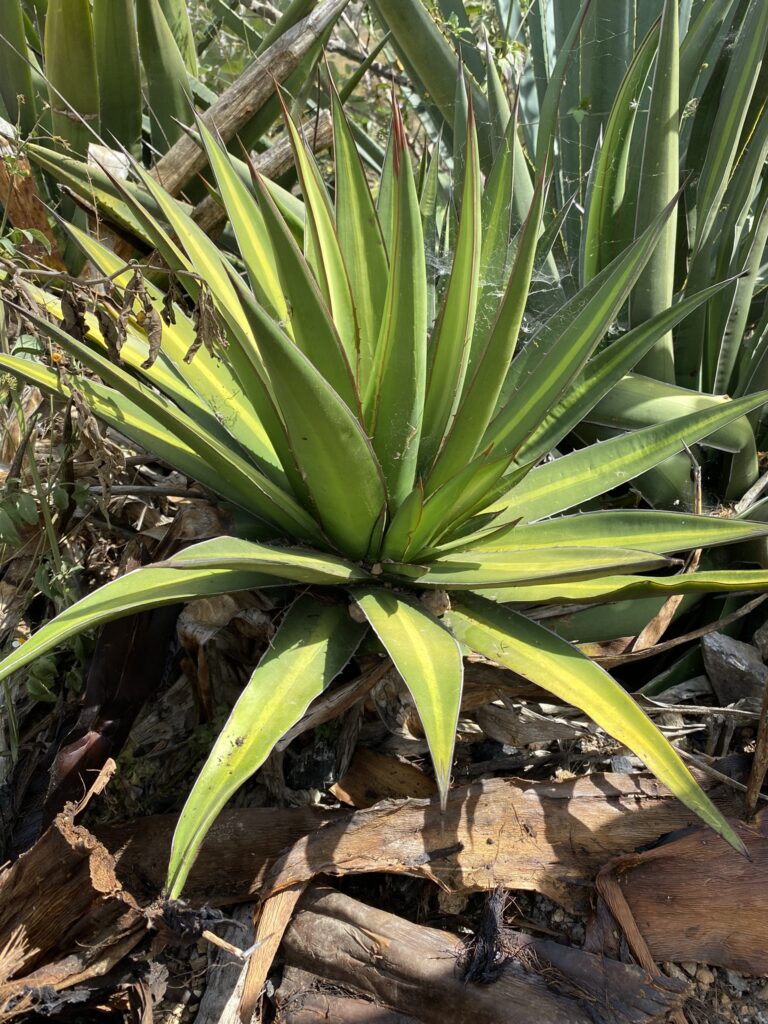
Agave triangularis is distinguished by short, extremely thick, triangular leaves. They generally measure 12 to 24 inches (30–60 centimeters) long and 2 to 3 inches (5–7 centimeters) wide; they are rigid, rough, olive green, and terminate in a robust spine. Together, these features produce a compact, geometric rosette quite unlike the long, linear leaves of A. kerchovei or the drooping leaves of A. dissimulans. Its best-confirmed distribution is centered in Puebla, especially on limestone plateaus and slopes west of Tehuacán, at approximately 5,580 to 6,230 feet (1,700–1,900 meters) in Gentry’s treatment. It inhabits xerophytic scrub and tropical dry forest. Although some sources also report it in Oaxaca, those records require verification through herbarium specimens. Documented common names include cacalla and maguey tunecho; so far, no unequivocal academic association with the name jabalí has been located.
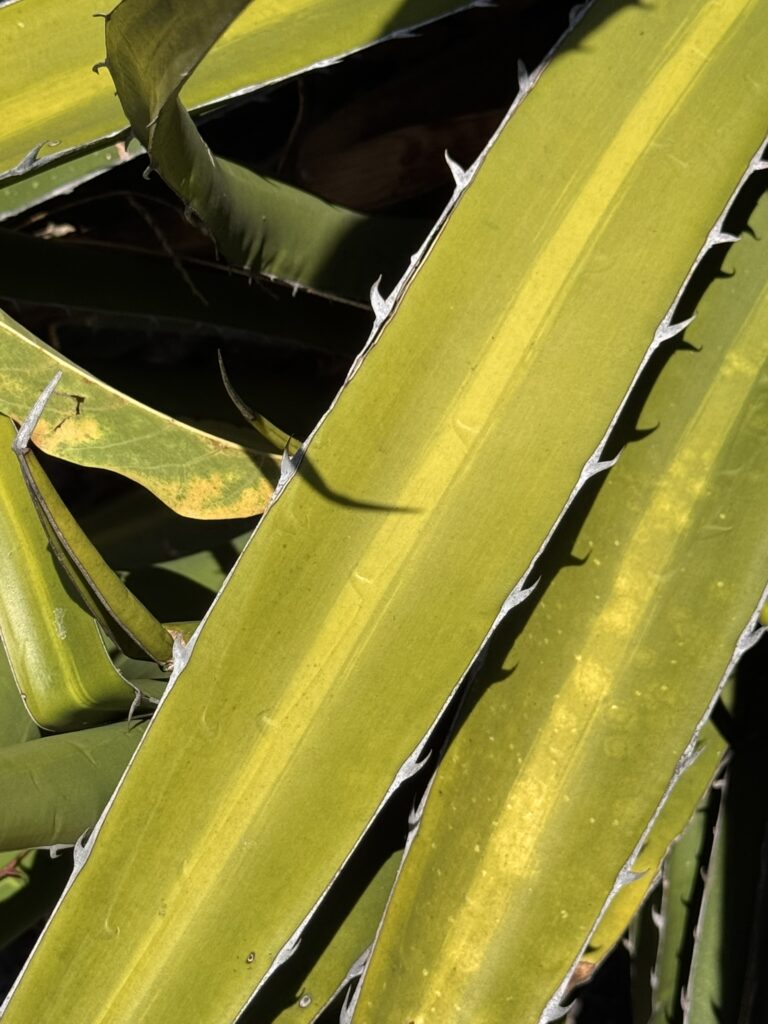
Agave angustiarum has the broadest distribution and the narrowest leaves of the five species. It forms an open rosette up to about 5 feet (1.5 meters) across, with relatively few rigid, pale green or bluish leaves that taper into a long point. Teeth are concentrated primarily along the lower portion of the leaf and disappear toward the upper end. Its inflorescence stands approximately 6.5 to 13 feet (2–4 meters) tall and bears white or greenish flowers. The species has been recorded from Jalisco and Michoacán through the states of Mexico, Morelos, Guerrero, Puebla, Oaxaca, and Veracruz, generally in tropical deciduous forest, dry scrub, and oak woodland at approximately 1,970 to 4,920 feet (600–1,500 meters). Recorded names include cacaya, lechuguilla suave, maguey de ixtle, and maguey angosto, demonstrating once again that common names may overlap among species.
Growth form and microhabitat provide additional clues. Agave triangularis produces offsets and may form groups of rosettes on slopes, plateaus, and limestone outcrops. A. convallis usually forms a solitary rosette, although it rarely develops small groups, and is closely associated with rock walls, shaded cliffs, and steep ravines. A. kerchovei and A. dissimulans are predominantly solitary: the former occupies open, exposed rocky slopes, while the latter grows on sandstone along steep inclines. A. angustiarum can produce basal offsets and form clusters on stony slopes and in other tropical dry environments. Even so, several nearby rosettes are not necessarily one clone; they may be separate seedlings that germinated in the same favorable site (García-Mendoza, 2011; García-Mendoza et al., 2025; Starr, 2020).
Heteracanthae must also be understood as a useful morphological grouping for recognizing agaves with rigid leaves, armed margins, and spike-like inflorescences, not necessarily as one evolutionary lineage. One molecular analysis placed A. convallis, A. kerchovei, and A. triangularis near one another alongside other traditional members of the group, while some species assigned to the same section appeared elsewhere in the phylogenetic tree. Broadly speaking, the major groupings reconstructed from DNA did not fully coincide with those based on the plants’ appearance (Jiménez-Barron et al., 2020). This does not make visible traits useless: leaf shape, tooth distribution, solitary or colonial growth, and substrate remain essential field tools. It does show, however, that outward similarity may reflect either close kinship or similar adaptations to dry, rocky environments. Delimiting these species therefore requires morphology, genetics, distribution, ecology, herbarium specimens, and local knowledge together.
The most cautious hypothesis is that jabalí functions as an ethnotaxon whose meaning varies by region. This hypothesis arises from the fact that mezcal producers in different communities use the name jabalí for plants that–based on their visible characteristics and geographic locations–may correspond to several of these agave species. The name is associated primarily with A. convallis, but it has also been applied to plants identified as A. kerchovei and possibly to other morphologically similar members of Heteracanthae. The inclusion of A. dissimulans, A. triangularis, or A. angustiarum has not yet been demonstrated, although it remains quite possible. Testing the hypothesis will require documenting the name community by community and supporting each record with botanical vouchers, photographs, location, habitat, and producer testimony. Only then can we determine whether jabalí designates several species, a set of local variants, or a category connected to how the plants behave during mezcal production (Caballero-Caballero et al., 2019; Cruz-Vásquez et al., 2024; Starr, 2021).
Back from the nerdy thicket
Why jabalí mezcal is so difficult to make
One fascinating question still under debate is whether plants can feel pain. Plants perceive damage, recognize mechanical and chemical stimuli, and activate complex defense responses. To date, however, there is no convincing evidence that they experience pain as a conscious state comparable to that of animals. They have no neurons, brain, or central nervous system to integrate such an experience. This does not make them passive organisms: they detect injury, alter their metabolism, release chemical signals, and produce defensive compounds. Perceiving damage and consciously experiencing pain are not necessarily the same thing (Draguhn et al., 2021; Taiz et al., 2019).
In animals capable of moving quickly, pain works as an alarm: if something burns us, we pull away; if a wound hurts more when we walk, we stop putting weight on it. A plant cannot escape an animal that tries to eat it, but it can defend itself chemically. Some plants produce capsaicinoids that irritate mucous membranes; others accumulate tannins that reduce digestibility and cause astringency; and many produce terpenes and saponins capable of affecting insects, fungi, microorganisms, and herbivores. These compounds form part of an extraordinarily diverse defense system shaped through millions of years of interaction between plants and consumers (Kant et al., 2015; War et al., 2012).
The word saponin comes from the Latin sapo, meaning “soap,” because saponins can generate abundant foam when mixed with water and agitated. Magueyes called jabalí offer an especially vivid example, but the same compounds that help protect the plant can also complicate its transformation into mezcal (Villanueva-Castillo et al., 2023).
Saponins and sapogenins have similar names, but they are not the same. One simple way to picture them is to think of a sapogenin as the molecule’s central body; when one or more sugars attach to it, the result is a saponin. This combination gives one part of the molecule an affinity for water and another an affinity for fats. Saponins therefore behave somewhat like soap and help foam form and persist. The diosgenin found in A. convallis is a sapogenin—the sugar-free core of certain saponins. Identifying it provides evidence of this chemical system, but it does not reveal which complete saponins the maguey contains, in what amounts, or whether it has more than other species. The composition of these compounds may also vary with species, plant part, and developmental stage (Cruz-Vásquez et al., 2024; Villanueva-Castillo et al., 2023).
To better understand the phenomenon, Cruz-Vásquez et al. (2024) studied raw, cooked, and fermented hearts, or piñas, of Agave convallis. The piñas were collected in Santa María Añuma in Oaxaca’s Nochixtlán district, while the microorganisms used in the experiment came from fermenting must at a mezcal distillery in San Pedro Teozacoalco. To reproduce part of the fermentation under controlled conditions, the researchers used two yeasts and two bacteria involved in the process. They then separated the compounds in the samples through a laboratory technique that identifies substances by the marks they leave on a plate.
The analysis detected diosgenin at different stages of production. The strongest signal appeared in the sample fermented for seven days at 89.6°F (32°C), conditions that also favored the microorganisms’ combined growth. This indicates that compounds related to saponins are present in raw maguey and either persist or change during cooking and fermentation. The study did not, however, measure their exact quantity or compare A. convallis with other agave species (Cruz-Vásquez et al., 2024).
This chemistry helps explain why jabalí creates so much foam and why mezcaleros consider it especially difficult to work with. During fermentation, foam can overflow the vats before the process is finished. During distillation, it may rise through the still, interfere with vapor condensation, and carry part of the pot’s contents into the cooling system. This reduces usable vessel capacity, forces producers to work with smaller charges, lengthens the process, and demands constant attention (Cruz-Vásquez et al., 2024).
The difficulty may extend beyond the foam. González-Martínez (2023) isolated thirteen yeast strains from A. convallis must and found that both crude maguey extracts and diosgenin reduced their growth in laboratory tests. The findings suggest that jabalí’s chemical defenses may also influence the microorganisms that turn sugars into alcohol. Because the tests were conducted outside an actual fermentation, however, they do not yet prove that saponins are responsible when jabalí fermentation becomes slow, irregular, or incomplete.
Scientific evidence aligns strikingly with producer experience. Maestro mezcalero Crispín Daniel García of San Dionisio Ocotepec told me that he finds it very difficult to determine by smell when jabalí fermentation is finished because, in his perception, the aroma changes very little. He also said that while an espadín distillation may take him about fourteen hours, working with jabalí can require as long as four days and five nights (C. D. García, personal communication, August 23, 2026). His account demonstrates how this maguey’s foaming capacity can radically alter a mezcalero’s work, but it should not be treated as a universal rule–timing depends on volume, equipment, temperature, and each palenque’s practices.
From a technical standpoint, adding a small amount of oil to the pot during the first distillation might help control jabalí foam. Oil enters and weakens the walls between bubbles, making them easier to break (Denkov, 2004; Deotale et al., 2023). I have not, however, found studies that test this procedure specifically in mezcal distilled from Agave convallis. Any trial would therefore need to use very small quantities and verify that the oil prevents foam from clogging the vapor pipe or lifting the still head without leaving residue in the equipment or altering the mezcal’s aroma and flavor. The proposal is technically plausible, but it still requires controlled testing and sensory evaluation.
Usually maestros mezcaleros choose to lower the fire, charge the still less fully, and accept a longer distillation versus using some other techniques. When that happens, they are not necessarily rejecting innovation. Their decision grows from experience and from protecting a flavor that we still cannot fully explain. Every batch embodies years of maguey growth and several days of labor. Adding a substance whose effects on the mezcal have not been studied is therefore a risk many producers would rather not take. The real challenge is to bring their knowledge into conversation with scientific research, without treating tradition as superstition or assuming that every technological solution is harmless. In jabalí, foam is at once a chemical reaction, a production obstacle, and visible evidence of the knowledge mezcaleros have developed through practice.
I think this choice reflects the fact that making mezcal is not simply a search for maximum efficiency. Maestros mezcaleros protect a way of working and a sensory identity. Our economy rewards speed, yield, and uniformity, so spending several days controlling jabalí foam can appear impractical and out of step with the logic of capitalism. Yet doing so allows producers to retain control of their process, trust their experience, and keep memory alive. Science can explain how foam forms and propose ways to eliminate it; the decision to use those methods belongs to the maestro mezcalero, who must judge whether an intervention is compatible with the flavor, tradition, and mezcal they wish to create.
Where did people begin distilling jabalí mezcal?
Oral history does not identify a single community as the birthplace of jabalí mezcal. Instead, it reveals a fragmented story pieced together from occasional accounts and knowledge that remained within certain families. In many mezcal-producing towns in Oaxaca and Puebla, jabalí was not a customary raw material: its foam made distillation slow and difficult, its yield could be low, and several communities valued it more for fiber or as a living fence. Maestro mezcalero Luis Enrique Juárez recalls that in San Agustín Amatengo it was distilled sporadically, mainly by people of limited means who had neither their own cultivated magueyes nor money to buy others, and who gathered whatever was available in the hills. He also says that jabalí, tepeztate, and tobasiche were once regarded as “second-rate” mezcales compared with arroqueño and, later, espadín (L. E. Juárez, personal communication, August 30, 2026).
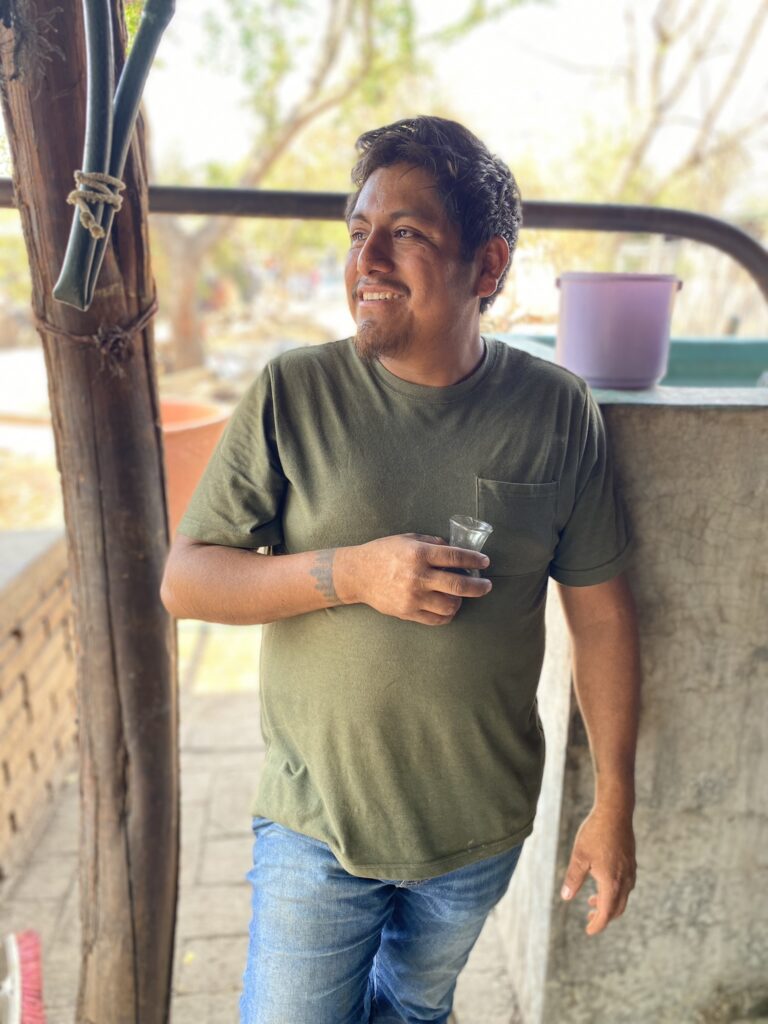
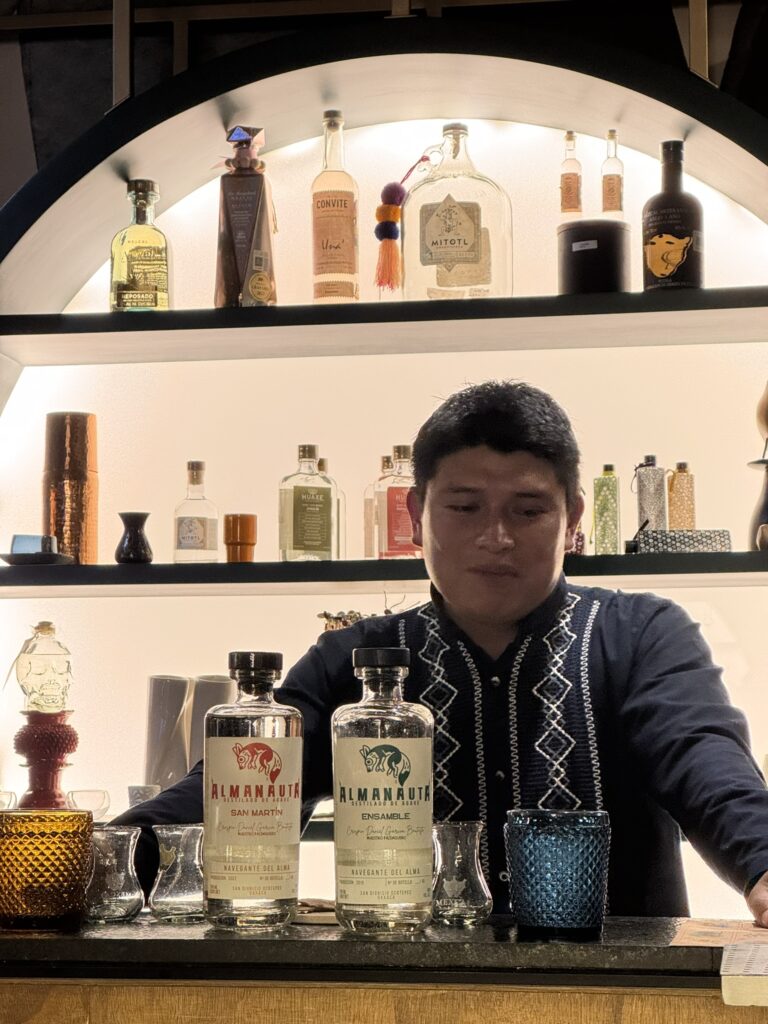
That memory prevents us from claiming that jabalí began to be distilled only when commercial interest appeared. Maestro Daniel Crispín García maintains that his great-grandfather and other old-time mezcaleros were already working with the maguey in San Dionisio Ocotepec, and that it could produce an extraordinarily delicious mezcal. His testimony supplies no exact date, but it preserves the memory of a family practice that predates contemporary bottling (D. C. García, personal communication, August 23, 2026).
The earliest commercial records I have been able to reconstruct appear much later. Maestro mezcalero Félix Monterrosa recalls that in 2010, Cuish (the brand) bottled a jabalí made by Francisco García León from San Guillermo Miahuatlán. Beginning in 2013, more references appear to bottled jabalí from brands such as Rey Campero and El Jolgorio, both linked to Santa María Zoquitlán (F. Monterrosa, personal communication, August 16, 2026). These dates do not mean no one distilled it earlier. They indicate only when a scattered practice became visible beyond the villages and began circulating in a bottle under the name jabalí.
In Santa María Velató, Maestro mezcalero Mario Acevedo dates his first jabalí batch to late 2017. He began working with it because he wanted to understand how the maguey behaved. Although he had heard that it was aggressive and foamy, his initial precautions were not enough: during the first distillation run, the foam lifted the still head three times. He ended up working at roughly one-third of the pot’s capacity and gradually learned to control the charge and the intensity of the fire (M. Acevedo, personal communication, August 22, 2026).
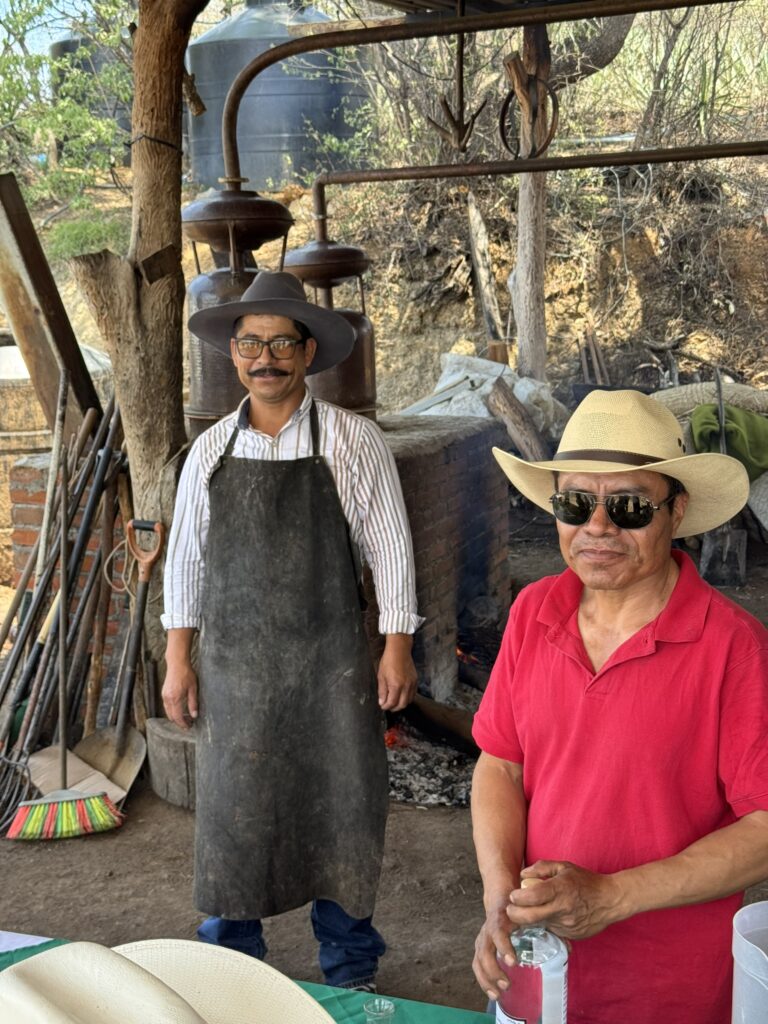
In Puebla’s Mixtec region, Maestro mezcalero Ildefonso Macedas Ginéz tells a similar story. He began making jabalí around 2016 after a client from Tehuacán requested it. First he had to investigate which of the region’s similar magueyes corresponded to that name. Then he learned to calculate the water, reduce the charge, and control the temperature so the foam would not rise and clog the condenser coil. Over time, his jabalí mezcal has received several awards, although he warns that a bottle’s prestige does not always translate into recognition or profit for the producer who did the work (I. Macedas Ginéz, personal communication, August 20, 2026).
These stories suggest that jabalí has no single beginning. In some towns it was a resource born of necessity; in others, an old practice that survived within certain families; elsewhere, it was a recent experiment driven by customers, brands, and a new appreciation for wild magueyes. Asking who distilled it first may lead us not to a precise date, but to a map of scattered memories in which each community preserves a different part of the story.
Jabalí mezcal: a tapestry of stories
Jabalí’s difficulties have produced more than different distillation techniques. They have also generated stories about its character, its strength, and the relationship producers maintain with it. In Santa María Velató, Maestro Mario Acevedo distinguishes at least a smooth jabalí and a “sierrudo,” or saw-toothed, jabalí. He describes the maguey jabalí of Coatecas as an extraordinarily resilient living-fence plant. Some people, he says, simply lay the rosettes on the ground like dominoes. Even so, they take root, produce offsets, and form groups capable of crossing property lines into a neighbor’s land. In this story, jabalí is difficult inside the still but surprisingly generous in the field (M. Acevedo, personal communication, August 22, 2026).
Maestro Daniel Crispín preserves an anecdote that captures the intensity of this mezcal in another way. Once, he says, his grandfather made a jabalí so good that he began sharing it with the other mezcaleros at the palenque. Taste after taste, they finished the entire batch. When he finally returned home, his wife asked where the mezcal he had made was. Smiling broadly, his grandfather replied, “I’m wearing it on my face” (D. C. García, personal communication, August 23, 2026). The mezcal was so good that it never reached a bottle; it went directly into the body, and onto the face, of the man who had distilled it.
Jabalí is also credited with properties that belong to belief rather than medical proof. In 2016, Maestro mezcalero Fidel Reyes García of San Sebastián de las Grutas told me about an engineer who had come to electrify the village and confided that he and his wife were having difficulty conceiving a child. Fidel invited them to spend the night in the community and gave each of them a glass—the kind traditionally made from a votive-candle holder—filled with high-proof jabalí heads. According to his account, the engineer returned a month later with the news that they were expecting a baby (F. Reyes García, personal communication, 2016). Similar stories circulate in Oaxaca’s Central Valleys, where some producers attribute aphrodisiac qualities to jabalí. These accounts do not demonstrate a pharmacological effect, but they do show how a drink can become a remedy and even a symbol of strength.
A truly singular mezcal
Jabalí stories move between two worlds. They tell of a marginalized plant that for years was reserved for fences, fibers, or distillations born of necessity, but also of a mezcal that now wins awards and attracts attention beyond its communities. Between those moments stand the producers who learned from their parents and those who learned to listen to a difficult fermentation; those who watched the still head rise and those who accepted hours or days of work for only a few liters.
Perhaps this is the best way to understand jabalí. For years, many people avoided it because it was messy, foamy, and demanded extra work; today it is one of the mezcales that inspires the greatest curiosity. But its story began among fences and hillsides, in overflowing pots and in palenques where someone chose to distill what others did not want. Every bottle preserves that difficulty: hours of vigilance, a low fire, and knowledge that no label can contain. Perhaps the mezcaleros will never completely master jabalí. Perhaps they learned something more important: how to work with its character without forcing it to stop being what it is.
Sometimes the mezcal reached a bottle; at other times, as Daniel Crispín’s grandfather used to say, it came home worn on someone’s face. What will always remain is the story, a story that, like jabalí foam, insists on rising and refuses to be tamed or contained.
Bibliography
Aguirre-Planter, E., Parra-Leyva, J. G., Ramírez-Barahona, S., Scheinvar, E., Lira-Saade, R., & Eguiarte, L. E. (2020). Phylogeography and genetic diversity in a southern North American desert: Agave kerchovei from the Tehuacán-Cuicatlán Valley, Mexico. Frontiers in Plant Science, 11, Article 863. https://doi.org/10.3389/fpls.2020.00863
Alducin-Martínez, C., Ruiz Mondragón, K. Y., Jiménez-Barrón, O., Aguirre-Planter, E., Gasca-Pineda, J., Eguiarte, L. E., & Medellín, R. A. (2023). Uses, knowledge and extinction risk faced by Agave species in Mexico. Plants, 12(1), Article 124. https://doi.org/10.3390/plants12010124
Angiosperm Phylogeny Group. (2016). An update of the Angiosperm Phylogeny Group classification for the orders and families of flowering plants: APG IV. Botanical Journal of the Linnean Society, 181(1), 1–20. https://doi.org/10.1111/boj.12385
Aparicio, J. C., Voeks, R. A., & Funch, L. S. (2021). Mixtec taxonomy: Plant classification, nomenclature, and identification in Oaxaca, Mexico. Ethnobotany Research and Applications, 21, 1–13. https://doi.org/10.32859/era.21.24.1-13
Beery, T., Chawla, L., & Levin, P. (2023). Being and becoming in nature: Defining and measuring connection to nature in young children. People and Nature, 5(2), 540–554. https://doi.org/10.1002/pan3.10451
Bogler, D. J., Pires, J. C., & Francisco-Ortega, J. (2006). Phylogeny of Agavaceae based on ndhF, rbcL, and ITS sequences: Implications of molecular data for classification. Aliso, 22(1), 313–328. https://doi.org/10.5642/aliso.20062201.25
Caballero-Caballero, M., Ruiz-Vega, J., Martínez-Jiménez, R., Silva Rivera, M. E., & Montes Bernabé, J. L. (2019). Agaves silvestres y cultivados empleados en la elaboración de mezcal en Sola de Vega, Oaxaca, México. Tropical and Subtropical Agroecosystems, 22(2), 477–485. https://doi.org/10.56369/tsaes.2750
Comisión Nacional para el Conocimiento y Uso de la Biodiversidad. (2021, 25 de mayo). Diversidad de magueyes. Biodiversidad Mexicana. https://www.biodiversidad.gob.mx/diversidad/alimentos/magueyes/diversidad-magueyes
Cortés, H. (2005). Segunda carta de relación (obra original escrita en 1520). Early Modern Spain, King’s College London. https://ems.kcl.ac.uk/content/etext/e015.html
Cruz-Vásquez, C. L., López-Sánchez, C., Palma-Cruz, F. de J., Villanueva-Castillo, D. M., & Enríquez-Valencia, R. (2024). Las sapogeninas y los microorganismos fermentadores del mezcal artesanal de Agave convallis. Revista del Centro de Graduados e Investigación. Instituto Tecnológico de Mérida, 39(107), 300–304. https://www.revistadelcentrodegraduados.com/2026/03/las-sapogeninas-y-los-microorganismos.html
Davis, S. C., Simpson, J., Gil-Vega, K. del C., Niechayev, N. A., Tongerlo, E. van, Castano, N. H., Dever, L. V., & Búrquez, A. (2023). Lessons from the history of Agave: Ecological and cultural context for valuation of CAM. Annals of Botany, 132(4), 819–837. https://doi.org/10.1093/aob/mcad113
De Queiroz, K. (2007). Species concepts and species delimitation. Systematic Biology, 56(6), 879–886. https://doi.org/10.1080/10635150701701083
De Queiroz, K. (2025). Recent developments in species delimitation and taxonomy considered in the context of the unified species concept. Herpetologica, 81(2). https://doi.org/10.1655/Herpetologica-D-25-00001
Draguhn, A., Mallatt, J. M., & Robinson, D. G. (2021). Anesthetics and plants: No pain, no brain, and therefore no consciousness. Protoplasma, 258, 239–248. https://doi.org/10.1007/s00709-020-01550-9
García-Mendoza, A. J. (2011). Agavaceae. En Flora del Valle de Tehuacán-Cuicatlán (Fascículo 88, pp. 1–95). Instituto de Biología, Universidad Nacional Autónoma de México.
García-Mendoza, A. J., Casas, A., Sandoval-Gutiérrez, D., & Torres-García, I. (2019a). Agave convallis. The IUCN Red List of Threatened Species 2019, e.T114937274A114963541. https://doi.org/10.2305/IUCN.UK.2019-3.RLTS.T114937274A114963541.en
García-Mendoza, A. J., Franco-Martínez, I. S., & Sandoval-Gutiérrez, D. (2025). Estudios taxonómicos en Agave franzosinii, A. dissimulans, A. gilbeyi y A. titanota (Asparagaceae, Agavoideae) para la Flora del Valle Tehuacán-Cuicatlán. Acta Botanica Mexicana, 132, e2484. https://doi.org/10.21829/abm132.2025.2484
García-Mendoza, A. J., Sandoval-Gutiérrez, D., Casas, A., & Torres-García, I. (2019b). Agave kerchovei. The IUCN Red List of Threatened Species 2019, e.T115644715A116354028. https://doi.org/10.2305/IUCN.UK.2019-3.RLTS.T115644715A116354028.en
García-Mendoza, A. J., Sandoval-Gutiérrez, D., Casas, A., & Torres-García, I. (2019c). Agave triangularis. The IUCN Red List of Threatened Species 2019, e.T115698330A116354568. https://doi.org/10.2305/IUCN.UK.2019-3.RLTS.T115698330A116354568.en
Gentry, H. S. (1982). Agaves of continental North America. University of Arizona Press.
González-Martínez, C. Y. (2023). El efecto de las saponinas de agave sobre las levaduras del mezcal [Tesis de licenciatura, Instituto Tecnológico de Oaxaca]. Repositorio Institucional del Tecnológico Nacional de México. https://rinacional.tecnm.mx/jspui/handle/TecNM/11617
Hernández-Vera, G., Vázquez-García, J. A., Cházaro-Basáñez, M., & Vargas-Rodríguez, Y. L. (2007). Inventory and distribution of Agave species in Jalisco, Mexico. Journal of the Botanical Research Institute of Texas, 1(1), 499–509.
Hörandl, E. (2022). Novel approaches for species concepts and delimitation in polyploids and hybrids. Plants, 11(2), 204. https://doi.org/10.3390/plants11020204
Jiménez-Barrón, O., García-Sandoval, R., Magallón, S., García-Mendoza, A. J., Nieto-Sotelo, J., Aguirre-Planter, E., Eguiarte, L. E., & Flores-Abreu, I. N. (2020). Phylogeny, diversification rate, and divergence time of Agave sensu lato (Asparagaceae), a group of recent origin in the process of diversification. Frontiers in Plant Science, 11, Article 536135. https://doi.org/10.3389/fpls.2020.536135
Kant, M. R., Jonckheere, W., Knegt, B., Lemos, F., Liu, J., Schimmel, B. C. J., Villarroel, C. A., Ataide, L. M. S., Dermauw, W., Glas, J. J., Egas, M., Janssen, A., Van Leeuwen, T., Schuurink, R. C., Sabelis, M. W., & Alba, J. M. (2015). Mechanisms and ecological consequences of plant defence induction and suppression in herbivore communities. Annals of Botany, 115(7), 1015–1051. https://doi.org/10.1093/aob/mcv054
Luna-José, A. de L., & Rendón-Aguilar, B. (2012). Traditional knowledge among Zapotecs of Sierra Madre del Sur, Oaxaca: Does it represent a base for plant resources management and conservation? Journal of Ethnobiology and Ethnomedicine, 8, Article 24. https://doi.org/10.1186/1746-4269-8-24
MacNeill, B. N., Eguiarte, L. E., & Fleming, T. H. (2023). Floral diversity and pollination syndromes in Agave sensu lato. Integrative and Comparative Biology, 63(6), 1376–1391. https://doi.org/10.1093/icb/icad116
Mugford, S. T., & Osbourn, A. (2012). Saponin synthesis and function. In T. J. Bach & M. Rohmer (Eds.), Isoprenoid synthesis in plants and microorganisms: New concepts and experimental approaches (pp. 405–424). Springer. https://doi.org/10.1007/978-1-4614-4063-5_28
Nielsen, J. C., Senne de Oliveira Lino, F., Rasmussen, T. G., Thykær, J., & Workman, M. (2017). Industrial antifoam agents impair ethanol fermentation and induce stress responses in yeast cells. Applied Microbiology and Biotechnology, 101, 8237–8248. https://doi.org/10.1007/s00253-017-8548-2
Palma-Cruz, F. de J. (1991). El género Agave L. y su distribución en el estado de Oaxaca [Tesis de licenciatura, Universidad Nacional Autónoma de México]. https://tesiunamdocumentos.dgb.unam.mx/ptd2013/anteriores/0157069/0157069.pdf
Parsley, K. M. (2020). Plant awareness disparity: A case for renaming plant blindness. Plants, People, Planet, 2(6), 598–601. https://doi.org/10.1002/ppp3.10153
Parsley, K. M., Daigle, B. J., & Sabel, J. L. (2022). Initial development and validation of the Plant Awareness Disparity Index. CBE—Life Sciences Education, 21(4), ar64. https://doi.org/10.1187/cbe.20-12-0275
Rai, S., Acharya-Siwakoti, E., Kafle, A., Devkota, H. P., & Bhattarai, A. (2021). Plant-derived saponins: A review of their surfactant properties and applications. Sci, 3(4), Article 44. https://doi.org/10.3390/sci3040044
Real Academia Española. (s. f.). Maguey. En Diccionario de la lengua española (23.ª ed., versión 23.8). Recuperado el 31 de agosto de 2026, de https://dle.rae.es/maguey
Routledge, S. J. (2012). Beyond de-foaming: The effects of antifoams on bioprocess productivity. Computational and Structural Biotechnology Journal, 3(4), e201210014. https://doi.org/10.5936/csbj.201210014
Singh, B., & Sharma, R. A. (2015). Plant terpenes: Defense responses, phylogenetic analysis, regulation and clinical applications. 3 Biotech, 5, 129–151. https://doi.org/10.1007/s13205-014-0220-2
Smith, G. F., Figueiredo, E., & Starr, G. D. (2018). Notes on the typification and nomenclature of Agave dissimulans Trelease, Agave convallis Trelease, and Agave kerchovei Lem. (Asparagaceae: Agavoideae/Agavaceae). Haseltonia, 24, 36–39. https://doi.org/10.2985/026.024.0106
Soga, M., & Gaston, K. J. (2016). Extinction of experience: The loss of human–nature interactions. Frontiers in Ecology and the Environment, 14(2), 94–101. https://doi.org/10.1002/fee.1225
Starr, G. D. (2020). A reevaluation of the Agave kerchovei complex (Asparagaceae/Agavoideae), including expanded descriptions of three species. Haseltonia, 27(1), 60–72. https://doi.org/10.2985/026.027.0107
Taiz, L., Alkon, D., Draguhn, A., Murphy, A., Blatt, M., Hawes, C., Thiel, G., & Robinson, D. G. (2019). Plants neither possess nor require consciousness. Trends in Plant Science, 24(8), 677–687. https://doi.org/10.1016/j.tplants.2019.05.008
Tewksbury, J. J., Reagan, K. M., Machnicki, N. J., Carlo, T. A., Haak, D. C., Peñaloza, A. L. C., & Levey, D. J. (2008). Evolutionary ecology of pungency in wild chilies. Proceedings of the National Academy of Sciences, 105(33), 11808–11811. https://doi.org/10.1073/pnas.0802691105
Thiede, J., Smith, G. F., & Eggli, U. (2019). Infrageneric classification of Agave L. (Asparagaceae: Agavoideae/Agavaceae): A nomenclatural assessment and updated classification at the rank of section, with new combinations. Bradleya, 37, 240–264. https://doi.org/10.25223/brad.n37.2019.a22
Vázquez-Pérez, N., Blancas, J., Torres-García, I., García-Mendoza, A. J., Casas, A., Moreno-Calles, A. I., Maldonado-Almanza, B., & Rendón-Aguilar, B. (2020). Traditional knowledge and management of Agave karwinskii in southern Mexico. Botanical Sciences, 98(2), 328–347. https://doi.org/10.17129/botsci.2421
Vela, E. (Ed.). (2020). Maguey (Agave spp.). Arqueología Mexicana, edición especial, (84), 58–60. https://arqueologiamexicana.mx/mexico-antiguo/maguey-agave-spp
Villanueva-Castillo, D. M., López-Sánchez, C., & Palma-Cruz, F. de J. (2023). Las saponinas de los agaves y su naturaleza citotóxica, usos y potencialidades. Revista del Centro de Graduados e Investigación, Instituto Tecnológico de Mérida, 38(99), 157–162.
War, A. R., Paulraj, M. G., Ahmad, T., Buhroo, A. A., Hussain, B., Ignacimuthu, S., & Sharma, H. C. (2012). Mechanisms of plant defense against insect herbivores. Plant Signaling & Behavior, 7(10), 1306–1320. https://doi.org/10.4161/psb.21663







Leave a Comment