We’re setting a high bar for our new series on hospitality industry professionals…Lui shares his thoughts on hospitality red flags, management mistakes, how to create a menu that matters, and the upside to the tequila adulteration scandal.
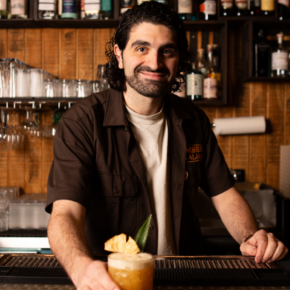
Bars are about people, not drinks. That’s what bartender, content creator, and owner of Ember & Alma Cocktail Bar Lui Fernandes told us, and it rings true. While drink quality is undoubtedly an important aspect of any bar, good cocktails rarely stand on their own if the space doesn’t match.
His comment reminded me of my recent trip to Vegas. Naturally, I had many cocktails but only remember one place because the bartender took excellent care of us. It was a polished space with premium drinks, but I mostly remember feeling welcomed through friendly conversation and regular check-ins. The bartender made us feel like our presence added to the space.
While good hospitality can sometimes feel like a dying art, there are still people like Fernandes who take a hospitality-first approach to running a space. His creative personality shines through in his engaging Instagram posts, where he teaches his more than 400,000 followers how to make cocktails, jokes about bar culture, and educates his audience about different spirits.
Fernandes has built an ecosystem rooted in a love for South and Latin American spirits and cocktails. He’s amassed more than 900,000 followers across his Youtube channel, Instagram, and Tik Tok, but how he shows up for the people at his restaurant and bar remains a top priority.
Mezcalistas spoke with Fernandes about his approach to hospitality, his early memories, and of course, drinks. Here’s what we learned.
What was the first drink you ever made?
Oh gosh, it’s been so long. My first bartending job was at a chain restaurant and the incredible gentleman who trained me taught me how to make a terrible old fashioned with a muddled bright red-dye-40 cherry and an orange wedge and some not-so-great bourbon that we had at the bar. To be fair, he taught me so much about hospitality but was not the best cocktail maker. And in hindsight, I actually am incredibly thankful for my time spent working at a chain restaurant because it taught me so much about human interaction, learning how to connect with folks from all walks of life and making people feel welcome. Terrible cocktails though.
Hardest drink to make?
Ramos Gin Fizz. At least to make it correct, it takes a lot of effort and work.
I overall do think this is an easy misconception, to a certain point. If we exclude cocktails that use more advanced techniques for a second, almost all cocktails generally don’t take too much effort when comparing one versus another. Now if we’re talking about some more extensive Molecular Gastronomy techniques, certain cocktails can take days to make.
What’s your all-time favorite liqueur?
I think I’d have to say Cynar. It’s so good.
Do you like it when customers ask you to concoct something for them based on their parameters? And how do you approach the request?
At this stage of my career, I actually do cherish the challenge. Especially because it allows me to pull on a lot of recipes I’ve made, whether recently for my content or based off of some kooky crazy idea I’ve been working on. I will usually start by asking them to give me something to work off of, whether it’s a spirit, or flavor they prefer, and I’ll follow it up with a question about style. Do they want something dry or more fruity? From there, I’ll pull a recent cocktail I made from a video or pull from my back bar library of cocktail books to find something that matches.
I also like to see the look of delight on someone’s face when I can create something off menu and they love it, because it makes them feel special, like they’re getting something that no one else gets. Which is sometimes counterintuitive because the cocktails on my menu are originals of mine that took years to refine. Usually when someone asks me to make them something off menu, I will make them a great drink but it’s not always necessarily an original recipe of mine. To me, the most special cocktail is the one I spent years working on, and there’s a reason it’s on my menu.
What’s the secret to creating a solid cocktail menu?
Giving a shit. What I mean by that is, outside of having a good balance of flavors and styles of drinks there should be SOMETHING that unites your menu. Whether it’s featuring South and Latin American flavors and spirits, which it is for me, or whether it’s “Our whole menu was developed by each of our bartenders and we asked them to recreate a childhood memory as a drink.” I think the secret is intention. That can take many forms, but your cocktail menu tells a story whether you realize it or not. Whether you want it to or not. So what story are you telling? And are you actively telling that story?
I think we’re past the point of bars getting by with just making solid drinks. I think the best places are intentional with everything they do. But it also doesn’t have to be super elaborate; it can just be that each cocktail was made to showcase a specific intention.
What’s your process for developing a new cocktail recipe?
I usually try to start with a great idea or some sort of inspiration, just something I can sink my teeth into and want to feature. Whether it’s featuring a specific bottle I recently picked up or a more obscure kind of spirit, or even taking a more seasonal approach and starting from there.
For example, I’m currently working on some new cocktails for a private agave event that we will be running in a few weeks. Since the event takes place in the fall, we want to reflect that. I usually go to the market and look for some great fresh fruit. I picked up some pears and plums in season and will use them as a base to start building flavors off of.
For the same event last year, I wanted to feature peaches, so I picked some still-in-season peaches and then needed to find more inspiration. I thought back to my childhood and how for Christmas sometimes, my mother would make candied peaches with cream and sweetened condensed milk. I then wanted to recreate that flavor but with mezcal. From there, I’ll rely on the classic elements of building a cocktail: citrus/acid, sweetener, spice, and balancing them and thinking of what’s missing or how to take it to the next level. From there, it’s trial and error while writing down things I liked and didn’t like and making a new version.
And that’s sort of how the Peaches n Cream was created.
Sometimes I also want to experiment with a new technique like making an alcoholic foam with methylcellulose (essentially a vegan egg white replacement). So I task myself with creating a new cocktail using that technique to challenge myself.
I always tell my bartenders that it’s relatively easy to make a cocktail that’s like 70% there once you’ve made enough cocktails and start to think of recipes as building blocks. But it’s the last 30ish percent that really takes the most time, tweaking this, tweaking that, microchanges that’ll take a cocktail from “Oh wow that’s actually pretty good” to “Holy sh**! That’s amazing!”
What’s a red flag for you when you’re looking at a menu?
I think there are two things. 1. Lack of intention, which we talked about and 2. When it’s kind of boring. A menu that doesn’t really push the bounds with flavors or even techniques and just kind of gets by as knock-off versions of classics or modern classics…We’ve seen it a million times by this point.
I don’t go out to a bar to have an okay cocktail. Especially because they’re going to be expensive. I want to see the intention and the creativity behind it. If I just wanted a simple cocktail, I could make that at home.
The other big red flag is if there are no local or more obscure spirits being featured on the menu. Doesn’t have to be in every single cocktail, but if your menu only features spirits from the big conglomerates that’s usually a red flag for me.
What do you do to mentally prepare for a shift?
I think this is such an underrated thing to talk about and think about. For most of my career, I used to just stroll into work and not even think about it. But this career is grueling. It’s taxing. If we don’t do a mental check-in before service, especially after five days working back to back, it can pass along to our guests. I think if everyone did a mental check-in for about five minutes before hitting the floor or stepping behind the bar to make sure they are centered, did some breathing, and made sure they were mentally prepared to be on stage, I think a lot more shifts would go smoother.
Today, I take about 10 minutes in my office before service to breathe and make sure I’m ready for a busy shift, regardless of where I’m needed. Whether it’s on the floor, behind the bar, or on the kitchen line.
What are your top three red flags when it comes to hiring?
I personally don’t necessarily look for someone with too much experience. I normally hire for the person, not the skills, because I can teach skills. What I can’t teach is how to actually like people, be personable or not be an A**hole. The red flags usually pertain to:
- If the person can’t keep eye contact while speaking to me.
- If the person can’t carry a conversation or speak at length about themselves.
- If the person doesn’t show any interest in the bar concept or job and doesn’t ask any questions.
How do you feel about juke boxes in the bar? What about TouchTunes?
I have mixed feelings about both. I think it depends on the establishment. In a lot of places that truly curate the entire experience, I think that music is a major part. I have a playlist that I have curated over the course of many years to create a very particular vibe for my bar and restaurant. That’s not very special or unique to me. A lot of the best places that I look up to want to control as many of the aspects of the guest experience as possible.
That being said, if it’s the type of bar where it’s not such a curated experience, I actually think that a jukebox or TouchTunes is a great addition because it creates a conversation piece. You can get together with your friends and put together your own kind of playlist. It’s a way to connect with people and I think they could be quite fun.
What are your thoughts on the tequila adulteration scandal?
Oh man, how much time do we have? I have made my thoughts on it pretty clear across so many videos but lately I’ve actually been reflecting on the positives. While there’s still so much that can and should change in the tequila industry, especially as it pertains to the adulteration scandals and class action lawsuits, I think the biggest positive we can take is just how much more people as a whole actually are now aware of the additive-free movement and just how much they are aware of adulterated tequila. Additive-free tequilas are now some of the most sought after, and I think the landscape has shifted so much that now the conversation isn’t just about whether or not a tequila uses additives. The industry has almost moved on and now people are getting a bit nerdier and more in depth about how a tequila is made and what makes it special.
Is it all tequila drinkers? No. and it may never be because those big massive brands have TONS of marketing dollars and the regulators on their side. But I think the industry has grown and moved on in such a fascinating place from where it was like 10 years ago. So many more bars are now carrying quality spirits. It’s a ripple effect. If the enthusiastic bartender learns about the ultra nerdy stuff, he’ll tell his friends and fellow bartenders and it’ll ripple out into even regular bars carrying at least a few well made tequilas and regular bar guests becoming more educated. That’s something to celebrate.
How do you approach running your establishments? Any management tips or best practices you follow?
I try to run my restaurant as people-first as possible, with a focus on empathy and making our staff feel taken care of, but there is a balance. We strive for a level of excellence and you cannot let people compromise that. Earlier in my career, unfortunately, I was so people-first that I ended up getting walked all over and let down by a lot of staff members. I was young, I trusted people too easily, and I’m still getting burnt by some people. I also believed that people were going to care about my establishment the way that I did, which will never happen. But I’ve learned boundaries a bit more, learned to instill those principles, and learned to be a better leader along the way. Still a long way to go, but I’ve learned a lot.
I try to take the approach of always teaching, always trying to enrich the lives of those who work with me. I train bartenders not just how to execute recipes but the principles behind those techniques and recipes. I try to explain the “why” behind everything so that if people one day go work somewhere else, they are properly equipped to handle it no matter where they go. And we take the same approach to the kitchen staff and servers as well.
My biggest advice, fuck up. A lot. But just make sure that your fuck ups don’t put you out of business. You can always do better tomorrow if you take lessons from today. You learn from failure. I’m still messing up, daily. But I have enough good sense to apologize and recognize when I’m wrong.
Second biggest advice: people first. Both guests and your own people.
What parts of your personality do you see most reflected in your work?
I’d like to think that it’s my creativity and my humanity. I want the work that we do to be creative, fun, and challenging, but presented in a very humble and human way. I always strive to get 1% better every day and that’s something I repeat daily to my staff, to the point where they’re probably very sick of hearing me say it. Massive changes and big swings are what a lot of people focus on, but I think where I’ve seen the most success is in perseverance and getting a tiny bit better every day.
That perseverance and creativity are the two things I cherish the most of my work. We bought a restaurant six months before a once-in-a-lifetime pandemic. Food costs have been skyrocketing year over year and we’re also located somewhere that isn’t where you’d imagine a bar like ours to exist. So it’s taken a lot of both creativity and perseverance.
What was the first concert you ever went to?
The first concert I ever went to was a Brazilian Country duo, when I was like 12, but recently there was a video that came out showing one of them beat his wife so we are not gonna count that one….
My favorite early concert was seeing The Wonder Years with one of my best friends Mikey, when we were in high school. Drove into Boston on a school night, and watched the concert hanging on to a horse statue on the side of the stage. It is a core memory for me and I have gone on to see The Wonder Years many times since.
What was your favorite food growing up?
My mothers chicken stroganoff recipe. It’s so good it’s been a mainstay on our menu for almost five years and I eat it twice weekly.
If you could fix one thing in the industry, what would it be?
I think the main one is the lack of hospitality in a lot of places. The modern craft cocktail revival and this new culinary driven bar era that we’re finding ourselves in have done wonders for promoting and elevating cocktails and bars into something incredible, but somewhere along the line, I think many people forgot that bars are about people, not drinks.
I’ve sat at so many bars that make outstanding incredible cocktails and their intentions drive them. They’re gorgeous, they’re delicious, but the people serving them forget that we need to feel welcome and to interact with not just the space and the drinks, but with the people in it.
I’ve met many bartenders who view themselves as “mixologists” or people who are incredibly creative at making drinks but cannot hold a conversation at the bar to save their lives. They think that just because they can make something fancy and crazy that automatically means that they are a good bartender.
A good bartender or server is one that takes care of the human being. And all places should be hospitality-first.





Leave a Comment