Dan Suro was raised in hospitality. In 1986, his family opened Tequilas, a Philadelphia restaurant with authentic Mexican food so good they caught the attention of Carlos Santana, who became a family friend
“I guess Carlos saw us and thought, yeah I want some real good Mexican food. He probably hadn’t had it in a while,” Dan told us.
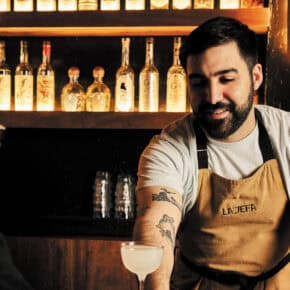
Dan’s father, David Suro, moved to Philadelphia from Mexico in the late 1980s, where he opened the renowned Mexican restaurant. Beyond Tequilas, David is well-known for the Tequila Interchange Project, Siembra Spirits, and many other projects in the industry. But in 2023, a kitchen fire devastated Tequilas and forced its closure. Though nobody was injured, the restaurant wasn’t able to reopen until 2025. By then, Dan had the chance to reimagine the space and bring his own vision to life. Now, the establishment is split in two, with Tequilas sharing the building with a second Suro restaurant, La Jefa, a “Guadadelphian” twist on coffee, wine, cocktails, and Mexican cuisine.
From his time as a young kid mixing margaritas behind the counter with Vinny, a bartender who had been with Tequilas for 30 years, to now, where he spends his days immersed in his own restaurant-bar concept, Dan appears to be in this industry for the long haul–and the right reasons. Driven by a deep respect for small producers and an ethos of conscious consumption, he anchors his program on supporting the right industry players and building capable, passionate teams that share his values.
We caught up with Dan in the middle of another busy week to chat about his approach to hospitality across his two restaurants, along with a few for-the-fun-of-it questions. Here’s what we learned:
What was the first drink you ever made?
Probably a margarita.
What is your approach to developing a new cocktail recipe?
It really depends on the cocktail. It’s a collaborative effort. It starts with inspiration from a classic cocktail. We use the format of classic cocktails with very modern techniques.
How do you develop a cohesive cocktail menu?
We try to fit the boxes for everything. We try to have a balance in spirits and whether it’s boozy or not. We have some drinks that are really fun and we know are going to sell a lot. We usually do that with more familiar spirits like vodka and gin and rum. Then we have a handful of cocktails that we usually take a financial hit on because it’s really cool stuff with really cool spirits that we want to use.
What’s the most overrated cocktail?
Paper plane. I just don’t think there’s much going on with it. It’s just expensive ingredients for not much of a reason.
What’s a red flag you notice when looking at other menus?
When you see large brand names all over the menu. Especially when you see the same names a lot more than once. You know what’s going on.
How do you mentally prepare before a shift?
I am a restaurant owner so I don’t know that I’m ever mentally prepared, I just have to go through it. We have a pre-shift and we make sure we go over service. But we also tie in at least one bottle of agave spirit or a cool rum we just got in – something that we’re really stoked about that the team can find joy in collectively. Learning about a really awesome producer and tasting something really gets us in the right mood and excited to do what we’re setting out to do.
How do you decompress after a long shift?
I try to make a point to read a little bit before bed just to ease my mind a little bit. To be honest, my life is pretty constantly working. It’s like the first year and a half of a restaurant so I’m kind of just roughing it right now. I’m just holding on to the wheel.
What are some management red flags you avoid?
The old school approach of expecting to be the authority figure and have everybody respect what you say whether it’s wrong or right is super common and super toxic. Some of the best people I’ve been lucky enough to train under told me that the best managers and owners set up a system so strong that it runs right when you’re not there.
What’s your philosophy about scheduling?
I’ve been in this industry forever and I’ve worked like five weeks in a row without a day off. Not only does it hurt the person working like that, but it doesn’t contribute to the program. People don’t perform well when they’re overrun. And people need to be able to have a life. The restaurant industry is one of the worst industries for actually being able to get out there, live your life, and spend time with family and friends. I think being lenient and really present with an individual employee when they need time off is important. But still have that structure so you don’t screw the program.
How have you seen the industry evolve over the years?
COVID was the big switch. There’s a bunch of us with an old-school mentality from back before COVID where we were asked for a lot more and we were fine with it. We were willing to take a lot to build up our names and our brand. I think after COVID people started realizing that maybe a lot of the restaurant industry isn’t fair. Maybe it isn’t necessary to kill yourself over a bartending job.
On the positive side, people are more self aware and build better boundaries. But it also feels like we’re lacking in passionate bartenders a bit now. There’s still amazing people out there and amazing new people coming in, but it used to feel like more. I think COVID really thinned us out.
What would you say to others interested in this career path?
If you’re not going to find joy and fulfillment through the great producers you’re supporting, the hospitality, making someone’s night, and making sure the right money is getting to the right mezcalero, or producer…if you’re not going to be able to truly source your joy and fulfillment through that, then just don’t do this.
I’m lucky. I grew up in this. My dad gave me all the opportunities to see how our work affects people and how it can be a vehicle for doing good things. If I didn’t truly enjoy this, then this wouldn’t be a sustainable life.
Also build boundaries for yourself. It’s like the cliche of the oxygen mask on the plane. Put it on yourself first before you put it on the child next to you. Treat your program like that. Make sure you’re taking care of yourself because your program is going to kill you and kill itself if you don’t.
How do you balance your offerings with your core values about the industry?
It’s very difficult to do the right things as a bar and also support the right producers. It’s not a financial match. We don’t do any mezcal cocktails, except two at a time, meaning they only use a teaspoon or quarter-ounce of the agave spirit. The rest of the drink is built around the spirit.
A good friend of mine, Jake Parrott, who works for Haus Alpenz, helped me out a lot with this idea. It lets us be financially viable in our cocktail program and also be able to support a producer or good brand that’s charging what they should charge.
It gives us an opportunity to talk about overconsumption in mezcal, and how to work this type of stuff into a bar program. We don’t have well mezcal or well tequila or anything like that, and it’s been landing a lot with bartenders. The people who just want a mezcal margarita are liking our drink a lot, but it’s kind of raising some questions in their head. It’s a conversation starter and a good way to use this stuff.
One of the main cores of our bar program is to leave open-endedness on our menus to give us opportunities to have conversations with customers. Every service, we’re going through it with guests.
Thoughts on the tequila adulteration scandal?
Because of my proximity to the agave industry, it doesn’t really change much for me. It’s been going on forever. It’s coming to light now because of the popularity and the upward trend that tequila has had, but it’s not news to me.
I would encourage people to realize that’s just tequila. Those brands are going to be fine. We should focus on the other legislation that is coming out against smaller producers. They’re the ones that will actually be affected. There are brands coming into regions that were never really commercialized regions. Big brands doing things like that in those regions are much more dangerous to local producers than big brands doing that in a big industry like tequila.
If you could fix anything in the industry, what would it be?
I wish there were more resources for private-owned restaurants. And I wish those private-owned restaurants would use those resources to help out. Our tipping culture is terrible, like the fact that our employees have to make their living on tips. Now that I’m in the seat of a restaurant owner, I see that it’s the only way it’s possible for this business to even survive. I don’t think it’s as much on private-owned restaurants as it is on the overall system.
As for the agave industry, I see bigger brands seeping in as the market is declining for tequila. I wish that wasn’t happening. I wish the overall mentality of drinking culture and agave spirits would change a little bit. For the people getting into agave spirits, I wish they wouldn’t view it the same way as they would a really rare whiskey or rare exotic brand. I wish they’d appreciate it for what it is and not try to collect it.
Favorite TV series?
Sopranos is one of the best shows ever. And Game of Thrones. I’m a huge Star Wars fan, if that helps anything.
First concert?
Carlos Santana. My family is friends with him. He was touring Philly one time back in the day when Tequilas was the only real Mexican restaurant so he and my parents became friends. I got to have a relationship with him and I’ve known him like my whole life.
Philly was cool as hell back in the day but not really in the restaurant industry.
What do you wish you could spend more time on?
Prioritizing my mental health, relationships, and my family.
What are you most proud of in your career so far?
My family. Being around since ‘86, we’ve been through so many huge obstacles. We had the recession, there was COVID, the passing of my mother, and a huge fire. We’ve just kept going and adjusted to everything and been malleable. I’m really proud of my family and team who have stuck it through with us and pushed through these obstacles.













Leave a Comment