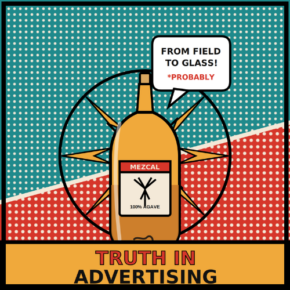
I spent years in advertising. There’s a phrase from that world I never let go of: “Truth in advertising”.
The good kind of advertising isn’t lying with style. It isn’t borrowing somebody else’s landscape, grandmother, Indigenous reference, and renting it out as a commercial shortcut. The good kind of advertising, and marketing in general, makes the story sharper. That’s it.
I’m in the Mexican spirits world now. I know how stories get built because I’ve built them. I know how a phrase travels from a founder’s mouth to a tasting table, a sell sheet, a journalist, then back into the founder’s mouth as if somebody else came up with it. After enough laps, repetition starts to look like proof. The problem isn’t telling stories, the problem is when the story takes the place of the evidence.
That’s where most of the agave and Mexican spirits world is sitting right now. Brands make big claims that get repeated, reposted, applauded but are never fully checked. These claims influence buyers, journalists, investors and almost every story out there. And because these create value, which is to say revenue, they should carry some weight. A few examples:
- “World’s first.” First at what, exactly? In which category? Says who? Since when?
- “First to export.” First into which market? On what kind of shipment? With what paperwork? Or just the first one with better PR?
- “Regenerative.” In what sense? What are the agricultural details?
- “Zero or carbon-negative.” How? What is the math?.
- “Protecting biodiversity.” What is the baseline? How are you measuring and accounting for that protection?
- “Community-led.” What does that structure look like? Where is the money coming from? Who is actually benefitting from this?
We’ve been trained to accept certain things as proof, but a website isn’t proof nor is an interview nor a photo of a guy in an agave field. You know what else isn’t proof? A beautifully produced video, a press release, a bartender repeating what an importer told him. The good news is that these days anyone with a laptop can fact-check a claim in thirty seconds, making it harder for brands to hide behind pretty words. But being able to check a claim and actually checking it are two different things. The people who used to do the checking, the trade press, the editors, the buyers who held a line, are slowly disappearing. Nobody’s minding the gate anymore. So the claim goes out, fewer people question it, and it travels. And the further it travels, the truer it sounds.
This concern didn’t start with one brand or one tasting. When I got into the agave business, one of the books that stuck with me was Sarah Bowen’s “Divided Spirits.” The part I couldn’t shake was the structure underneath the romance: value climbs upward through branding, export, distribution, global demand, and the small farmer or producer is the one left carrying the risk when the music stops.
When a bottle lands on a shelf in London, New York, Berlin, or LA, the story sounds beautiful. But who owns the story? Who profits from it? Who’s standing there when the market turns?
In “Agave Spirits,” Gary Paul Nabhan and David Suro Piñera argue that good mezcal isn’t really measured by proof or price, it’s measured by how memorable the taste and the story are. I agree. A great spirit needs a story. Stories carry place, labor, time, skill, weather, culture. Which is exactly why a story has to be handled with care.
A good story moves bottles. It turns a producer into a symbol, a landscape into a promise, a tradition into a brand asset. That’s a lot of power, and it should come with responsibility. The story is supposed to open a door to the truth, not stand in front of it. Same goes for origin myths, “maestro” language, and the whole celebrity-discovery routine. Long before a polished narrative showed up in a press release, real people did the work: farmers, producers, families, early importers, restaurant owners, bartenders, small brand builders. A “maestro” might be presented as exclusive to one bottle and also be making spirits for three other brands, consulting for a few more, and showing up mostly as the symbolic face.
That is fine. It just shouldn’t be hidden.
Who actually grew the agave? Who cooked it, fermented it, distilled it? Who owns the brand? Who owns the story? Who gets paid for the picture being sold? These are all points that a brand needs to be ready to answer. Transparency doesn’t always need an expensive certification. It needs honesty. It needs specifics. It needs being willing to say what you know, what you don’t, and what you’re still figuring out.
There’s a big difference between “we’re working on reducing our footprint” and “we’re carbon-negative”; between “we work with a family producer” and “this is a producer-owned brand”; between “we support replanting” and “we’re restoring the ecosystem”; between “we’re one of the first brands trying this” and “we’re the world’s first”. Language matters.
And then there is the basic reality of farming. Agriculture is messy. Agave is messy. There’s drought, soil exhaustion, pest pressure, and pressure to spray. The agave snout weevil can take down a plant from the inside before you see it from the outside. Any brand calling its agave natural, regenerative, organic, or low-intervention should be ready to talk about its pest management. Were there weevils? Were plants treated? With what? Were infected plants pulled? Was anything tested?
The same question applies to how and where the agave was grown, especially when it is grown in regions where other crops have a history of heavy fertilizer or contamination (think mining). That doesn’t necessarily mean the spirit is problematic. It just means you ask questions like what grew there before? What chemicals or herbicides were put on the soil? Was the water or agave or finished spirit tested for contamination?
Even a claim as simple as “made from agave grown on our ranch” deserves a second read. Maybe it’s true, but it doesn’t answer the whole question. Was the agave only “grown” there? Or also cooked, fermented, distilled, bottled, controlled there? Was a contract distillery involved? Whose name is actually on the NOM? Transparent companies could share documents even when their efforts failed, so that others could learn.
Origin in agave spirits isn’t one thing. It’s a chain that begins with the land, plant, harvest, transport, oven, fermentation, still, blending, bottling, ownership and sale. If you highlight one link and skip the rest, the consumer ends up misreading the whole bottle.
Then there’s the most basic question: what’s actually in the bottle? Methanol can form as a by product of fermentation and distillation. In a properly run process it’s measured, managed, kept within legal limits. That’s the point, it has to be measured. If a brand wants you to trust its purity, it should be willing to show batch-level lab results. Romance doesn’t replace analysis. “Traditional” isn’t an excuse for skipping the test.
There’s also the part of the story that is rarely touched on: what happens after the distillation is done? Tequila already showed everybody why this matters. Bagaso, the used agave fiber, and vinasa, the acidic liquid that comes out of distillation, are environmentally problematic. If a brand wants to claim sustainability, regeneration, circularity, respect for the land, it should be able to talk about its waste with the same confidence it talks about its origin. What happens to the bagaso and the vinasa? Is it composted, treated, reused and returned to the land? Or is it just trucked off to where nobody’s looking?
I lived through the early years of all this when everybody was talking about how authentic: and handcrafted the spirits were; how family methods and respect for tradition were so ingrained in each bottle. But as demand grew, so did the pressure behind the scenes. Some brand owners wanted to grow faster than the process could honestly support, so spirits were bought from outside sources and either blended into the product or bottled on its own. Quality was assumed instead of verified. Containers shipped because too much money was already in motion. And when the problems showed up, it was the importer who took the first hit, facing distributors, unpaid invoices, broken relationships, and the question of whether the next container could be trusted at all. And behind all of that, the people carrying the long-term risk were the “jimadores” and the families actually making the spirit.
Think of the words “artisanal” and “ancestral.” They paint a picture of small-batch, human-scale work. But a traditional system has physical ceilings: oven size, cooking time, mill capacity, fermentation vat volume, weather, still size, labor, the cuts you can make, the mature agave you can find. When a brand publishes either on a sell sheet, a label, a website that its spirit is cooked in stone ovens, fermented in American oak, distilled in copper, made from wild-harvested agave, distilled on the ranch and bottled there, those aren’t just atmospheric details, they’re factual claims. They justify the price,build trust and sell the bottle. So those claims need to be backed up with something real: production records, photos, batch data, NOM records, harvest logs, invoices, maps or the producer’s own word. Without backup, it’s just marketing. With backup, it’s verification and trust.
When a brand wrapped in this kind of language goes into national distribution, chain retail,pallet-sized export, or gets bought by a big importer, what does “handcrafted”, “artisanal” or “ancestral” actually mean at that scale? Growth isn’t the issue, but the lack of clarity is.
Plenty of bartenders and mixologists ask serious questions and know the category, as do folks in the influencer scene. But just as often, visibility gets confused with expertise. A brand trip, a reel, a tasting-table selfie, a styled distillery visit is turned into free credibility for brand claims nobody examined. Clicks, followers, lifestyle imagery, none of this verifies anything. If you use your platform to turn brand language into public belief, you also have the responsibility of asking the tougher questions.
Spirits competitions sit in a similar place. Blind tasting is useful and a well-run competition can judge aroma, balance, finish and technical quality. But it doesn’t verify the larger story around the bottle. A medal doesn’t prove regenerative agriculture practices. It doesn’t prove zero carbon, fair economics, organic farming, community benefit, biodiversity protection, responsible waste management, or cultural consent. Awards are about the liquid in the bottle. They shouldn’t be turned into proof of the story.
Some projects outside the bottle world show what a different standard looks like. The Billion Agave Project, associated with the late Ronnie Cummins, isn’t a spirits brand but it’s a useful example of claims that are tied to visible systems, research, land practice, and measurable goals. You can still question it. The point is the claim is connected to a framework you can examine and measure. The issue isn’t whether every verification system is perfect. The issue is whether a brand gives you enough information to question it at all. If a brand rejects existing systems, fine, but show me the alternative.
The agave world doesn’t need less storytelling. It needs more truthful storytelling, stories that are beautiful because they’re specific and honest and accountable, not because they got inflated past the point of proof. If a claim is true, it can stand up to questions. If it can’t, it shouldn’t be selling bottles.
I’m not interested in attacking brands. I’m not interested in a blacklist. I’m interested in one question: Can the brand prove what it profits from?
So how do we make that happen and hold brands accountable for their stories? We need better questions from journalists and influencers and when a post is sponsored or paid for. We need more vigor from importers and more careful language from distributors. We need bartenders and retailers asking for evidence before turning brand language into sales language. We need investors looking past the pitch deck and doing true due diligence. We need people at tastings and trade shows actually listening to what brand representatives are telling them. And we need consumers to understand that a beautiful story isn’t the same as a verified fact.
That’s what true respect for these incredible spirits, the producers, the farmers, the drinkers, the land, the culture and the truth in the bottle in the bottle looks like.



Thank you for this thoughtful article. I’d add one question I keep going back and forth on: are we holding all spirits categories to this same standard?
When the “truth in advertising” conversation centers almost exclusively on agave, it can unintentionally suggest this category is the only one with something to hide, when in reality, these are industry-wide issues. At the same time, I don’t believe transparency is a bad ask. I want to know more about how spirits are made. But I always have this internal debate with myself that agave is already competing hard against categories like Scotch and bourbon, and if agave spirits are the only ones held to a stricter disclosure standard, it risks becoming another cost of doing business that the competitors (e.g. bourbon, vodka, rum, etc) don’t carry. Or how should we be thinking about it? Thanks!
I think you make an incredibly valid point. Personally, I think we should be asking these questions around anything we put in our bodies! But, I also think that we have accepted that so many other spirits like vodka are industrial products. Additionally, most of those other spirits don’t market themselves in the same with with such intensive stories built around culture, myth and agriculture.
Mexican spirits are deeply rooted in the communities and in general we always should ask what is being sid or advertised in drinks and foods and hopfully get true answers
I don’t think agave spirits compete with Scotch and Bourbon but should be looked at also about how they are made. I know of e UK companies that are very open about their process and admired them for the work that goes into their reporting. Check out these 2 report https://twodriftersrum.com/pages/sustainability-report,,https://www.mezcalistas.com/truth-in-advertising-why-agave-spirits-brands-need-more-than-good-stories/
This is the best article on marketing Truth and lies I have ever read. Long overdue. The level of bullshit in tequila and mezcal marketing is so excessive it renders almost all of it meaningless. Thank you for writing this. Truth matters. -Craig Reynolds, Founder of California Agave Council and owner/producer of Dos Volcanes agave spirits from Colima, Mexico.
Thanks Craig, it means a lot coming from you. It needed to be said and I appreciate Susan and the Mezcalsistas Team to accept my story. Not sure if you remember, but we met many moons ago in Oaxaca in a B&B after I returned from a Moto trip. What do you think can or should be done with that issue?