I think I first fell in love with Mexico City in college when I read Where the Air is Clear by Carlos Fuentes, but it was probably before that. Sometime in the 1970s when my parents hosted dinner parties and there was always a stream of foreign service and political exiles who spoke of the grandeur and modernity of what would become one of the largest cities in the world. To a kid growing up in Washington DC, in that era, it sounded so cosmopolitan–the opposite of my hometown.
I definitely fell in love with Mexico City the first time I visited, a quick three day stay on the heels of a longer trip in Oaxaca. Just enough time to visit the Anthropology Museum and the Zocolo, Belles Artes, and the Paseo de la Reforma. And of course Sanborn’s and the Casa de los Azulejos. Friends who had lived there warned me it was dirty and dangerous, the air so thick you could taste the grit in your mouth. But the city was smog-free those three days, the sky a brilliant bright blue as we rode atop a doubledecker bus admiring the <very ungentrified> avenues and parks of Condesa and Roma. And the Chilangos? So kind and helpful and completely forgiving of my shaky Spanish. I returned home and proclaimed Mexico City the greatest city in the western hemisphere.
But it was reading Los Detectives Salvajes by Roberto Bolaño that sealed the deal for me. Streets and cafes filled with poets, writers, and musicians, drunkenly carousing through all hours of the night and morning, searching for authenticity and truth? Be still my beating heart. In other words, this was no youthful infatuation but instead a long love affair that would never end.
If New York is a 24 hour town, Mexico City is a 72 hour town (see this video to understand what I mean). I could never live there; San Francisco is more my speed, but–man oh man–do I love visiting and getting introduced to neighborhoods and tiny little museums and more kinds of food than I could ever imagine. While tooling around with friends who are locals, I began venturing outside the city boundaries into fields of chiles and agave, eating from roadside stands that sold tamal sandwiches and seriously delicious atole. Distinctive areas and yet completely connected to a larger urban environment. So when we began talking about doing Mezcalistas tours again, Mexico City and its environsit wereas the first places that jumped to mind, especially given all the groundwork my colleague Joahna Hernandez, a CDMX native, has already done with her day trips to Tlalpan and Tlaxcala.
If you haven’t been paying attention, Mexico has become the “it” country and Mexico City the “it” city since the pandemic. The city government courted digital nomads and you can see the results of that walking through the Roma and Condesa neighborhoods. The rise of Mexican gastronomy on the world stage brought even more attention to the city. Its restaurants and bars now top every single world’s best list, which is both a blessing and a curse.
When I was there in May I can’t tell you how many travelers I encountered who had their lists of where to eat and drink, virtually all in Roma and Condesa. I absolutely believe that the best way to understand a country and culture is through its food, but Mexico City is enormous and these two neighborhoods are but a speck on the larger map. It truly made me realize just how much people miss in their travels when they are guided by best-of-lists and Instagram photos.
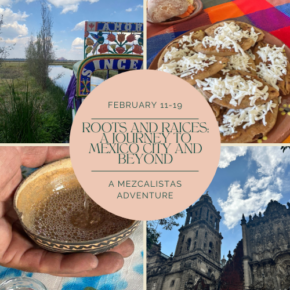
Our inaugural Roots and Raices Culinary Journey is a whole other animal. In addition to Mexico City, we travel beyond its borders into the states of Tlaxcala and Puebla to understand the history and interconnectedness of food traditions and farmlands. Over nine days, twelve lucky travelers will explore these areas,, through the landscapes and into the kitchens, markets, and distilleries where Mexico’s culinary and cultural identity was forged — and where it continues to evolve today. We’ll be joined by locals and experts at each stop, guiding us to pull back the layers and see things we might never have seen, let alone understood. This isn’t a tour of famous restaurants. It is an invitation to understand the ecosystems that make Mexican cuisine possible.
Imagine slowly floating through the agricultural canals of Xochimilco first thing in the morning and joining noted ethnobiologist and CDMX local César Iván Linares to explore the local markets and sip ancestral beverages while learning about yeasts, fermentation, and the kaleidoscope of flavors that are created.
Picture walking an agave field and harvesting fresh agua miel, or joining the brujas at Taller Astrafilia to learn how botanicals are crafted to create incredible gins and liqueurs. Feel the warmth of a campfire at an old hacienda in Puebla as we sip on a special selection of mezcals from local guide César Lima, after a day of learning how to make cheese. Spend an afternoon with Ernesto Vargas Mendoza as he talks about heirloom corn varieties and how he uses them in his whiskeys. Listen to a group of chefs talk about the cultural significance of maiz and the tamal and what is being lost (and found) with the gentrification of Mexico City in a dinner conversation led by award winning Mexico City-based food writer Mariana Castillo Hernández. These are just a few of the experiences awaiting you next February.
I have been traveling the backroads and cities of Mexico for almost 25 years, first as a tourist who wanted to know more about maize traditions, then as a writer and co-founder of Mezcalistas focused on telling stories about the people and places producing mezcal, as well as tracing the roots and branches of other culinary and beverage traditions and more. I’ll be leading this trip alongside Joahna, who not only is an amazing writer but also a fountain of knowledge when it comes to food history and, anthropology and looking beyond the surface. We’ll learn through the producers, cooks, artisans, historians, and farming families whose work tells a much deeper story than any menu ever could. This is truly a behind-the-scenes look at why Mexico has become one of the most exciting culinary destinations on earth.
You can check out the trip information and full itinerary and costs here. We cannot wait for you to join us.




Leave a Comment