
This article explores what happens when a plant crosses the border but the histories, wounds, desires, and economic imaginaries attached to it cross with it too
A new kind of bucolic event is happening under the sky of California’s Central Valley: guests smile and clink their veladoras filled with agave spirits; a linen dress catches the desert wind and a camera lens captures the contrast of its straw tone against the green spears of the agave rows extending in the field. Terracotta ornaments in the garden halls are embellished with bouquets of dried flowers and straw. At this rustic-style wedding, everything feels carefully curated to remember a Mexican landscape.
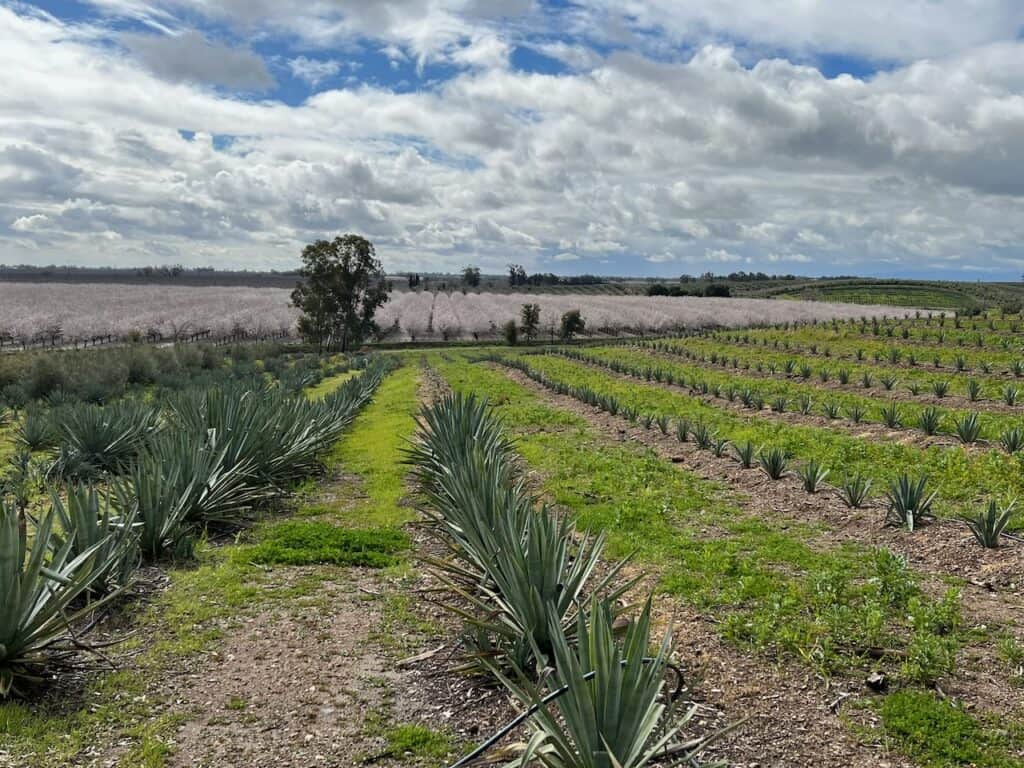
This California wedding demonstrates an aesthetic of agave recontextualized in a new landscape. The scene, increasingly more common on both sides of the border, is part of a larger pattern. Across California, a growing network of farmers, entrepreneurs, researchers, and advocates are beginning to imagine agave as part of their agricultural future. Confronted with chronic droughts and restrictions on groundwater, they see the potential of a plant adapted to the drylands.
As such, the panorama of the agave in California reflects a rapidly growing and highly intentional agricultural change that has grown from 50 hectares in 2023 to more than 600 in 2025. California farmers are growing blue weber, espadín, and other agaves commonly used to make mezcal in Mexico. Emerging bodies like the California Agave Council recognize more than 80 growers and eight dedicated craft distillers. The council worked to pass a Californian bill to legally define a “California Agave Spirit,” ensuring protections for a real economic product.
Some see an agricultural innovation emerging from a changing landscape; others see the beginning of another cycle of extraction. In Mexico, where generations of farmers and communities have developed deep biological and cultural relations with the plant, the emergence of the California agave spirits industry has raised concerns about cultural appropriation, theft of plant resources, intellectual property, and the future of rural ways of life tied to agave spirits.
In this article, I argue that neither side of the story is enough on its own to make sense of what people are feeling and hoping for. What is happening in California goes beyond both the commonplace story of Mexican culture being taken by Americans or one of California farmers discovering the silver bullet of land regeneration. It is a struggle situated in a larger history of political ecology, migration, and a global economic model of development. And beneath the arguments about who has the right to grow and profit from agave lies a question more meaningful to address: What kind of worlds and relationships are we all creating around this plant as it moves into new landscapes?
This essay tries to reorganize the approach of a seeming two-sided confrontation. Rather than pointing out who is right, I want to untangle three questions: whether agave can fulfill the regenerative promise that California farmers claim for it; whether the movement of plants and knowledge into a new industry represents a form of biopiracy; and who gets to claim cultural legitimacy around an ever-evolving plant when surrounding cultures do not really follow the same defined borders as nations.
Agave and the potential for regeneration; when resilience becomes a commodity
One of the flagship promises of California’s emerging agave movement is land regeneration. As drought, extreme weather, and groundwater restrictions increasingly threaten the state’s agricultural model, farmers are looking for crops that require less water. Agave appears perfectly suited for the circumstance. According to California Agave Council’s founder, Craig Reynolds, while almond orchards can require around 48 inches of water a year, agave can survive on an almost insignificant fraction of that. For farmers confronting the prospect of abandoning their land, the plant offers something more than a new crop: the possibility of keeping an agricultural livelihood in a changing climate.
But is this enthusiasm warranted? A plant is not isolated from the socioecological system around it: cultivation management, further ecological relations, inputs and waste cycles are all nested in the broader socioecological productive system. Each distinct operation matters a lot.
The familiar almond tree in California grants the perfect example. Almond cultivation has become almost synonymous with water-intensive agriculture, and the tree itself is frequently demonized in the context of the state’s drought crisis. Yet in the Spanish Mediterranean, the almond tree tells a very different story. There, the tree has long been part of dryland (secano) agriculture, growing in landscapes where farmers depend primarily on a few inches of winter rain. The problem does not appear to be the almond tree. It is the agricultural system in which the tree is embedded: the density of planting, irrigation, expectations of yield, access to groundwater, machinery, markets, and the economic imperative to maximize production. A plant can be ecologically fit while the agricultural system built around it is not.
Agave is a remarkable contender for a water resilient farming system because of its ecological characteristics, but an agave that thrives in the drylands does not automatically create a drought-adapted agriculture. It is the structure surrounding that determines the ultimate socioecological impact of its drought-adapted characteristics.
In this context , the California agave story begins to resemble a much older story about the American Southwest. In Blue Desert, journalist Charles Bowden described a paradox in the settlement of the arid West: people fleeing the restless urban landscapes of the East arrived in the desert only to recreate many of the infrastructures they had hoped to escape. They wanted the desert, but they also wanted it paved, air-conditioned and predictable.
That paradox resembles what may be unfolding in California’s agave fields. Agave is being transplanted as a symbol of agricultural resilience precisely because the existing agricultural model is becoming increasingly difficult to sustain. So if the plant becomes a monoculture in the same eroded landscape and is subject to the same expectations of intensive production, commodification, low wages, and market growth, what exactly is it that California farmers are trying to sustain?
The mindset surrounding agricultural systems is telling. This is visible in the almost immediate association between agave and spirits. California proposes to grow a drought-adapted plant, but much of the excitement is derived from the possibility of producing mezcal and creating a new premium spirits industry. This is understandable: mezcal offers a well-established cultural narrative, a recognizable product, and the possibility of considerable added value, but it also introduces a strange contradiction. A plant is being promoted as part of a transition away from an agricultural system that has become ecologically unsustainable, while its economic future is being imagined through another commodity system whose success depends on extracting economic value from the plant. All this unfolds while agave prices in Mexico are plummeting due to overplanting, and overproduction of tequila and mezcal has created massive inventory leftovers.
It appears that what advocates are looking for is not a sustainable plant but a plant to sustain business as usual.
Swapping one monoculture doesn’t solve erosion. And turning a drought-adapted plant into a high margin spirit still preserves an extractive logic of water use. The plant can provide for food, fiber, forage, biomaterials, soil cover for nourishment, clothing, and affordable housing, so why does the imaginary around it so quickly narrow around spirits?
However, none of these questions in fact invalidate the efforts of California farmers. Many are responding to a very real climatic crisis and trying to find ways of keeping their farms and livelihoods. Their search for alternatives might not be inherently extractive. It does remind us that regeneration is not a property of a crop nor a cultivation objective. It is a state of harmony between human relationships, knowledge, landscape, and practices.
Is transplanting another form of extraction?
Agave arrives in California carrying more than its biological characteristics. It carries centuries of cultivation, technologies of transformation, culinary practices, stories, selected species, and economic relationships. It carries extraordinary cultural weight, all tightly woven with the histories of the towns and people who have lived alongside it within Mexico.
This is why the California agave story generates another kind of unease.
For many Mexican producers, advocates, and organizations, the emergence of a California agave industry hints at something more than another country transplanting a crop. It raises questions about what happens when biological material, agricultural knowledge, and cultural practices move into another economic system. Concerns about biopiracy and cultural appropriation are therefore not out of place. They reopen a longstanding wound for people whose communities have experienced the extraction of resources and knowledge without receiving a reciprocal share of the wealth created at their expense.
The history of tea provides a dramatic example of biopiracy. In For All the Tea in China: How England Stole the World’s Favorite Drink and Changed History, Sarah Rose relates how tea in China was embedded in highly artisanal, localized systems of cultivation and traditions intertwined with Daoist and Buddhist philosophies on hospitality, health, and meditation.
In the nineteenth century, the British East India Company sent the Scottish botanist Robert Fortune into China disguised as a merchant. Fortune obtained tea plants and manufacturing knowledge. Consequently, the British were able to establish large monoculture plantations in occupied Indian territories. As a result, China’s tea trade plummeted from 90% of the world market to a minor fraction within a few decades. This collapse shattered the smallholder economy that depended on tea as their primary cash crop. The movement of the plant was engrained in a system where power, knowledge, and dispossession are connected and affected each other.
This is one of the incidents that makes the fear of biopiracy strike so strongly today. To explain if there is a real case of theft in California, we would need to know the conditions of the exchange: if and how farmers were retributed for botanics, recipes, and millenary knowledge–the combination that insider mezcaleros name gusto histórico. We would need to know where the plants went, if there will be patents in the future, and what regulatory bodies legitimized the transaction. This might respond if theft actually exists.
Nevertheless, I don’t think biopiracy is enough to make sense of the whole entanglement. To gain deeper insights, we need to ask more challenging questions. Sometimes material and immaterial heritage may not be wrongfully taken, nevertheless peoples and cultures end up displaced–culturally or economically. For instance, we can ask: Why are people demanding modest retributions, economic or other, for bodies of knowledge that span generations? What happens when regulations turn livelihoods into national products? Why is knowledge of dwelling in a place turned into intellectual property? Who benefits from the new value created around it? What’s the relation between the monthly wage of a field worker and the shelf price of the premium mezcal bottle that they helped produce?
These questions take us beyond property, theft and the conventional dominant narratives. We can study other relations in a broader system of power relations, and as a matter of fact, considering different cosmovisiones (loosely, cultural worldviews) can be quite insightful.
California based anthropologist Anna Tsing offers a useful way of thinking about this tension. In her work on capitalism and what she calls “collaborative survival,” Tsing describes how plants, landscapes, and people can form complex relationships that do not conform to the same patterns of capitalist production, like people gathering at the ringing of the church bells to start another “unpaid” collective roasting of agave. Capitalist frameworks then encounter these relationships and reorganize them, extracting particular forms of value and funneling them into supply chains.
Communities that have spent generations developing diverse ways of cultivating and transforming agave are now part of economic and political systems that give them far less power than the industries and institutions that later profit from their knowledge and resources. Seeing a new industry emerge elsewhere, sometimes beginning with knowledge, genetic material, or cultural narratives that did not originate there, can feel like the continuation of an old imperial pattern.
Apparently, the rules of the free market tell us that everyone should be entitled to go wherever they can; invest, compete, and start any venture, because we should all have equal opportunities in any given economic landscape. In reality, this speech obscures historical structural inequalities that influence our ability to participate in the market. Not everyone in that “race” has been equipped the same and are not deploying from the same starting line. California’s emerging agave industry is beginning with the gigantic economic, political and logistical power of the USA. Peasant farming communities in Mexico, where a lot of the unrest about agave in California comes from, have inherited a very different history. Wealth and power do not appear spontaneously and are not neutrally given. This does not mean that contemporary American farmers are personally responsible for those histories, but they venture into a landscape shaped by those asymmetrical conditions, and are able to benefit from the opportunities that are not available to everyone the same way.
On top of that, there is another, bigger, uncomfortable truth. Agro-extractivism does not happen only when a foreign imperial power takes control. It can also happen from within.
Mexico itself has its own histories of dispossession and extraction. Mexican companies have commercialized indigenous knowledge; scientists have collected and worked with genetic material; entrepreneurs have profited from territories where they are not culturally attached; agricultural systems have turned diverse landscapes into monocrops; and the Mexican government has standardized cultural practices through regulation. The mezcal de tequila industry, for example, has been extensively studied as a case in which industrial consolidation and regulation transformed relationships between agave, land, and producers.
This is related to a recurring rhetoric among some Mexican actors who are claiming maguey belongs to the nation and its people, and that it is up to “us as Mexicans” to keep it or share it. It raises the question, who is “us”? Contemporary nation-states have inherited and reproduced an old colonial mechanism: defining territories, populations, histories, and identities through categories that can be controlled. Probably the “us” in those statements is the reproduction of this nation-state mechanism of control. This is particularly visible in countries like Mexico, where dozens of ethnolinguistic peoples and many distinct histories interact but are flattened through homogenizing discourses.
Being born on one side of a national border does not automatically make someone part of the same historical relationship with a territory, a plant, or a body of knowledge. This does not make national identities meaningless, it just helps us recognize that they are narrative devices rather than an intrinsic attributes of people, and that they are not enough to explain this situation.
When supported and enforced through national legislation, borders as narrative devices start to have concrete consequences in people’s lives. These laws dictate the conception of what a product is, as well as who is able to transform it and access it.
Denominations of Origin are a prime example of this mechanism. They are a particular way of organizing protection by categorizing, defining, and territorializing a product. They can have legitimate and important functions—keeping value within a region, protecting producers, preserving standards, and preventing the misuse of a name. Yet DOs operate within a market system in which territorial identity is turned into a label with economic value :
This creates a cultural paradox: the Mexican state defines and protects a cultural category that has acquired significant market value, helping establish the success of the category. Once that commercial place exists, simultaneously another space is created within the category to emerge around that protection.
The California agave industry is trying to avoid the denomination “mezcal.” Many do so out of a genuine show of respect, recognizing it as a Mexican symbol and regulatory framework. Instead, they adopt the term “agave spirits.” This reveals that a legal category can protect cultural heritage while inadvertently expanding the market outside its protected geographical boundaries—fostering not the preservation of cultural or ecological relations, but the growth of the capital market. Californian and Mexican industry regulations may claim respect for mezcal, and at the same time threaten the livelihood of rural mezcal producers in Mexico. Families and towns are already being displaced, small-scale farmers are being swallowed by corporate supply chains, and transnational companies are already profiting from peasant labor. Through the language of property and regulation, this is not only permitted but structurally encouraged.
This is why the California agave story is more complicated than a binary between theft and ownership. The historical wound is real and the concerns about biopiracy are justified. However, national borders cannot fully explain either the movement of plants or the systems that organize their value. A plant can cross a border without reproducing the social relations from which it came. Conversely, a system of extraction can be seamlessly reproduced by people who share the same cultural history as those from whom value is extracted.
The state of the matter is not whose agave this is or in what country are agave cultures reproducing. In this scenario, the border starts looking less like a clear fixed identitary boundary and more like an institutional strategy to organize and legitimize socio-economic relationships around agave and mezcal.
Here another complication appears.
Who gets to claim cultural attachment to agave and who is culturally appropriating its body of knowledge?
The last question I want to address is about the raised alarms for cultural appropriation: Who can legitimately claim a relationship with agave and mezcal, and who has the right to use that relationship to create something new? And once we start looking at who is making these claims, the answer becomes much less clear.
Some Mexicans argue that it is up to them to decide how agave culture should be shared and whether it should be shared at all. Others see agave as a fundamental part of their Mexican identity and consider it unjust for people elsewhere to profit from something that has been cultivated and transformed by Mexican communities for generations.
Then there are people who were not born in Mexico but have a very real attachment to Mexican culture. First and second generation Mexican Americans, for example, may carry with them a history of a struggling rural family, alongside agricultural memories, food traditions, and customs of hospitality. Some of them are now taking part in the agave-mezcal supply chain across the border. Their relationship with the plant cannot be dismissed because it happens north of a wall. Though this is also complicated because proximity with a culture does not automatically mean understanding or the development of diverse ecological relationships. This goes for people at both sides of the border. Familiarity does not confer legitimacy.
Hence, we need to distinguish between attachment and entitlement. A person can have a meaningful relationship with a plant without having the authority to speak for everyone who has historically lived with it. A community can have an intricate history with a plant without claiming that nobody else can develop a relationship with it. And a company can legally cultivate a plant without being accountable to the people that gave them the know-how, the selected species, or a well-positioned market category.
Other claims of attachment are even more difficult to untangle. At an agave gathering in Arizona, a caucasian American participant reportedly said: “We’re all Indigenous” to claim their right for agave use. In one sense, the statement is not wrong. People are born in a place. People can develop relationships with landscapes. People can learn from them and participate in their reproduction. However, not all bodies would feel as confident to make this claim publicly–context matters.
Indigeneity is not merely a declaration of attachment to a landscape. The concept is embodied in histories of dispossession, marginalization, racialization, linguistic discrimination, and survival. Someone may claim an Indigenous relationship to a plant while never having experienced the forms of exclusion through which indigeneity has historically been produced. There have been (and still are) people that are discriminated because they have a relationship with agave beverages. These sort of discriminatory practices are always tied with skin color, formal education level, bank savings, and demographic situation (urban or rural). Therefore, “We’re all indigenous” can flatten very different histories into one. One person can feel completely entitled to claim Indigeneity while another has learned to hide an accent, a language, or the color of their skin in an airport security line. The term matters because the histories behind the term matter in everyday life.
To untangle notions of the borderlands, hybridity, and shifting identities, we need to look from a place where these categories are in evergoing friction. Chicano culture offers precisely such a view.
Gloria Anzaldúa, the queer Mexican-American writer who lived and wrote from the borderlands, understood the border as an open wound created by an unnatural geographical line. For Anzaldúa, surviving this wound and its unnatural separation requires moving away from clean, abstract categories to rely instead on embodied knowledge and lived experience. Inhabiting the borderlands means navigating a vague, undetermined space and developing a tolerance for ambiguity. This awareness allows individuals to pay close attention to the power dynamics operating within contradictions and conflicting worldviews.
When we look at agave through this lens, the necessity to embrace contradiction becomes clear. What one specific agave means in terms of fiber for one community means nourishment for another. The local vernacular in one village might completely contradict the rigid scientific botany of the west. These positions coexist simultaneously as irreconcilable as they might be.
With this framework in mind, we can also see that geographical distribution, patents, legal definitions or what a person holding a specific passport says about it does not give agave its cultural meaning. The plant becomes meaningful through lived experience: the hardship of cultivation and the joy of harvesting, working through reciprocal tequios in the fields, roasting the plant collectively, eating and drinking it during celebrations, making tools and materials from it, and passing down stories about the places where it grows. Or transforming it into a commodity.
There are many cultures across landscapes that today span Mexico, California, Arizona, Guatemala and other places where agave has natively evolved, but the plant does not have one universal meaning or use for those diverse cultures. Agave does not have the same relationship for a Tohono O’odham person in the arid desert of Arizona as it does for a Maya person in the humid tropics of Yucatán. Agaves do not carry culture inside their piñas; culture is actively produced and reproduced through the fluid relationships between people, plants, and places.
Those relationships are situated, historical and changing constantly. California itself was part of a larger Mexican colonial state. And even before that, the region had other names given by the dozens of groups that for generations lived there before the modern nation-state of Mexico even existed. This is why the California agave question cannot be reduced to a binary between Mexican agave versus foreign agave, cultural heritage versus innovation, or those who belong versus those who do not. And this is also where the language of cultural appropriation starts to become blatantly insufficient.
Cultural appropriation describes a real pattern: a social practice, a knowledge system, biological resource, or aesthetic can be detached from the relationships that produced it and then converted into value somewhere else. Nevertheless, the lens of appropriation runs the risk of reducing the whole system to a diagnosis of theft between locals versus foreigners. But theft does not explain what happens after agave is transplanted from one place to another. Cultural appropriation is nested in a larger pattern.
Global plant migration cannot be reduced entirely to the politics of colonialism. Capital and imperial powers have certainly instrumentalized plant movement to create private value, like the case of tea. That does not mean that plants will indefinitely reproduce the dynamics of domination.
Empires have certainly moved plants, people, knowledge, and technologies across the world. This is an aspect of conquest. Nevertheless, it would be a mistake to imagine that every plant that traveled in a colonial world inevitably reproduced colonial relations wherever it arrived. Such is the case of the diversification of tomatoes by peasant gardeners in the Mediterranean basin. There are important distinctions to make about the consequences of colonial extraction. Plants have been moving for a very long time, and their migrations have produced very different, unpredictable networks of human and ecological relationships.
On Hvar Island in Croatia, Benedictine nuns developed lace-making practices using agave fiber to develop their arts of spiritual contemplation. In the Sonoran desert, communities have been using specific varieties of agave to build water retention structures across mountain slopes. In Mexico, people have been working through tequios and resisting the modern urge to turn labor into a product. From the perspective of gross domestic product (GDP) the dominant economic narrative interprets this communal work as unpaid labor and a sign of underdevelopment. However, tequios represent a highly sophisticated form of resource management—economic systems that actively transcend the limitations of monetary transactions. These practices have not led to an international agave industry.
This does not indicate a failure of ambition or imagination.The fact that they did not create an international industry is precisely what allows us to see how different cultures create other forms of value. This is what anthropologists call the reproduction of social life or cultural reproduction. It is a different lens from the common growth logic that is focused on how much can be taken from a certain system to accumulate profits. Instead social reproduction looks for ways to develop a life-sustaining ecology of practices.
A plant is useful and ecologically resilient without becoming a commodity or a national symbol that people with a certain passport can claim as theirs. Cultural appropriation is not an inadequate concept to study relations; but instead of pointing out who is guilty, we can call attention to cultural and social reproduction practices that do not reduce a community’s life to a large-scale industry that raises the gross domestic product.
These relationships emerge through a complex biocultural process: feedback between people and landscapes in which agriculture, food, migration, identity, technology, industry, and borders continuously shape one another. Nothing is given. No identity sprouts from spontaneous generation. It is shaped by history and reproduced through practice.
This also means that the Mexican position cannot be romanticized. Again, much of what Mexican voices are now advocating against has already happened in Mexico, carried out by other Mexicans. And again, one term—cultural appropriation—does not explain it all. A larger pattern across cultures is involved. If the same practices can be reproduced by Mexicans against other Mexicans, then nationality or culture cannot be the fundamental explanation. Foreigners taking Mexican things is not the problem, but rather a common economic and political equation that manages the relationships that people create in their everyday life: relationships become resources, resources become property, and property becomes value. That is why I am reluctant to see what is happening in California only through the lens of cultural appropriation.
Mezcal diversity itself is a clear example: there are clear differences between one mezcal and the next. Not because DO’s have protected them but because there are actual larger, profound biocultural processes making the difference: a wide diversification of a plant genus to many different species in different ecological niches and different ethnolinguistic groups and know-how linked to the plant have facilitated the creation of dozens of ways using the plant. A great diversity of human cultures and landscapes have emerged out of these processes, an ever-going adaptation and co-evolution between people, plants, and places.
That means no one possesses agave in its entirety. And it also means that developing a relationship with agave is not spontaneous. Every new relationship is based on a biocultural history that already exists.
Conclusion
Imaginaries of commodification are not only found in history books nor only in highly industrialized nations. They are embedded in the ways we exchange knowledge, transform ingredients, and make business all over the world. California farmers operate within a national system that has spent centuries refining this particular grammar of property, specialization, accumulation, and markets. Mexican campesinos also exist within a capitalistic nation-state logic, but have never been completely absorbed by it and that’s why we’re able to discover other ways of life with them. People that have traveled to a small family mezcal production place have, in Anzaldúa’s terms, the lived experience of that way of life. Campesino practices have remained entangled with local landscapes, kinship, reciprocity, survival and other forms of social and ecological reproduction.
This is one important acknowledgement, but it should not be romanticized. Mexico contains large industrial producers, investors, small family farmers, Indigenous communities, cooperatives, and many other forms of agriculture. California also has small-scale farmers and Indigenous communities cultivating different relationships with land. Looking closely, what differs most isn’t nationality, but the forms of life that are given institutional and economic space to reproduce themselves.
This dynamic may help explain the friction around California agave. Claims about ownership may stem from a need for recognition: recognition of histories of extraction, dignity, autonomy, accountability, and the fear of yet another cycle of dispossession. Those needs are real. A core premise of the narrative approach in psycho-social studies reminds us that “the problem is the problem.” The problem is never intrinsic to people or communities.
When understood systemically, we see that needs are not the same as the strategies used to express them. A strategy that separates people into those who belong and those who do not may express a legitimate wound without actively repairing it. Instead of individualizing blame to the actors involved, a systemic approach allows us to map the structural patterns governing the conflict.Until now, public discourse has been more interested in passing moral sentences and judging individuals than disarming the underlying pattern.
The Mexican and Californian stories become strangely interdependent. Much of what is being defended as “Mexican culture” was never a single, uniform Mexican culture in the first place. It was produced by many peoples, territories, languages and practices, and later compressed into national categories. The legal protection of mezcal is one way of defending a particular history and livelihood. California producers, by defining the category as “agave spirits” rather than mezcal, can respect that legal boundary while disrupting campesino sales with a category of their own. Both can be acting in good faith, and both can still reproduce the same economic grammar.
National identity, private ownership, and market exchange are so familiar that they can appear natural. These terms become our cognitive frame to organize what we think a resource is, who can use it, who can regulate it and who can profit from it. Even the protection of culture can end up speaking through this language. The mechanism that was originally situated in Europe with western values did not remain there. It travelled too. The ideas of individual property, market freedom, specialization, and accumulation have traveled across borders to become embedded in institutions and everyday practices almost everywhere. These concepts are reproduced by governments, corporations, entrepreneurs and farmers in Mexico, California, and many other places.
This is perhaps the stranger part of the story. We often speak about capitalism as though it were something outside ourselves: a system that acts upon us. What we don’t stop enough to consider is that it also shapes our aspirations, our definitions of success, and even the kinds of solutions we are able to imagine. This is the almost bewitching aspect of language and ideas; they create our relations with matter and the world. We can oppose extraction while reproducing its mechanisms, like defending culture through property or rejecting one commodity category and inventing another. We can criticize the system while using the same strategies through which the system organizes value.
This is why I am less interested in deciding who is guilty than in looking at the pattern. California agave and Mexican agave are not isolated cases. They are local expressions of a much larger, integrated economic system in which plants, knowledge, labor, identities and landscapes can be moved across borders and reorganized as value.
News needs to do more than create alarms about how exceptional the world is. World events need to be shared in ways in which we understand them. Frameworks such as anthropology help us choose beyond the binary. Agave gives us an unusually clear place to look at that evidence because it sits between biology and culture, landscape and economy, memory and innovation. It has traveled across borders before. People have carried it, transformed it and made new relationships with it. Some of those movements reproduced domination. Others produced new forms of life.
We should spend less time worrying about the physical migration of plants; they always have moved and they will continue to move. We could ask ourselves more systemic questions than where/who has the right to use it or who owns genetics. We must look at what kind of socioecological realities we are actively cultivating through our relationship with the plant. Because right now the trend is to flatten complexity and erase diversity, treating both landscapes and peoples as standardized commodities.
To resist homogenization, we need a more complex measure of regeneration. Deep ecological and social reparations cannot be measured by counting how much water a plant consumes, how many product names are protected by the state, or how much economic value an industry creates. Instead, we could evaluate the depth and health of the relationships built around a plant. A true measure of success is whether this network allows people, landscapes, and knowledge to continue reproducing life together.
















Leave a Comment