Eric Hernández is behind more mezcal brands than you’ll find on the shelf of your average liquor store. Correspondent Anna Bruce explores Destilería Tlacolula and Eric’s influential role in the modern history of mezcal. All photos by Anna Bruce.
What’s in a number? When it comes to agave spirits – a lot! Whether it’s a batch number, percentage of alcohol, or the more complex concept of the NOM, these numbers can help consumers understand what’s in the bottle before they even take it off the shelf.
Case in point: the Destilería Tlacolula holds the registration number NOM-001X. This indicates it was the first palenque to receive certified accreditation, and hints at the role it played in the modern history of mezcal.

The distillery is tucked away down a quiet unassuming side street in the town of Tlacolula, about forty-five minutes from Oaxaca city. But behind the gates, master distiller Eric Hernández has created a hub for innovation in the mezcal industry. Eric is widely credited with shaping the modern mezcal market, introducing a bright, light-smoke style that has helped make artisanal mezcal accessible to international audiences.
A pioneer in exporting mezcal to markets such as New York, Europe, and Japan, Eric co-founded or contract-produced prominent brands, including Maria, Místico (now Mystique), Los Amantes, Xicala, Sacrificio, and Ilegal.
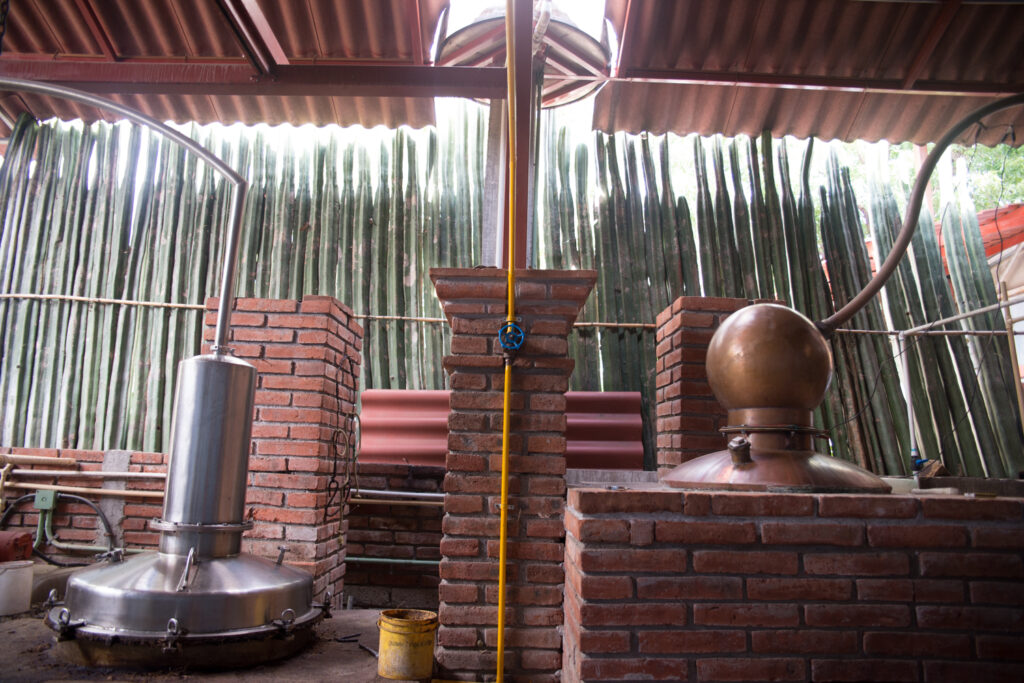
Ilegal was one of the first mezcal brands I came across in the UK, and it led me to visit Destileria Tlacolula in 2014. I was enthralled by the space, with its strange sculptural components, divided up by walls of red brick and organ cacti. The copper stills looked like repurposed diving helmets from the 1930s.
The bottling and tasting room are home to old black-and-white family pictures of Eric’s ancestors leaning against barrels (presumably filled with mezcal). It’s a reminder that, despite his innovative take on production, his roots stretch through five generations of uninterrupted mezcal production.
Eric’s great-grandfather began to produce mezcal in 1917, in what Eric describes as a “nomadic way.” He moved between small distilling sites around Tlacolula and Díaz Ordaz. In 1920 he settled down and built a distillery and mezcal shop. The location was a logistical masterstroke; the palenque was positioned upon the Camino Real, which at the time served as the primary route connecting the central valleys to the coastal Isthmus of Tehuantepec.
During the Mexican Revolution, the distillery’s strategic placement made it a supply point for both federal troops and revolutionaries. The business grew. In an era of high military tension, it could be said that mezcal served both a medicinal and psychological role, appeasing the fears and pressures of war.
Engineering a humane distillery
The current Destilería Tlacolula is defined by the collaboration between Eric and his brother-in-law, Octavio Morales. They are very close. Although Eric is the overall “maestro” in charge, it’s clear that both have similar motivations and passion in making (and changing) mezcal.
Before focusing on mezcal, Eric and Octavio had worked respectively as a civil engineer and a mechanical industrial engineer. Their backgrounds allowed them to bridge the gap between traditional heritage and scientific rigour. Applying industrial engineering principles, they redesigned the palenque to reduce physical strain and thermal shock for workers, prioritizing long-term health and worker welfare.
Octavio explains that they focus on ergonomics, creating systems that “adapt the workstation to the worker, instead of the worker adapting to the workstation.”
Eric has patented key designs to solve the historical limitations of artisanal production. These include a modified pit oven that reduces firewood consumption by two thirds, and an electric mechanical tahona that eliminates animal labor. By replacing draft animals, this system increases efficiency by over two hours per batch.
In most mezcal ovens, rocks have to be replaced regularly as they tend to break down in the heat of the fire. Eric’s pit features a permanent rock structure on which to pile the piñas; below the main pit there’s a chamber where he lights the fire.
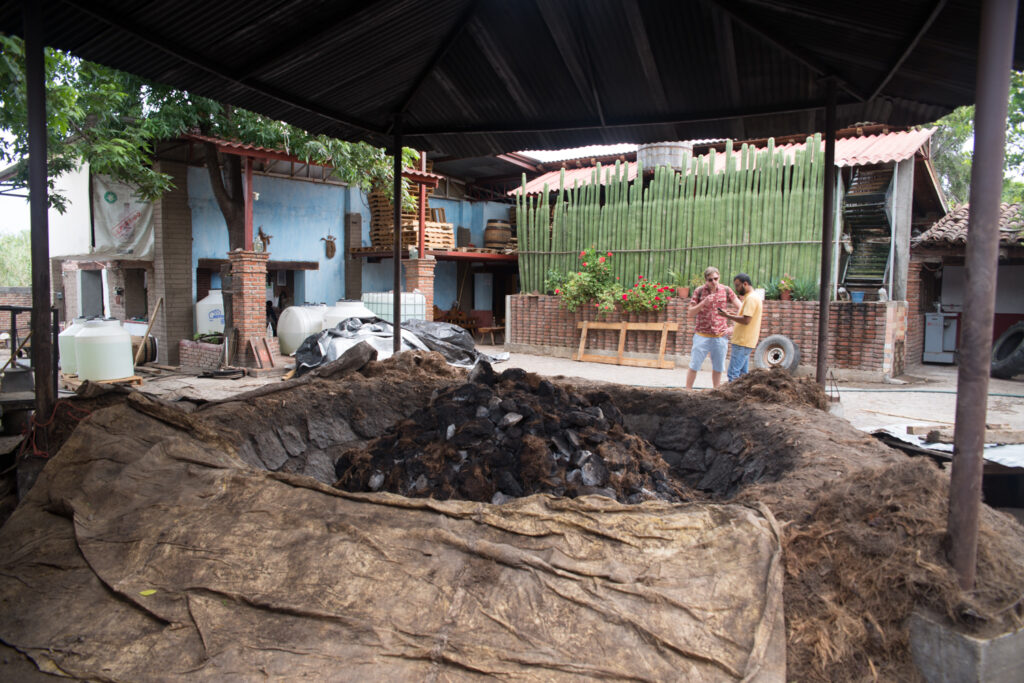
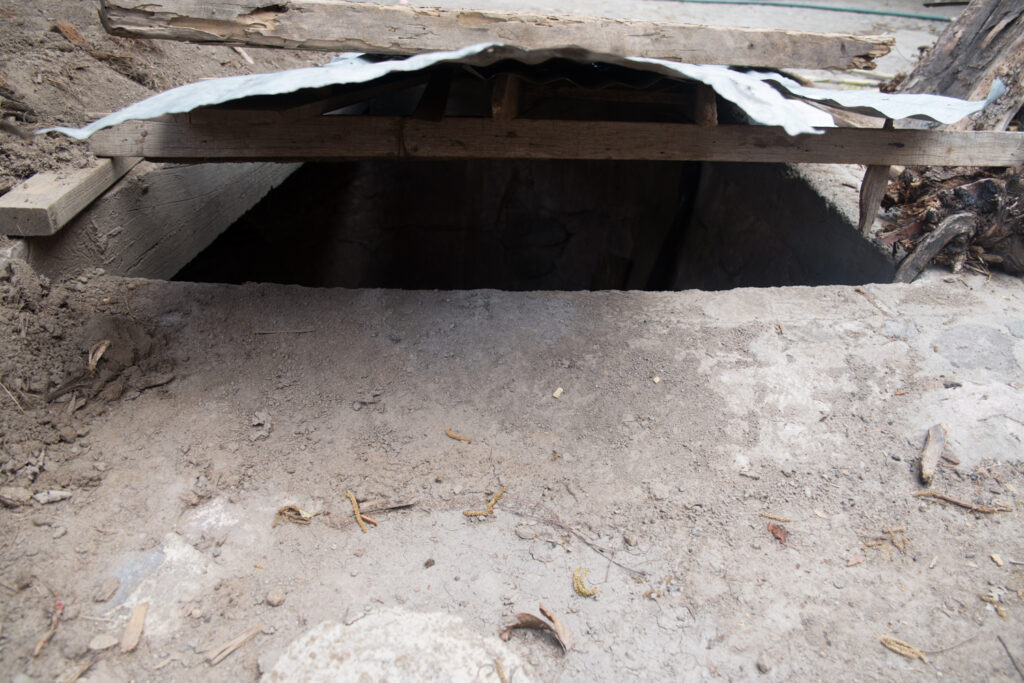
Wood is an expensive (or sometimes illegally acquired) element of production, and deforestation is an issue in Oaxaca. The clever oven design achieves two purposes: reducing wood use minimizes how much smoke is in contact with the agave. “We take great care because the smoke in a very strong state overshadows all the aromatic and taste profiles of the agave,” Eric says.
And returning to those steampunk-looking stills…Most mezcalistas readers are accustomed to the look of the traditional copper stills used in Oaxaca. In these stills, it is common for small pieces of metal to become loose in the distillation, eventually becoming visible as sediment in a bottle of mezcal. At Destileria Tlacolula, Eric has tweaked the design. Their unusual shape, which is a bit like the Portuguese still at Danzantes, features clamps on the vapor tube, bringing a small electrical charge to the vapors, and thus extracting any metallic debris that develop as the copper tubes are eroded over time.
Becoming NOM-001, the Ilegal era, and a pivot
When the Official Mexican Standard (NOM) was published in 1994, it marked a shift toward legal protection. Destilería Tlacolula was at the forefront of this movement, and Eric remembers how “The palenque was like the training center for the personnel” for COMERCAM (the Mexican Regulatory Council for Mezcal Quality).”
While waiting for the regulations to go into effect, Eric stayed busy. He began exporting mezcal out of Destileria Tlacolula in 2001, first establishing a presence in New York with Místico (later Mystique) and Los Amantes, which Eric co-founded in partnership with Oaxacan artist Guillermo Olguín. Their mezcal gained traction due to early enthusiasm from chefs and bartenders, who promoted the brands.
In 2003, when COMERCAM received its official accreditation to certify products, Destilería Tlacolula was among the first ten companies to be certified. The definitive milestone was reached in 2004, when Eric secured NOM-001X—the first official registration for a packaged Denomination of Origin (DO) mezcal.
The partnership with Ilegal was a significant chapter in Eric’s endeavors (and the reason I was so excited to meet him back in 2014). From roughly 2005 to 2018, he managed five different palenques to supply the required volume. In 2018, Ilegal moved to the Mal de Amor distillery in Matatlan and in 2023 it was bought by Bacardi.
Eric transitioned away from high-volume third-party production to focus on his exclusive estate spirits. In 2016, he opened a larger distillery to produce Los Amantes, scaling up his ergonomic designs.
At the time, I was working as a bartender at the Amantes mezcaleria (under Amayo). When they launched the new space they held a ProMex event for international bartenders, and I was asked to translate live for Eric as he explained what he had created. I was not prepared for the technical Spanish involved with that! (Now the place is called Rancho Cebu and is managed by Amando Alvarez of Ixcateco mezcal.)
Engineering safety and sustainability in mezcal production
These days Eric is focused on his own brands, Mistique and Maria. He and Octavio are continuing to pursue ways to make the work at the palenque safer and healthier for the workers while getting as close as possible to a fully sustainable product. They use traceable agave and were early adopters of recycling vinasas for biogas. To safeguard the future of agave diversity, the distillery has established a germplasm seed bank in collaboration with the University of Chapingo. These banks preserve the genetics of wild and cultivated agave, ensuring unique profiles and fructans are protected against industrial monocultures.
Eric says that they are a sustainable company in every sense of the word. “From our environmental practices—such as avoiding pesticides and agrochemicals—to our overall approach, it all comes together to create a product that sets us apart.”
This commitment to sustainable practice was recognized in August 2025 when Destileria Tlacolula became the first company to receive the “Distintivo Verde” (Green Distinction) label. The purpose of this certification is to establish a commitment to sustainability at every stage of the mezcal value chain. Eric is turning his attention toward ageing his product in both barrels and glass. This isn’t new for Eric–all of his brands are known to have reposado and añejo expressions. But now these expressions are taking the spotlight.
Getting deep into aged mezcal
Eric’s newest project is Cavaforte, a beautiful cave built five meters deep into the natural rock. The depth, combined with a four-point brick vault architecture, creates a microclimate that reduces the “angel’s share” (evaporation loss) from the 10% annually he recorded at his previous cellar, to just 3.5%. The vault also features portholes (vents) at the apex to facilitate hot air removal through natural convection. Eric uses new barrels made from French Oak (sourced from 175-year-old trees) and American Oak (75–150 years old) as well as Gran Reserva wine casks from Soria, Spain, which impart a nuanced finish without submerging the agave’s signature taste. The cave is organised with a French honeycomb stacking system (known as bows) that allows for the precise management of over 200 barrels.
Recently I went out to Tlacolula for a meeting with Eric, and Octavio was there to greet me. As we walked across the road to their bar, he told me that Eric would probably be an hour or so late. That seemed fine–it was a great opportunity to speak to Octavio, who is passionate and knowledgeable about all aspects of the mezcal process.
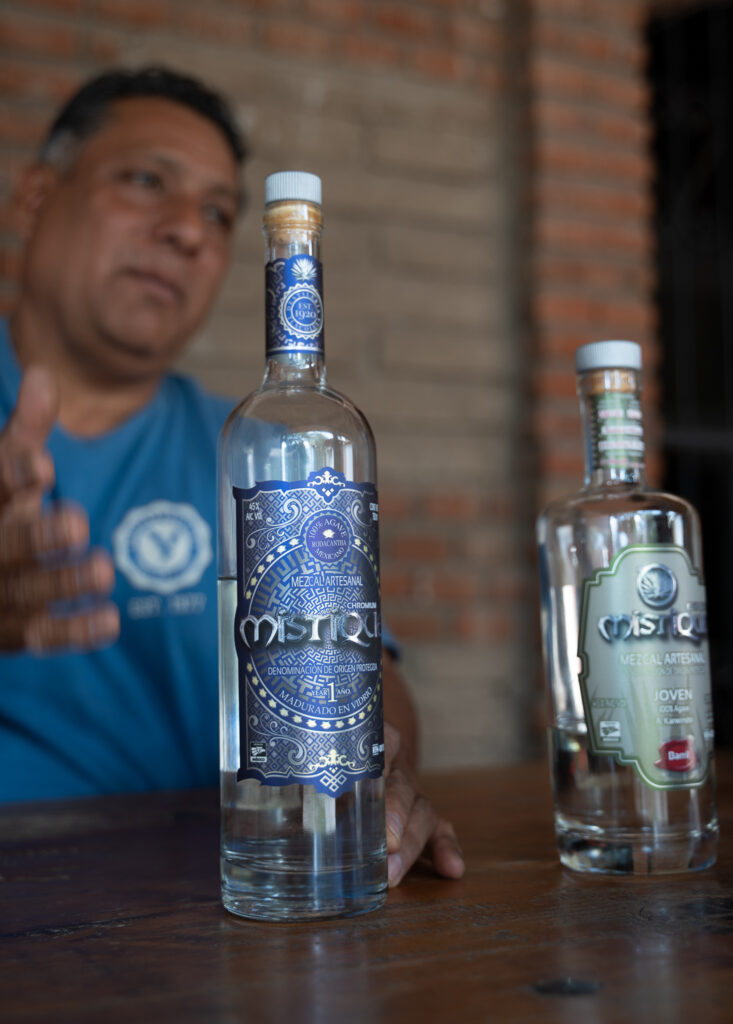
He started by pouring several copitas, taking me through a detailed tasting experience. It was thorough, from analyzing the vapors from varying distances, to looking at how the mezcal’s long legs clung to the side of the glass. After trying most of the range, going through wild varieties to pechugas and eventually a couple of reposados, the conversation shifted from tasting notes to what’s happening in the industry.
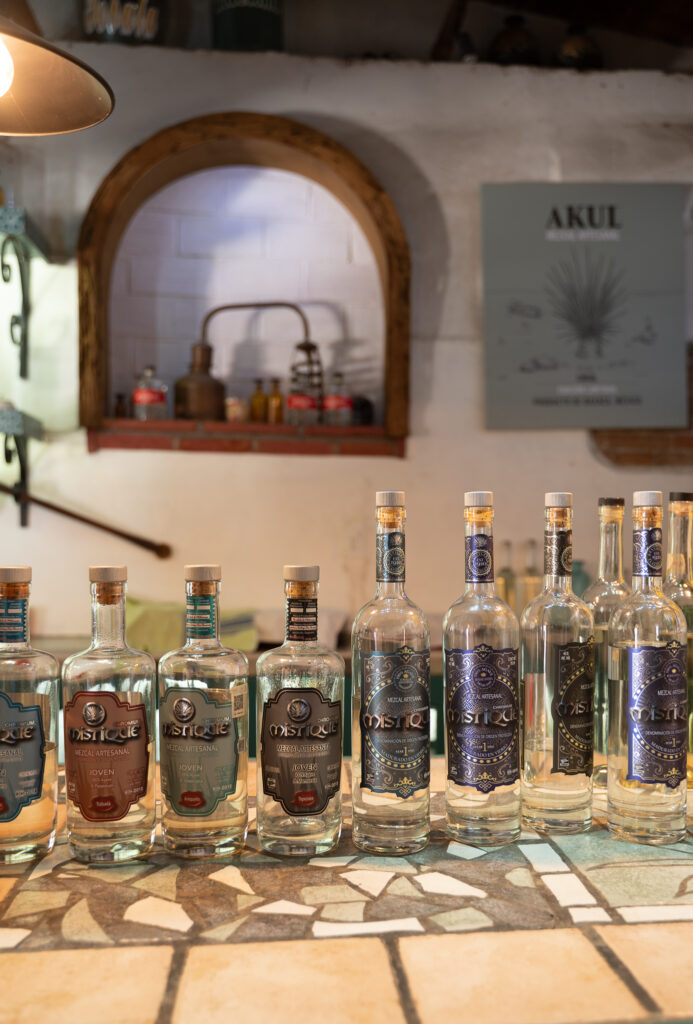
He was particularly incensed over the introduction of “cristalino,” which makes sense when you see the care and commitment he has for their aged product. He referred to the cristalino process of clarifying the aged agave spirit as “like a person who spent his whole life studying, who finishes a master’s degree, a doctorate, only to return to teach in an illogical kindergarten. It’s stupid. I already see it as a justification for the poor quality they have.”
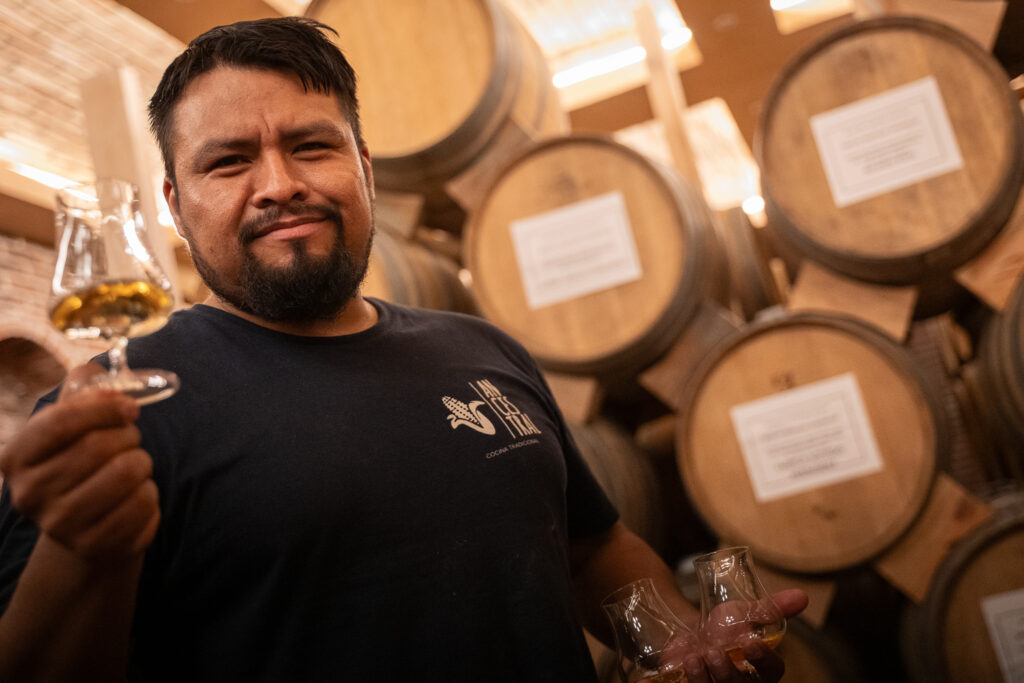
Just as I had all but given up on seeing Eric, he showed up with Xavier Amayo, one of Oaxaca’s great bartenders. They had been on a trip out of town together and returned a little raucous but ready to get involved with the mezcal tasting.
We moved from the bar down into the belly of Cavaforte. Sipping aged mezcal in the cave (illuminated by a 19th century English chandelier) was such a glamorous way to spend a tipsy afternoon.
Eric says that this experience will soon be available to visiting groups. As well as being able to try (and buy) mezcal, visitors will have the option of buying a batch of mezcal that Eric will age for them in the cave. “You will have the opportunity to get your own aged or reposado mezcal, sheltered in our barrels,” he explains.
During our afternoon together, both Eric and Octavio talked extensively about how ageing in wood has a deeper history than typically acknowledged in the mezcal world. Eric explains that producers like his grandfather used to transport mezcal in wooden barrels on month-long journeys to the Isthmus of Tehuantepec.
From the nomadic distillers of 1917, to NOM-001 and recognition for green practices, Eric and the family behind Destleria Tlacolula have bridged 19th-century roots, 21st-century innovation, and goals for a sustainable future in mezcal. As they expand the Cavaforte project, Eric’s legacy stands as a benchmark for the industry, proving that true craftsmanship is always underpinned by reason.






Leave a Comment