
Looking to listen to son huasteco and drink mezcal in Mexico City? Contributor Holly Devon has the low-down on a oasis of traditional music and mezcal.
Visitors to Mexico City looking for the perfect night out can hardly do better than Guie’Huini. Located in the heart of the city, just steps away from metro station Guerrero, the bar offers hand-picked mezcals straight from the producers, performers from Mexico’s most vibrant regional traditions, and a thoughtful menu of Oaxacan fare designed to keep you energized on the dance floor. And certainly, owners Mara López and Alexis Jiménez are delighted to welcome all comers—they have the kind of bone-deep hospitality that separates a competent bar owner from those for whom it is a true vocation.
But while they may have created an ideal destination for curious travelers, the better you know the city the more you can appreciate what the bar has been able to achieve. While every corner of the country is represented in Mexico City’s diverse population, different regional groups often keep to themselves. Guie’Huini, whose name comes from a Zapotec word for blossom, is a reflection of its owners’ regional pride. From there they have expanded outward, encouraging others to bring in their own cultural traditions, creating a distinctive mosaic of Mexico’s many colors. As Jiménez puts it, “Places like this aren’t just about going to listen to music or drink. They create a broader social dynamic where community ties develop.”
An oasis of Oaxacan cuisine in CDMX
Though López and Jiménez are both from Oaxaca, they met in Mexico City, where they came to study. López attended Universidad del Claustro de Sor Juana’s highly regarded culinary arts program, and when they decided they were ready to start their own brick-and-mortar business, she applied her kitchen bona fides to the Oaxacan fare they had both grown up with. The result was Comixcal, which they opened in the Santa Maria de Ribera neighborhood in 2016. There, aficionados of Oaxacan cuisine looking for some deep cuts can find satisfaction in garnachas, enchiladas de coloradito, and estofada de lengua, or beef tongue stew. A focus on fresh ingredients sourced directly from producers indicates a farm-to-table ethic that understands healthy food systems as a basic right. López and Jiménez work hard to keep the quality to price ratio within an accessible range, and the menu is always shifting around available ingredients. Such carefully considered choices have earned them a loyal following.
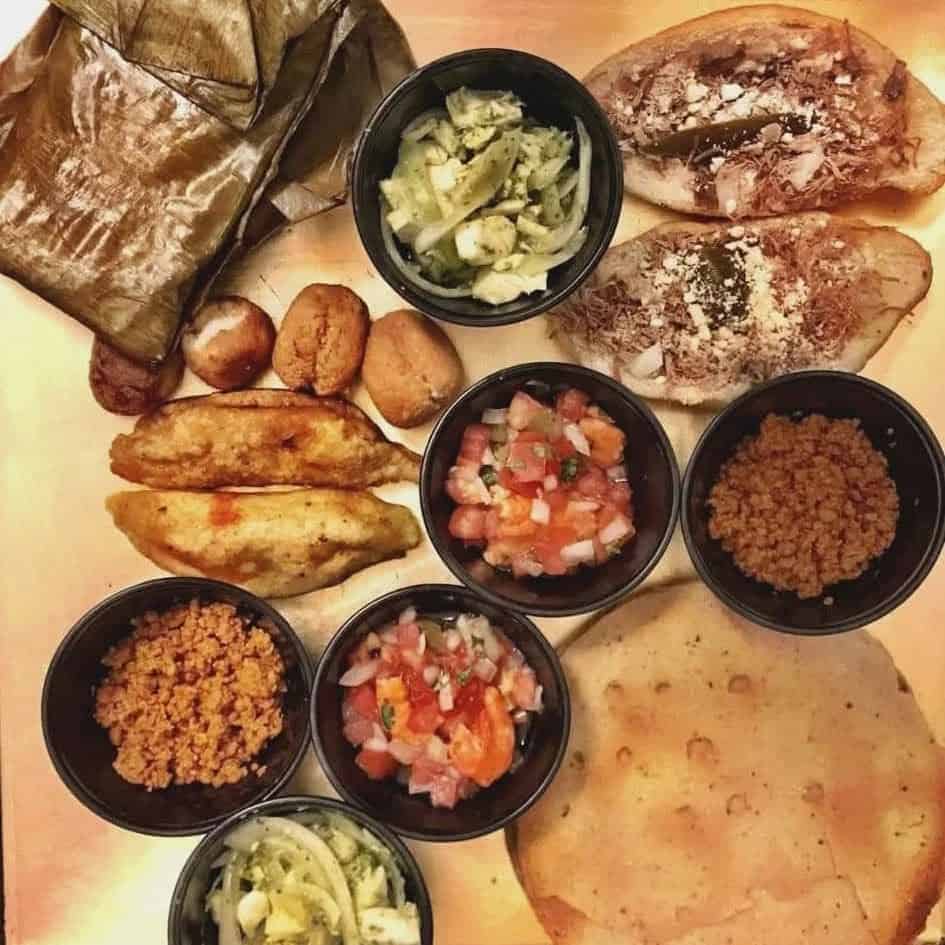
But as far as community spaces go, restaurants come with certain limitations. “In a restaurant, meals follow certain rhythms,” López says, explaining that creative impulses are strictly governed by the simplest logistics. “People need to sit down with cutlery.” If you’re properly observing the rites of the meal, there’s little room for anything else. As Jiménez puts it, “At the end of the day, as Oaxacans, we always want to celebrate, but the conditions at that space didn’t allow us to have music.” And so they decided to expand.
To find the right spot for Guie’Huini, they hit up all their networks, haunted online rental sites, and pounded the pavement. Eventually they found a place that was both centrally located and had room enough for big communal tables, a dance floor, and a small stage—a cultural hub waiting to happen. Originally, they had planned to continue to center Oaxaca. “When I thought about creating this new space,” says Jiménez, “the idea was to open a traditional Oaxacan cenaduría—a casual place serving evening meals—with Oaxacan music. Our plan from the beginning was to have music, but it was going to be very specifically Oaxacan.”
This was easier said than done. Though the region’s music, like its cuisine, is extremely diverse, its most recognizable forms can require as many as fifteen musicians onstage at a time. “Finding a venue large enough for everyone is complicated,” Jiménez admits, adding that certain instruments common in Oaxacan music are harder to find in Mexico City. But rather than perceive such obstacles as diminishing the original vision, they saw an opportunity to widen it. “We realized these difficulties weren’t unique to Oaxacan music; they affected traditional music from Mexico more generally,” says Jiménez. “That’s why we began opening the space.”
While establishing themselves as a music venue, they cast a wide net, inviting musicians of all genres to their stage. As they built their network of performers, they could see that the opportunity they were providing was somewhat rare. As Jiménez explains, “In Mexico—and not just Mexico City—not enough venues were built with live music in mind. Finding a space is difficult, and many venues end up on the outskirts, in the State of Mexico or far from the city center. Those that do find suitable spaces often face high production costs, which makes it difficult for traditional music to be presented there.” To highlight the struggle music venues face, he cites the example of Multiforo Cultural Alicia, a legendary countercultural venue that had thrived for decades in the Colonia Roma, until it shut down in 2023, in part due to the acceleration of gentrification in the neighborhood. After it opened again in Santa Maria de la Ribera, the club was raided by federal troops under the pretext of permitting issues, though many felt the club’s leftist values made it a target.
Jiménez is an analytical thinker, and likes to consider the wider context when discussing the particularities of his business. He studied anthropology at the Escuela Nacional de Antropología e Historia, and he is dextrous in picking apart the hydra of Mexican politics. His t-shirt, like his Instagram profile, professes unabashed anarchist sympathies, and he has clearly worked to inject that ethos into his commercial enterprise. Both he and López know that countercultural spaces are vital for the project of urban solidarity, and they take pride in doing their part. While describing the range of music on offer at Guie’Hini, he makes a point of highlighting a Chilean political trap singer who performs in her indigenous language. López and Jiménez had heard about her fight for her Mapuche community’s water rights, and they were eager to offer her a platform.
A live venue for son huasteco and son jarocho in CDMX
But more often, the musicians they host are radical in the etymological sense—as a hub for traditional regional music such as son huasteco and son jarocho, they play a crucial role for performers who remain faithful to their roots. The Oaxacan couple have friends from La Huasteca, a region in Mexico that includes parts of Veracruz, Tamaulipas, Hidalgo, and San Luis Potosí. The region’s traditional music is typically played by a trio—perfect for an intimate venue like Guie’Huini—and in Mexico City, son huasteco has many committed fans for whom Guie’Hini has become a thriving center of their music scene.
They aren’t alone. The bar is known for hosting a variety of traditional Mexican genres, which can be hard to find outside the regions where they originated. “Today, the traditional styles most often featured are son jarocho, Huasteco music, Oaxacan wind bands, chilenas from the Costa Chica—both Guerrero and Oaxaca, and the sones of Tixtla,” says Jiménez. Many of these musical styles were created during the colonial era, drawing inspiration from the Spanish poetic forms that Mexicans all over the country quickly made their own. The earliest reference to a Mexican son comes from a 1776 ban by the Spanish Inquisition, an indicator of where within the power structure these forms developed. Son jarocho is a musical style which was also developed in Veracruz, but features different instruments and has roots that are said to stretch back to 18th century Afro-Mexican communities.
It can be a real struggle for these regional musicians to find venues in the capital. “I think racism is part of it,” Jiménez says. Spaces associated with what people call ‘high culture’ aren’t challenged in the same way. Popular music, by contrast, is seen as rowdy, noisy, or something for drunks.” He says the bigotry in the conflict between high and low culture in Mexico is notorious, though as someone who is constantly interacting with the individuals being stereotyped, the discrepancies between these tropes and his lived experience are obvious. “These places aren’t just about going to listen to music or drink. People come to dance, there are workshops for children…Of course, people drink, too; alcoholic beverages are closely linked to many cultural practices in Mexico—mezcal, sotol, pox, comiteco, pulque, and many others.”
The right way to drink mezcal
When he says this, my eyes light up. I tell him he’s preaching to the choir, and that as a representative of Mezcalistas I have no choice but to interrupt his searing social analysis to talk mezcal. How, I wonder, did they cultivate such a stellar selection at their bar? If I had worried about interrupting the politics to nerd out about mezcal, I needn’t have—as it turns out it’s all connected.
“In 2006, there was a very strong popular movement in Oaxaca: the Popular Assembly of the Peoples of Oaxaca, in which I took part,” he explains. “During that period, I also decided to study in Mexico City. My parents were teachers and stopped receiving their salaries for much of the conflict, which lasted around eight months. When I moved to the city, my father told me he didn’t have money to support me, but he would give me mezcal whenever I went back to Oaxaca. He’d give me a couple of liters and tell me I could sell it, give it away, drink it, or do whatever I wanted with it.” During his time at university, he developed a reputation for always bringing the good stuff to the party—he never had a shortage of invitations. Each time he went home he returned laden with small batch mezcales, and eventually, his friends convinced him to make a business out of it.
And so in 2010, he ditched the plastic containers he’d been using to haul mezcal from Oaxaca and broadened his customer base beyond the contacts in his phone. Thus began Bicu’xolo, a mezcal brand that upgraded the presentation of a supply that already had plenty of demand.
“My parents are rural schoolteachers, and through their work they have close ties to communities and mezcal producers,” says Jiménez. “That helped us source and bottle our products.” Having a line on some of the finest small batches in the region meant that word spread fast. Eventually, their customers started asking for a way to sample many of their mezcales rather than committing to a bottle. “Buying a 750-milliliter bottle is a bigger expense if what you really want is to try five different mezcals,” says Jimenez. “Being able to taste them by the glass was one of the reasons we opened the mezcal bar.”
If there is a governing ethic to mezcal consumption at Guie’Huini, it’s to forgo any and all snobbery—according to Jimenez and Lopez there’s no wrong way to drink it. “Sometimes certain customs are presented as universal truths. For example, people say mezcal should be drunk a besitos, or with tiny sips. Not necessarily. Everyone can drink it however they like.” He says that in his experience, drinking mezcal is inherently a collective experience. Where he’s from, the spirit is often passed around from person to person in the same vessel, though he remembers at least one occasion where he was expected to drain the whole thing.
“The first time I drank mezcal, I was about sixteen,” he recalls. “I was in a community and they gave me a vessel that was hardly a little shot glass; it was huge, perhaps three ounces. The mezcal producer’s son asked my father if I was old enough to drink mezcal. My father told him to ask me. Then the young man touched the area around my liver and said I was mature enough. They gave me the mezcal and told me to drink it all.”
Such memories are embedded in the celebratory atmosphere at Guie’Huini. López and Jiménez have faithfully tended their ties to Oaxaca; planting themselves firmly in their adopted city was never a renunciation of home. As the name of their bar suggests, they have no interest in making compromises to be understood in the capital—the Zapotec word is puro Oaxaqueńo, to the point where it causes a bit of friction with customers. But rather than shake their conviction, the confusion around the name has reinforced their sense that they’re filling a gap. “Sometimes people don’t know how to pronounce it because it’s written in a language other than Spanish, they make all sorts of associations,” says Jiménez, who tells me customers often refer to Guie’Huini as “Winnie the Pooh.”
He says it used to bother Mara, who comes from a Zapotec-speaking community, though now they take it in good humor. Still, he thinks it’s odd that residents frequently encounter words in Nahuatl, the Aztec language, around the city, but seem reluctant to extend that grace to other indigenous languages. “The idea isn’t to “rescue” a language as though it had disappeared, but to help it remain present and in use. Zapotec is still spoken in Mara’s family, and we want to support that continuity,” says Jiménez.
It’s a rarity when individuals resist the urge to allow their regional pride narrow into chauvinism, and instead show the same curiosity towards the traditions of others as they hope to receive. It’s what makes a night out at Guie’Huini so special. Even with their unflagging enthusiasm for Oaxacan mezcals, they have made room on the shelf for other mezcaleros. “We came to understand that mezcal doesn’t belong to Oaxaca alone,” says López. They now serve mezcal from Guerrero, Durango, Puebla, and Michoacán.
In a metropolis as vast as Mexico City, it can be tempting to retreat inward, to seek comfort in the familiar. But even as López and Jiménez hold their traditions close, they continue to open the circle. As for their patrons, no matter where they’re from, if they want to pass Guie’Huini’s crash course in Mexican culture, all they have to do is eat, drink, and dance.





















Leave a Comment