In our ongoing talking with hospitality luminaries, Macey Wolfer chats with Ryan Fitzgerald about hiring from within, bar education programs, and cocktail menu red flags.
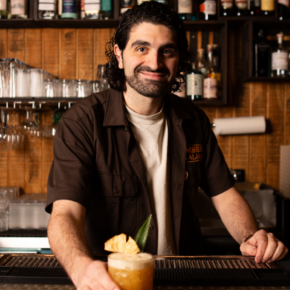
Ryan Fitzgerald has had a front row seat to the evolving San Francisco bar scene for decades. He first made drinks working at a Senegalese bar in the ‘90s, where he’d mix spirits with ginger or hibiscus juice and chat with his friends in the Mission District. Fast forward to 2014 when Fitzgerald partnered with Todd Smith and Erik Reichborn-Kjennerud to open ABV in the same neighborhood–to much acclaim. Today, it stands as a staple in the San Francisco bar scene.
In 2022 the inaugural 50 Best Bar Awards ranked ABV at #39 across all of North America, marking the only San Francisco bar on the list. The following year, Liquor.com named ABV the best neighborhood bar of the year, describing its leadership as looking like a Venn diagram of hospitality. The bar’s many accolades are no surprise given that all three owners are hospitality veterans. The balance of an unpretentious environment paired with top-quality drinks makes it approachable for casual visitors and up to snuff for discerning connoisseurs.
Fitzgerald’s approach to hospitality is rooted in intentionality and integrity. The owners keep the backbar stocked only with spirits the team can personally attest to. Staff of all experience levels get a hands-on look at the process of assessing for quality and developing new drinks, too.
To get a better look at Fitzgerald’s work in San Francisco’s dense cocktail scene, we asked him some questions. Here’s where our conversation went:
What was the first drink you ever mastered?
I worked at Foreign Cinema in the Mission District, and it was mojito heaven. It was just the time of the mojito. In 1999, 2000, you just couldn’t sell more mojitos. I haven’t sold as many mojitos since then as we did in one month.
Do you have a favorite place to drink?
I love drinking at Loló. But as a 51-year-old man with a 19-month-old son, I don’t get out to drink as much as I did in my heyday. I used to love drinking at Nopa back in the day, too. And I love going to Stoa now, that’s probably one of my favorite bars to drink at, considering it’s Yanni who used to run the bar program at Nopa. So, mostly just following friends and people who make the drinks I like.
What’s your secret to creating a good cocktail menu?
I don’t know if it’s a secret–it seems logical after years of doing it–but balance. Balance of ingredients and having something for everyone. When we started at ABV, we decided that in order to make something that appeals to everyone, we’ll have a stirred and a shaken rum drink, a stirred and a shaken bourbon drink, a stirred and a shaken scotch drink, a stirred and a shaken brandy drink, and so on.
That was the goal at the beginning of ABV, to sort of provide something for everyone and at least two of each option.
What’s your process for developing a new cocktail recipe?
I usually take a lot of inspiration from a new ingredient. Someone drops off a sample of something that is new and interesting, whether it’s a liqueur or an amaro or an actual spirit. Often, we’ll taste it and get the ideas flowing. We’ll just pour a tiny bit of it into a glass. Then whatever idea hits first, we’ll pour a tiny bit of that in there and taste those two together to see if it’s going in the right direction. Then we keep adding another thing and playing with it until the cocktail starts to take shape.
Sometimes I’ll taste something new and decide the new ingredient is better than the old one, so I update the original drink and see how it tastes. Other times, it’s an ingredient we’ve never even had before and it just screams to be paired with mezcal. I can taste it already.
With all of this cocktail talk, we have to ask about your Instagram handle, “ihatecocktails.” What’s the story?
I was a cocktail apprentice at Tales of the Cocktail in 2008. I think there were 18 of us making all the drinks for all the seminars and some parties. We were promised accommodations and free access to any seminar we wanted on our days off, but instead we shared rooms and worked from 8 a.m. to 8 p.m. everyday. It totally sucked in the best way.
It was hell because we went out and drank all night every night. Then we had to wake up super early to make more boozy drinks. I think it was the third morning when I nearly vomited as I walked into the kitchen at 8 a.m. and was hit with the overwhelming smell of brandy and citrus. I truly hated cocktails at that moment and felt it would be funny to write “I HATE COCKTAILS” with a sharpie on my t-shirt to proclaim that to every person at the cocktail convention.
What are some red flags you notice when looking at other menus?
We know enough about the business to know that if the whole menu is all Diageo products, it’s probably all bought and paid for. It doesn’t speak to integrity. We as bartenders need to make it so guests can trust us. When I’m the guest, I don’t trust a bartender or a bar that has a menu that’s fully made of all products from one portfolio or another.
That said, we don’t use product names on our menu because we don’t really play that game. We love small producers. Sometimes we’ll use their names if it’s helpful to describe what is in there. It’s a hard business for everyone now, even the big guys.
I’ve been in the business of selling booze for over 25 years. When I was first learning, I remember hearing that as the bartender, you’re the last line of quality. What you serve the guest really matters. What you choose to put on your menu really matters. You’re kind of voting with your dollars at that point. Once guests really trust you, they’ll understand that the bottles you stock are ones you approve of and appreciate.
Have there been any notable industry evolutions since you started?
When I was learning to bartend in the 2000s, I don’t think many of us thought it could really be a career. Maybe owning a restaurant at some point or a bar, I guess. But the cocktail was coming back, and it started to become evident to a select few people that this was going to be an opportunity. I think a lot of people got really hungry for bartending and it just caught on.
You went to Tales of the Cocktail in 2008 and there were so many attendees and you go now and it’s like, 10 times that. It’s great for the industry to some extent, but I think it’s also kind of daunting for new bartenders. When I was young, it was like okay, there’s only five people in the city who are actually doing this. That means we all know each other, we’re all learning together, we’re all going to have opportunities here…My generation of bartenders always complained that everyone would ask us, “What are you going to do for a real job?” And we’d say this is actually going to work for us. It’s a great career.
Now we’re seeing a situation where it’s so saturated and the younger generation is kind of like, nah, I don’t think this is the career for me.
Fewer people that are really dedicated to this as a full-time career. I think that’s a big change, and it makes sense. When the pool’s full of people you don’t want to get in as badly as when there’s only six people .
How do you mentally prepare for a shift?
It’s interesting, after doing this for so many years, there are some days where I’m just jazzed to talk to people, hang out, and have that social interaction. I feel like I’m ready to shake hands all night and see people. Then there are other nights where I’m starting a shift and not in that headspace. But it doesn’t matter, that’s part of the job. You kind of have to steel yourself a minute and get in the zone because it’s important.
I took the full summer off, and my family and I went to upstate New York. I didn’t have that social outlet for three months, and I really, really missed it. I get to hang out at my bar and see people I haven’t seen in a while, chat for a bit, run around, take care of guests and meet new people.
What do you look for when hiring new staff?
We like a sort of blank canvas person who is nice, confident, can take a joke, and comes in ready to work hard. We want to hire people who don’t bat an eyelash when we tell them they’re going to work eight hours and get out of here at three in the morning sometimes. People who are hungry for that and also seem like someone we’d like to hang out with. We can always teach people to make drinks, the steps of service, nuances of taking orders, and things like that.
Generally, we just look for nice people who are willing to work hard. But we haven’t hired a bartender in a long time because we’re promoting so many of these nice kids who were barbacks and put in the time and hard work. We’re really lucky to be able to do that.
How do you retain your staff?
We thought a lot about that when we opened. As three owners who were bartenders before, we know what it’s like to work for a shitty owner. And we know what it’s like to work for a great owner.
Early on, we asked what we’d do to keep people at ABV. One of the things we landed on was prioritizing education. Since we’ve been open, we’ve had a once-weekly, one-hour voluntary lab. Todd and Erik, the other two owners, and I look forward to it every week. It’s a great hour. It’s going to happen later today and I can’t wait. Today’s staff will be there and some of the staff who aren’t working today will come in, too. They get free food and an education. We’ll taste three new spirits people have dropped off. We’ll taste them blind and see if they like them. We’ll taste a new liqueur. We’ll probably start R&Ding some cocktails with those things and pass them around.
Some barback with two weeks of experience will be sitting right next to a bartender with six years of experience, another with eight, and three owners who have a combined over 60 years of experience.
We’ll workshop a cocktail and a person with little experience will taste it and recognize something’s off, but not necessarily know what it is. Then everyone else will talk about what we could change or add, and hopefully that turns a light bulb on so they can understand what it takes to make a menu-worthy cocktail.
We also bring in people to speak about their brands. We’ve promised our staff from day one that we’re not going to bring in any random brand ambassador. We’re only going to bring in people that we know are very good at what they do, can teach well, and are representing a spirit we think has integrity. There’s nothing worse than being asked to go to a spirits seminar about a bad product represented by someone who doesn’t know shit.
Thoughts on the tequila adulteration scandal?
It’s not surprising to me that all these tequilas are adulterated. I guess what’s surprising is that it’s taken this long.
I don’t know what the battle is, essentially. I don’t stock any of those brands, never did, because they never tasted good. I don’t need to know that there’s bullshit in them. I’m not a part of that class action because I never bought that stuff. But it’s good to know.
People come to ABV saying they need to know what products are great and which products they should carry. I’m just like, look behind me. There are very few products that aren’t on our back bar that we would say you should go get, and in those cases it’s mostly because we don’t have room for more.
I hope this lawsuit does make some change, but I’m jaded. I was excited that 100% agave was going to be this thing. Like, now we have a benchmark for judging tequila. Then nope, that changed because now we’ve got diffusers. That took the wind out of those sails.
Every time we get a new word to determine product quality, it just ends up being marketing. The tequila companies will grab that word. I’m jaded enough to know you just have to taste the tequila, hopefully visit the place, and talk to the people. Then use your best judgment because you’re never going to know 100%.
What would you fix in the industry if you could?
It’s tough. Initially I’d say crush the three-chain system in the United States. But I know that’s kind of an asinine statement. It’s capitalism. The big producers would have all the power, whereas now the distributors have all the power. I’d fix that in a way that would be egalitarian.
Real regulation, too, especially Mexican spirits. It’s tough to add more regulations because you need to have people to enforce it. And those people need to get paid. Then the producers need to pay to get regulated. A lot of producers don’t have the money for that.
Favorite food growing up?
Mexican. Tacos and burritos.
First concert you ever went to?
I think I was six or seven and my parents took me to see Men At Work at the Checkerdome in St. Louis. I only lived there for like three years of my young life but I was obsessed with the TV show Solid Gold. Men At Work’s “Down Under” was the top song for weeks in a row, and I was obsessed. Luckily my parents were keen to buy tickets and take me there. It was definitely a life-changing event.
What part of your personality do you think is most reflected in the work that you
do?
I like to have a good time. I’m the last person to leave a party and the last person to go home.
I really enjoy being out and talking to people. I think that’s something you need to have if you’re going to own a bar.
Also, integrity. That’s been an important piece of my personality. I think a light bulb went off when I discovered the opportunity to express that through the spirits we carry and pour for people.


Leave a Comment