
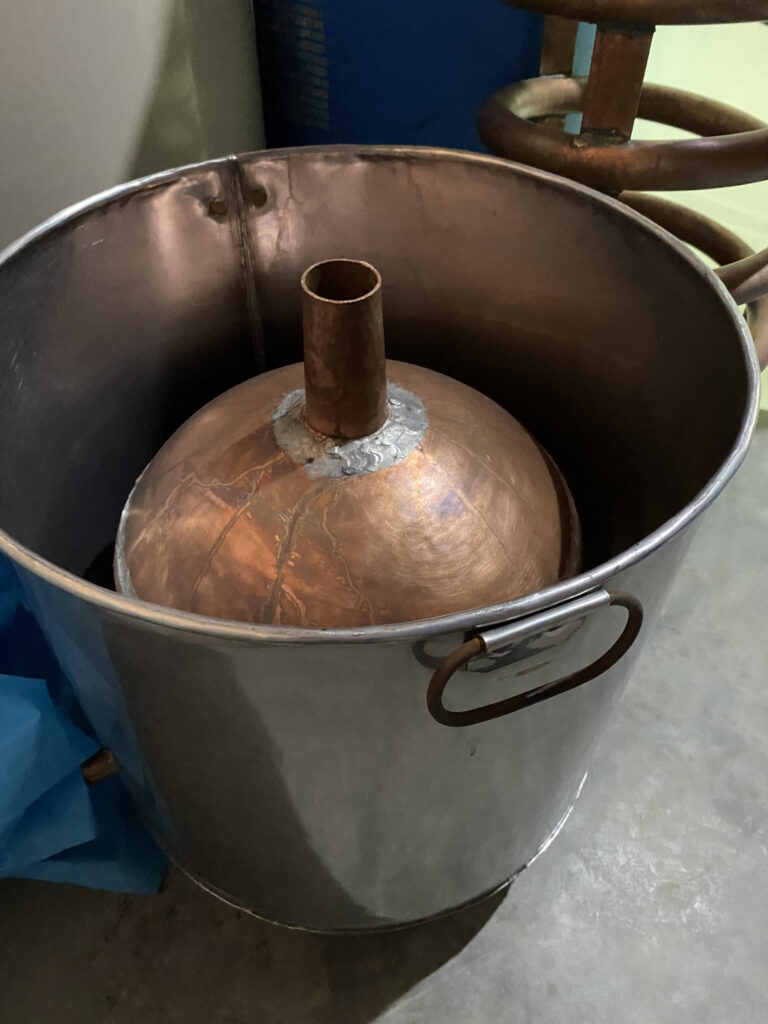
The most common copper still used in Oaxaca consists of a pot, over which a second piece shaped like a dome, called the montera, is placed. This is connected to a pipe arm known as the “turbante,” which leads to a coiled condenser submerged in water. This water bath creates a thermal shock that condenses the vapors traveling through the system.
What is a refrescadera?
A refrescadera is a modified version of a metal pot, traditionally used to steam tamales, placed over and around the montera of copper stills. This pot includes two lateral pipes: an inlet and an outlet, which allow for the continuous circulation of fresh water. During distillation, the mezcalero runs water through the refrescadera, creating external cooling along the surface of the dome. This allows the internal volume of the montera to remain at a lower temperature.
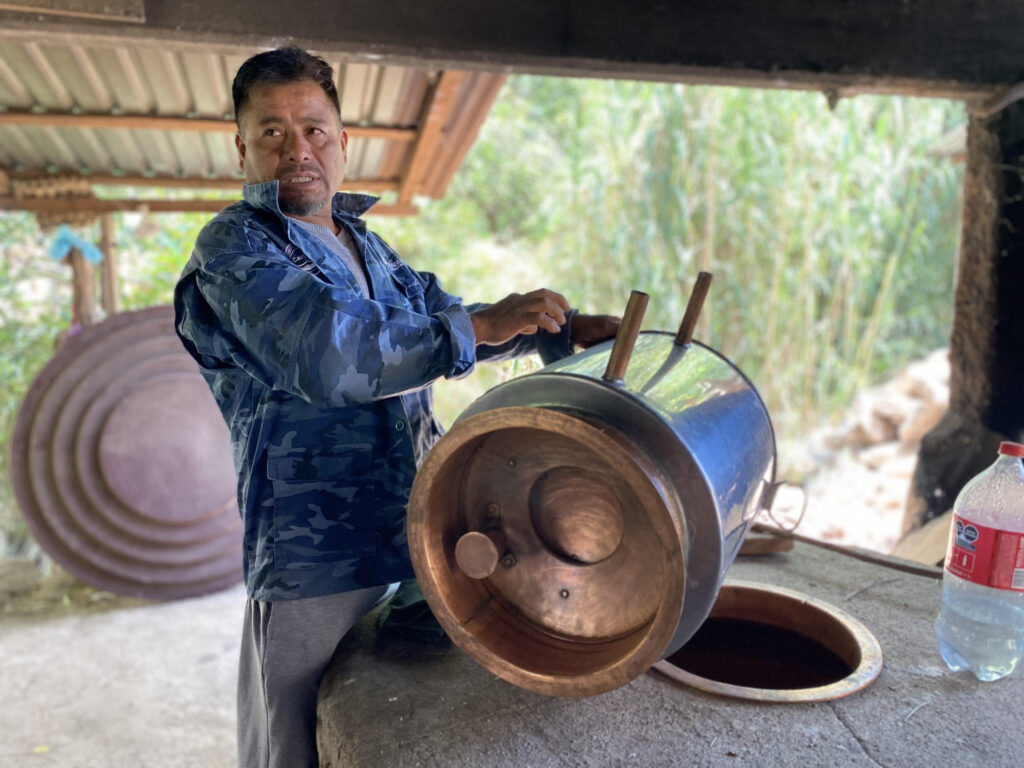
According to the testimony of Maestro mezcalero Sergio Juárez Patricio, the refrescadera was invented in the 1940s in San Agustín Amatengo, Oaxaca, by his godfather, Heliodoro Reyes. Although his primary occupation was farming, he also worked as a carpenter and a still maker.
In the regions of Ejutla and Miahuatlán, refrescaderas are commonly used. Their design varies between distilleries: some include internal plates within the montera, while others consist of smooth copper surfaces without plates. These structural differences indicate that the functionality of the system can vary from one distillery to another.
The refrescadera is a structural component of the still that influences vapor dynamics during distillation. Its function is best understood within the broader context of batch distillation. With each distillation, congeners are lost. In distillation science, congeners refer to all compounds other than ethanol, including esters, terpenes, higher alcohols, aldehydes, and acids, which contribute to aroma, texture, and flavor.
During fermentation, ethanol forms hydrogen bonds with water. These interactions are energetically stable and are not fully separated in a single distillation. As a result, the first distillation produces what is known as ordinario, a distillate with relatively low alcohol content and a high concentration of dissolved congeners. A second distillation promotes the separation of these ethanol–water associations and increases alcohol concentration.
In this process, compounds responsible for sensory complexity also undergo transformations. Esters, associated with fruity aromas, and terpenes, associated with citrus, herbal, and floral characteristics, may initially be present in less perceptible forms. During the second distillation, thermal processes and phase equilibrium contribute to their redistribution, making them more perceptible as defined aromas and flavors.
If distillation continues through additional stages, such as repeated rectification, there is a progressive reduction of these congeners, resulting in distillates with lower aromatic complexity.
Within this context, the refrescadera introduces a modification to the system. It creates a cooler zone at the top of the still, which promotes partial condensation of ascending vapors along the inner walls of the montera and, when present, on internal plates. These condensed vapors may then re-evaporate as they interact with hotter vapors rising from below.
This cycle of condensation and re-evaporation occurs within a single distillation run. The process functions as a form of internal rectification, altering vapor composition without requiring additional external distillation steps.
As a result, mezcals produced with a refrescadera can reach relatively high alcohol concentrations and display greater structural definition, while retaining a meaningful proportion of aromatic and flavor compounds.
The use of a refrescadera does not imply a fixed number of distillations. Some producers perform two distillations, while others achieve the desired profile in a single run. The refrescadera operates as a structural element that influences vapor behavior, condensation dynamics, and ultimately the sensory profile of the mezcal.







Leave a Comment