
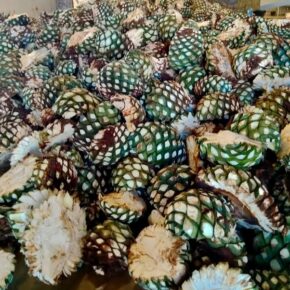
The types of agave used for tequila and mezcal typically take at least six years to reach maturity and some varieties take much longer. This long growth cycle puts stress on both farmers and distillers. Constantly trying to plan at least six years in advance is a huge challenge, as is calculating how much a kilo of agave will be worth at any given time. Dramatic price fluctuations have historically been caused by everything from weather to war; rising and falling demand for tequila and mezcal is another factor. But essentially the boom-and-bust cycle is inherently self-perpetuating: agave shortages cause gluts and vice-versa.
“A good price at the time of harvest stimulates the expansion of plantings and the demand for plantings and the demand for farmworkers,” Ana G. Valenzuela-Zapata and Gary Paul Nabhan note in Tequila! A Natural and Cultural History.
Price spikes inspire more farmers to get in on the action–often taking out loans to be able to afford to plant. Five or six years later, the first crops come to market and agave prices swiftly drop due to the increase in supply.*
If prices drop low enough, farmers may leave their agave to mature, die, and rot in the fields. As agave spirits scholar Clayton Szczech writes, “Rotting agave is an ideal habitat for picudo weevils and other natural predators. No one is monitoring the abandoned agave, so the bugs have a field day: eating and reproducing in the dying agave, and eventually migrating into neighboring fields en masse to devour healthy plants. Eventually, supply gets so low that the price rebounds, climbing high enough that farmers can’t resist planting, and the whole cycle repeats.”
Zapata and Nabhan argue that the economic fluctuations have an adverse impact on the environment–leading to an intensification of the most irresponsible aspects of monoculture, reducing genetic diversity, and thus leaving agave crops more vulnerable to fungal and bacterial infestations.
Is there a boom and bust cycle in the mezcal industry?
Tequila’s problem has spread. The mezcal boom caused an increase in monoculture that leaves espadín fields more susceptible to disease and infestation. Over-planting has also contributed to a drop in agave prices. By 2025, the price of espadín had dropped to around one peso a kilo–which echoes the fall in the price of blue agave.
To put this in context, blue agave was worth 32 pesos a kilo in 2018, when the peso was stronger than it is now.**
Is the boom and bust cycle inevitable?
The impact of the price fluctuations on farmers is incredibly severe in a country that offers neither subsidies nor incentives to plant when demand is low. And as sociologist Sarah Bowen notes, “The cycles that have long plagued the industry are neither natural nor avoidable. They are fundamentally linked to decisions made by people–agave farmers, tequila distillers, and people in the regulatory organizations–over multiple generations.”
A number of tequila and mezcal producers are working to rectify these problems, but self-motivated solutions aren’t necessarily realistic for poor farmers.
References:
Tequila! A Natural and Cultural History by Ana G. Valenzuela-Zapata and Gary Paul Nabhan, University of Arizona Press, 2003
*A Field Guide to Tequila: What it is, Where it’s From, and How to Taste It by Clayton J Szczech, Artisan Press, 2023
Divided Spirits: Tequila, Mezcal, and the Politics of Production by Sarah Bowen, University of California Press, 2015
Facing the Hangover: Thoughts on how to create a smarter, stronger mezcal industry by Vicente Reyes, Mezcalistas, 2025
**The peso was at around 20 pesos to the dollar in 2018 and, as of this writing in 2026, it’s fluctuating at around 17-18, but this doesn’t account for inflation.







Leave a Comment