
Visiting a palenque is a transformative experience. We celebrate the smoke, the earth, and the hand of the maestro mezcalero. Every magical sip of mezcal can evoke those sights, sounds–and definitely smells. If you’ve ever visited an active palenque, you’ll have caught the sour barnyard whiff of vinazas, or vinasse, the liquid waste from making our favorite spirit.
For every single liter of mezcal that reaches your glass, the process generates 10 to 15 liters of vinazas, a potent contaminant with a pH between 3 and 5, making it as acidic as vinegar or even stomach acid. The high levels of phenol make vinazas corrosive and toxic.
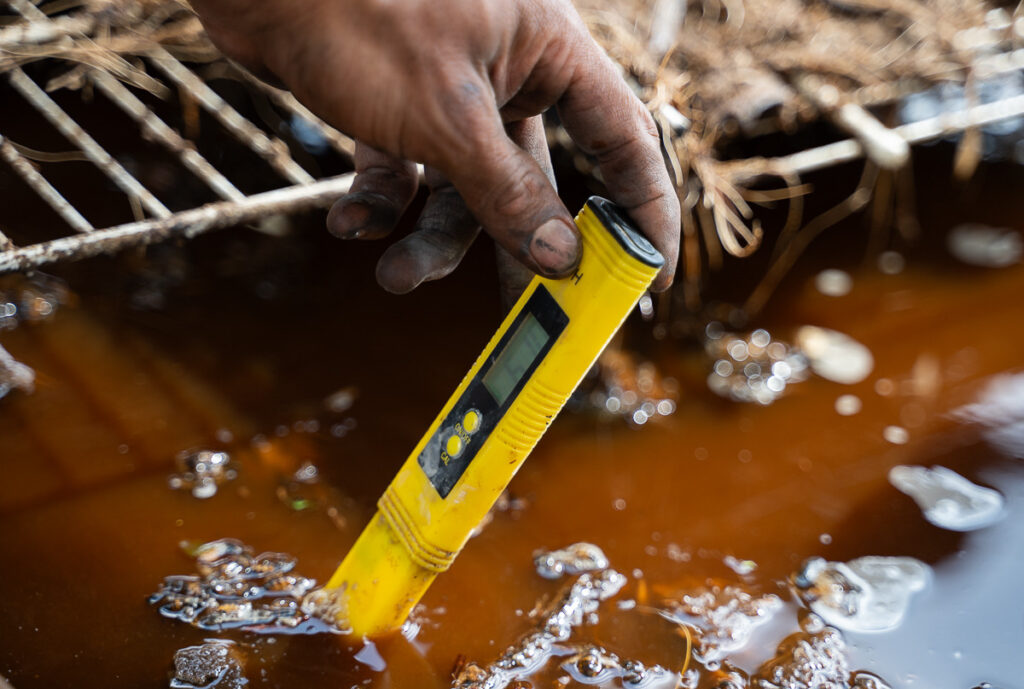
As mezcal production has increased, dumping this waste into drains or holes in the ground has led to catastrophic results: soil degradation and water eutrophication. The waste triggers rapid algal blooms that block sunlight. As the algae blooms decompose, they deplete oxygen in the water (hypoxia), leading to massive fish kills and aquatic “dead zones.”
The best way to solve this problem has been discussed at length amongst producers, brands and in articles here at Mezcalistas. Researchers and producers are actively testing and implementing filtration systems, evaporation tanks, and organic composting strategies to clean the wastewater. Some producers even use the byproducts to manufacture adobe bricks.
Despite some progress, communities that produce a lot of mezcal typically deal with negative side effects – from corroded drainage pipes to polluted waterways. The environmental bill for industry growth is past due.
San Dionisio Ocotpec is a town where they make a lot of mezcal. The number of producers has grown tenfold, from a few families to nearly a hundred in the last generation. The issues of contamination from industry waste products is creating significant friction in the community.
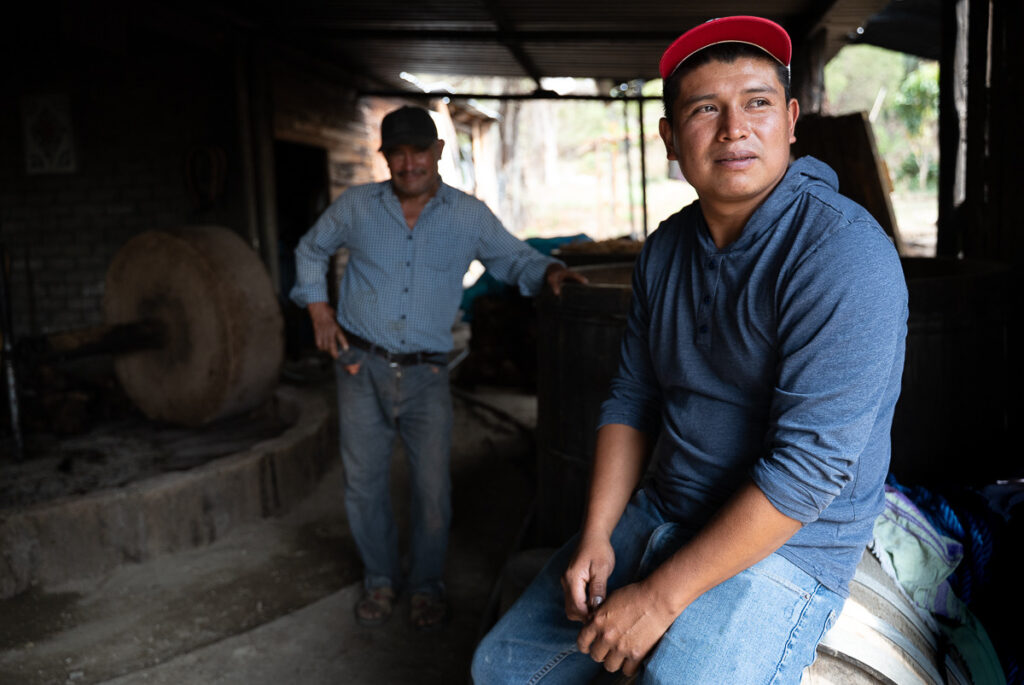
Daniel Garcia Bautista, who produces Almanauta mezcal (his father Don Crispin is known for making Geu Beez), affirms that vinasse is a major problem in San Dionisio. “It is polluting rivers, water wells, fertile land, and the wastewater system, since many producers are already polluting excessively and are not taking responsibility for their waste.”
He highlights a key problem: Some producers are putting their vinasse into the drains, which is killing the good bacteria used in the water treatment of wastewater, and deteriorating the pipes and drainage system overall.
“In the center where the church is, they were fixing all the drainage pipes because there are parts where the vinasse ate the entire tube, and melted it like acid,” Daniel says.
To tackle the issue, local authorities called a series of meetings starting in May of 2025. All mezcal producers were supposed to attend, and there were numerous meetings. At one point, members signed an agreement to move forward with a biodigester for the entire community. The cost would be partially funded by the community, partially by the palenqueros themselves.
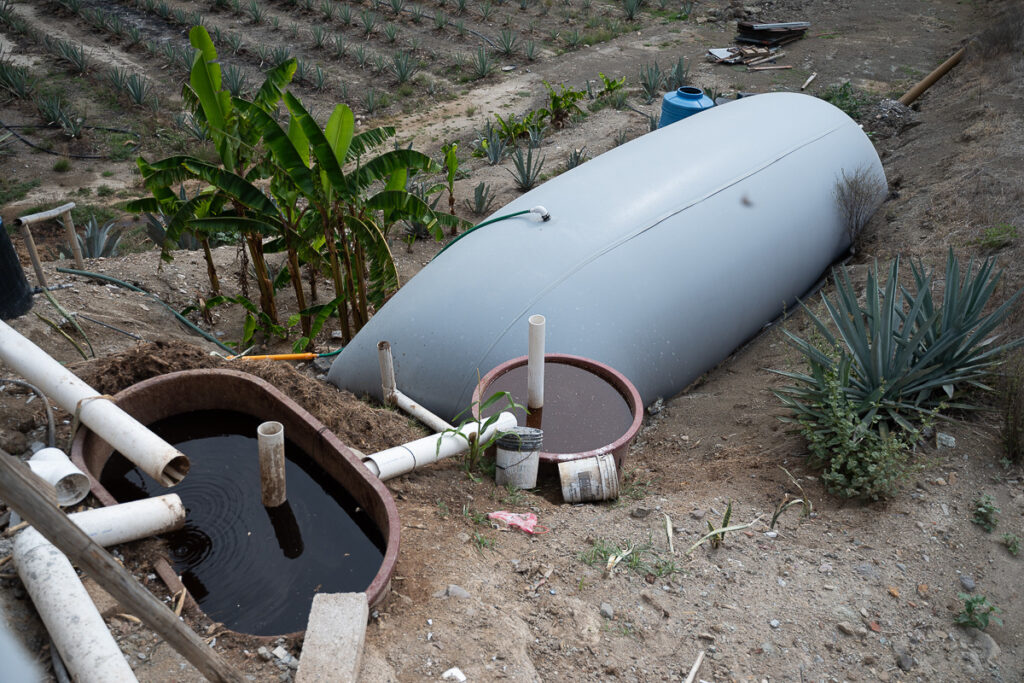
What is a biodigester?
The anaerobic biodigester offers a way to “close the cycle.” At its core, a biodigester is a large, sealed container (often a high-tech “bag”) where bacteria break down organic waste in the absence of oxygen. Technical studies show that biodigesters can achieve a 62.16% removal efficiency of organic matter (COD) while stabilizing the pH to a neutral 7.38. This process transforms a liability into two valuable assets: bio-gas and biofertilizer.
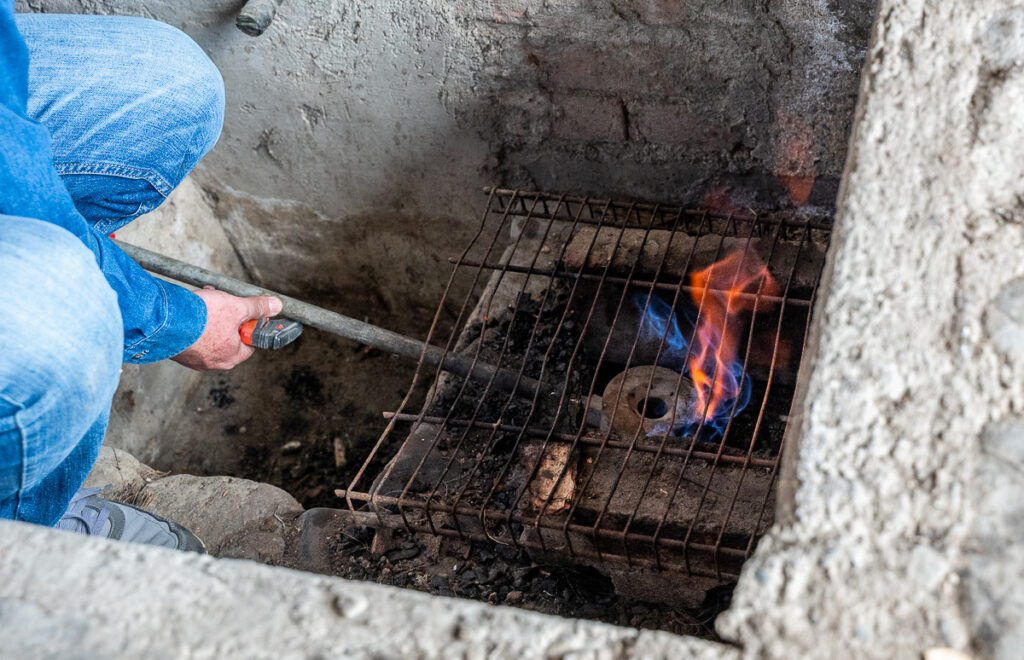
One of the most immediate benefits is fuel. A standard treatment can produce 15.61 liters of bio-gas per liter of vinasse. For palenqueros, this means a direct reduction in the need for firewood, which is often a significant expense and an environmental concern in its own right.
Roadblocks on the path to a sustainable solution
Despite the positives, biodigesters are prohibitively expensive. Daniel says the cost initially discussed by the community to meet its needs was approximately 200,000 pesos.
Not everyone was keen on the ideas proposed, as the plan was for producers to contribute a percentage of costs, subsidized by the municipality. Daniel says that some of the large palenques denied their pollution, while others denied the issue outright, saying If things were fine before, why should we change now? Daniel notes, “There are producers who got angry with me, because there came a time when I said, ‘How come you have money for a new truck, for cars, but you don’t have any to buy a biodigester?’”
After several sessions, the authorities gave the main polluters an ultimatum to resolve their waste situation or they would be fined or permanently shut down. Unfortunately, the local council changed over earlier this year, causing the project to stall. Daniel is frustrated. He says that although some producers have been able to acquire biodigesters, this does not tackle the problem at a community level.
Donaji García Martínez, whose family makes Mezcal Guey in San Dionisio, says that many local people aren’t clear where things stand. “As I understand, the vinasse project couldn’t be finalized with the previous administration. Ultimately, it’s a matter of individual conscience. I think the fine is fair for those who are actually polluting, but it’s very complicated with our people.”
Donaji elaborates: “A biodigester would be an excellent way to reduce pollution, and it also helps with gas for daily use or simply for mezcal production. However, not everyone can afford a biodigester because of its high price.” She says there’s no meaningful support from the municipal government. “Perhaps they touch on the subject in some meetings, but in the end, they never reach any conclusions.”
The discussions between the local authorities and producers in San Dionisio happened in tandem with a palenquero from San Dionisio approaching the government body of SEFADER (the Oaxaca State Secretariat for Agri-Food Development and Rural Development), a government initiative that trains field technicians to provide specialized advice on sustainable agriculture.
How SEFADER is helping palenqueros access the technology
In the spring of 2025, Mezcalero Alberto Morales (Wahaka Mezcal), brought a proposal for implementing biodigesters to SEFADER. He and a group of other producers subsequently received a 50% subsidy for the installation of each biodigester and assisted with the safe disposal measures implemented by local authorities.
Representative Mari Cruz explains that any palenquero can apply for this support at their office in Oaxaca City or speak to a field technician about application requirements. She says that the head of SEFADER, Engineer Victor López Leyva, and the Undersecretary of Agribusiness, Engineer Mario Robles Gonzalez, “are deeply committed to supporting producers and are well aware that sustainability is the path to opening new markets for production chains.”
In February 2025, agronomist and founder of Arquea, Dr. Edwin Alfonso Zelaya, hosted a demonstrative workshop in San Dionisio. Arquea is a biodigester manufacturer. This was organised as part of the technical support provided by SEFADER. The workshop focused on the operation and maintenance of biodigesters for the treatment of vinasse from mezcal production; as well as the use of the gas, promoting sustainable production and reducing the environmental impact of crops.
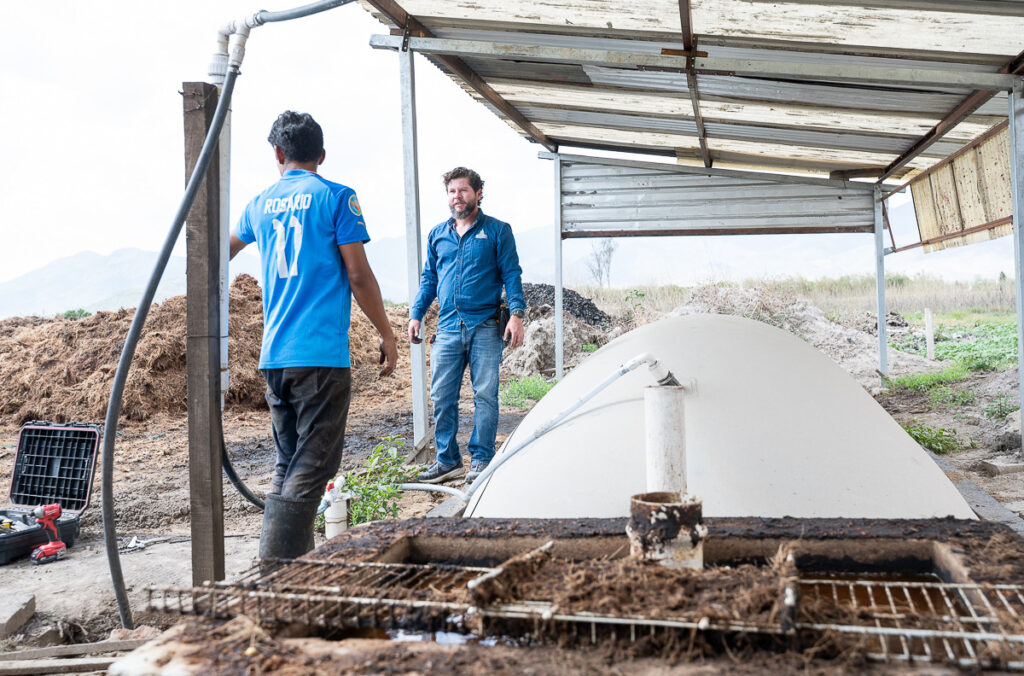
Edwin is a leading voice in the conversation around biodigesters and has installed them across the state of Oaxaca, as well as in other agave spirits regions throughout Mexico. Recently, Edwin invited me to see how he helps guide producers and teaches them how to maintain this new technology. He showed me how they use found objects from around the palenque to make makeshift components for the biodigester, so that the small areas of maintenance were possible independently.
According to the company, the cost for a 30m3 tank(30,000 liters) comes in at 114,482 pesos, including installation.
Biodigester success stories
Edwin says that reception has been mostly positive in Oaxaca and credits the welcoming nature of producers. The young producer we visited in San Juan Guelavila was teaching two more palenqueros from San Balthazar Guelavila how to assess the vinassas and had been writing a thesis on biodigesters.
Samuel Santiago Mendes, who produces Ocotales, has a biodigester installed by Edwin with support from SEFADER. Samuel also attended the committee meetings to address the issues of vinazas in San Dionisio. Following the discussions, he pursued the option of using a biodigester for his vinazas.
Samuel clearly loves innovation. In 2023, he built a stunning new ancestral-style palenque with clay pots and a star-shaped roof that channels rainwater to cool the stills, or can be stored in a 70,000 liter underground cistern. So it’s not surprising to find him at the forefront of this new initiative.
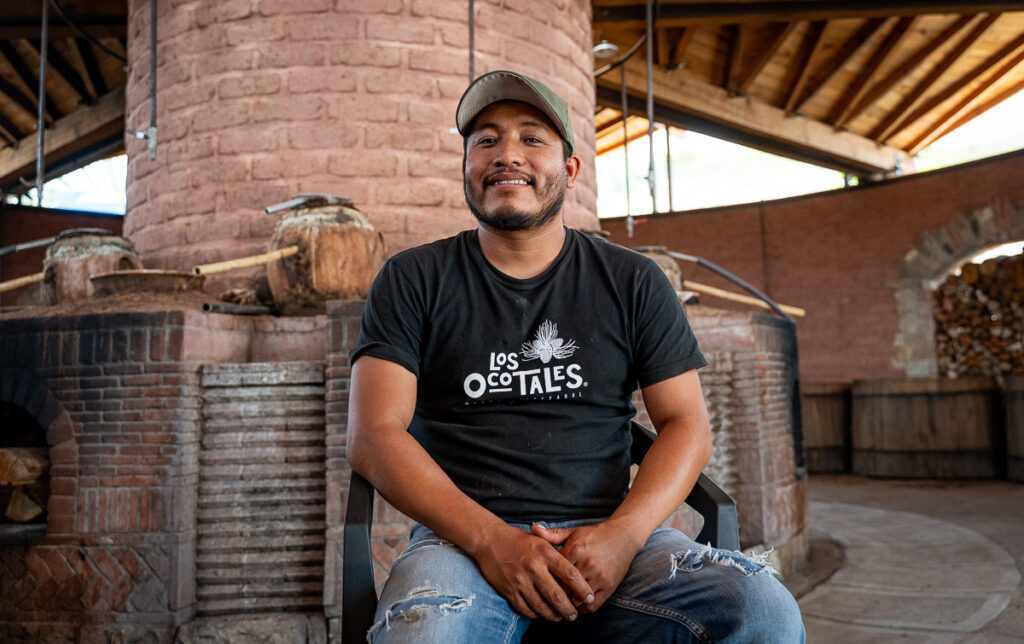
Samuel’s biodigester can hold 30,000 liters. Once filled, it could be ‘fed’ about 1000 liters of vinazas a day. Simultaneously, you would remove the biogas and biofertilizer. However, he usually ‘feeds’ it about 1000 liters of vinazas per week. “Once it’s activated, it’s always working.”
He uses the biogas to run his second round of distillation. “We have a gas that lasts for more than seven hours with intense distillation in the second distillation. We don’t use as much firewood anymore. So we’re solving two problems,” he says.
He speaks enthusiastically about this investment: “We never imagined the impact would be so significant; we thought it would only reduce the problem. However, when we put it in this bag, it transforms into biogas and also produces biofertilizer–it no longer pollutes as much. In fact, the biofertilizer is used to water our own plants. It has helped us immensely.”
Samuel sounds underwhelmed by other alternatives to biodigesters; just “more and more tanks,” which can be used for storing the vinasas. Over time, they can be denatured using ash or lyme. But it is an inefficient method that requires a lot of space. Furthermore, the vinassas eventually corrode the tanks.
Samuel echoes some of Daniel’s frustrations over certain attitudes toward the disposal of vinazas. “There’s about 20% of the people who are against it. They don’t want to invest, and they don’t want to allocate their resources to these things. They’re kind of stuck in the old mindset, like, We used to throw things in the river and nothing would happen.”
Samuel acknowledges that the price can be confronting, but says that for him, with the 50% backing from SEFADER, it has been worth it. “I had my doubts about whether it would work. Investing 100,000 pesos in that is a lot of money for a producer; it’s their entire profit for a year, two years, and so investing all that didn’t seem logical. Now that we’ve achieved it, we see the benefit.”
Before municipal discussions broke down, there had been ideas for communal biodigesters, and that the municipality would pay for trucks to collect the vinassas. Unfortunately, with the turnover of the local council, plans fell apart. Samuel says that he recently spoke with the municipal president, who claims the aim is to revisit this plan. “It’s even profitable for them, since the biofertilizer can also be sold. It’s a type of organic fertilizer and could work for tomato plants, as well as for agave.”
When I asked Samuel if any of the certification boards offer funding or other support in the disposal of vinazas, he said, “I’ve seen that they hold many meetings, but I haven’t been able to participate in them. I don’t know if they discuss these issues directly, but we haven’t seen any concrete actions.”
“I think it would be very nice to highlight the brands that are doing something right, such as water conservation, wild agave management, vinasse treatment, and bagasse treatment. It would be a good way to emphasize that. With a seal, with something. With a distinctive mark. With a distinctive mark so people can see that they’re not just buying mezcal, but also buying mezcal with environmental responsibility.”
According to Samuel, the collaboration with SEFADER has been a “pilot test.” He says SEFADER is supposed to support the installation of 70 biodigesters this year.
Mari from SEFADER indicates that this success in San Dionisio is serving as a basis for designing the next stages of support in other communities with a high density of palenques. She says they are strongly promoting the sustainability of palenques. “We want our producers not only to protect their environment, but also to have the tools to achieve organic certification or the green seal, opening doors abroad,” she says.
Mari explains that this outreach is two-way: “On the one hand, we actively disseminate the operating rules and support components in the producing regions; on the other hand, the producers themselves, individually or organized in palenques, approach us requesting technical and financial support to improve their production processes and move toward sustainability.”
In light of the community-led program in San Dionisio, Mari emphasises that they were not contacted directly by the vinasse committee, and that although the secretariat sought to engage with them, the committee did not respond. “Despite this, the project has moved forward with great success,” she says.
Their goal is to join forces with more producers and community initiatives. “We hope to support more ecotechnologies, not only in San Dionisio, but in all the communities of the state where mezcal production is the main economic activity and where there is a willingness to transition to sustainable practices,” she says
Daniel and his family are in two minds about the biodigestor as the solution. Although he sees many positive aspects, Daniel says, “Many improvements can be made in conjunction with biodigesters. In San Dionisio Ocotepec, people think that having a biodigester is enough to be considered sustainable, but it’s only part of it.”
“I am worrying about my daughters, my son, about the environment. What are we going to leave them?”
Daniel is aware that, even on a small scale, he is contributing to the pollution by continuing to make mezcal. His reaction is to look to both the past and the future. He has put together a bilingual book (Spanish/Zapotec) for the local school to help the children engage with their environment and their native language. He is also passionate about the knowledge we can gain from experienced guardians of the land like his father Crispin. Together they are working to reforest the hills around San Dionisio with native trees and endemic agave.
This approach reflects the thoughts of anthropologist Vinik Jure. His perspective is that, although there is a critical point at which technologies such as biodigesters are necessary, reliance on them might distract from the issue of perpetual growth. If brands are making so much waste that it cannot be managed without external intervention, is the biodigester a contribution to sustainability, or just a band-aid that allows growth to continue until the next critical point?
As emphasised by Daniel, there needs to be consideration of the big picture. Fixing the problem of vinazas with a biodigester might work now, but knowing how previous generations managed that land is invaluable for the future. Conserving the relationship with the land through education programs is key.
What became clear with the efforts in San Diniosio is that getting everyone to agree on one strategy is next to impossible. Tackling issues like vinazas requires a multi-prong approach. There needs to be personal accountability, supported at a community level, with accessible programs like those offered by SEFADER.
Despite the complex nature of this issue, it is motivating to see palenqueros coming together to navigate the future; sharing empirical knowledge and harnessing technology like biodigesters to reduce waste, while using byproducts to fuel distillation. For Samuel, this has been a positive step: “We’re really happy with the family, the brand, and everything because it worked. This worked.”
Updated July 10th to include the cost of a 30,000 liter biodigester from Arquea.






Leave a Comment