
I read a lot of books about booze–even spirits I don’t typically drink. I am fascinated with how a spirit category is the result of biological, ecological, and cultural evolution. How a bottle is always enmeshed in a web of tradition, history, politics, agriculture, and science. I am drawn to the long march of characters–the inventors, outlaws, schemers, farmers, craftspeople, fieldworkers, distillers, and drinkers who populate a liquor’s saga. And I am always, always interested in the plant at the root of the story.
So naturally I was delighted to get my hands on a copy of Nat Harry’s Spirits Distilled: A Guide to the Ingredients Behind a Better Bottle.
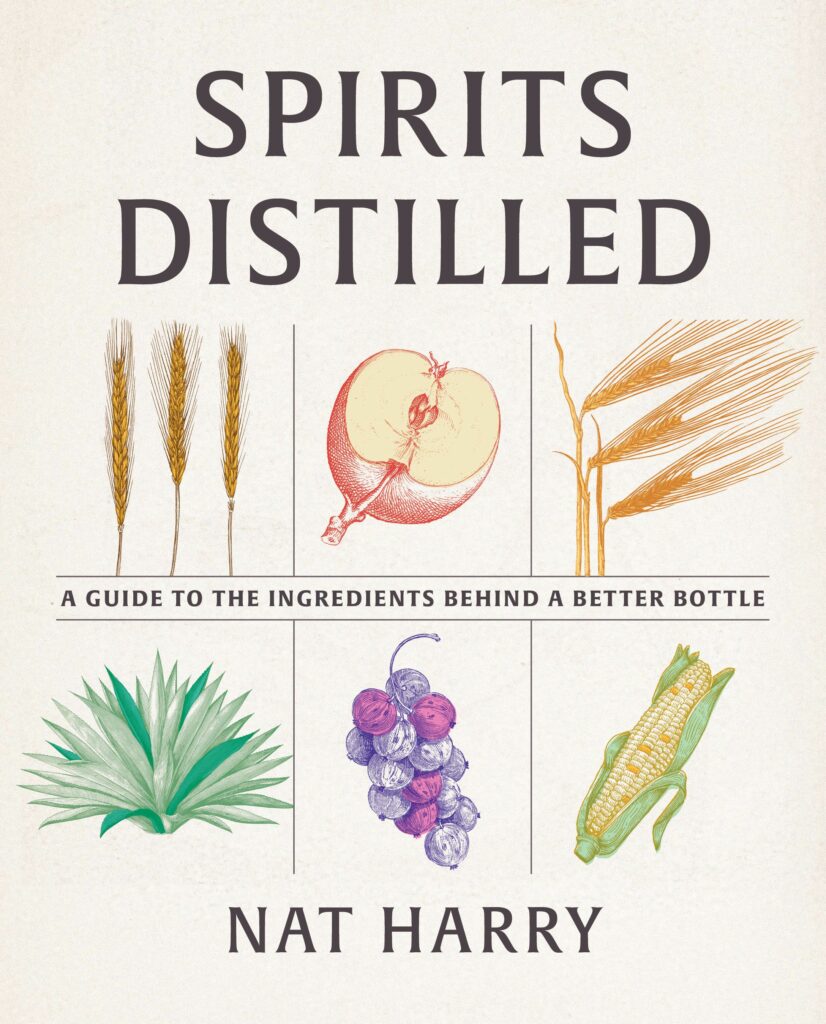
The book is divided into detailed chapters organized by the raw materials that define most spirits: cherries, apples, and pears; grapes; barley; corn; rye and wheat; rice; agave; sugarcane; root vegetables; and wood.
The author approaches each raw material and its related spirits from every conceivable angle. For example, in the general fruit chapter I learned that cherries were included in the rations for Roman soldiers, who, by discarding pits, likely hastened the tree’s spread into central and northern Europe. I also learned about cherry-picking machinery, how the cherry industry is affected by climate change, and the origins of cherry bounce. I was particularly delighted to come across a section titled “The Sordid Corruption of the Maraschino Cherry.”
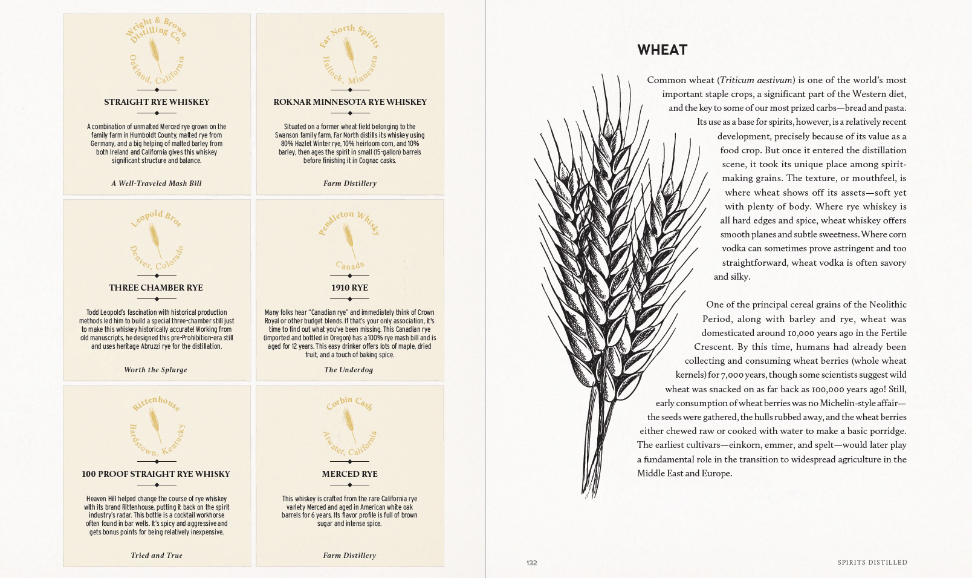
Spirits Distilled is larger-format with photographs, illustrations, and graphs, so I expected it to be a fairly basic reference book. I was pleasantly surprised that it is littered with weird historical tidbits and humorous asides that make for a fun read. For example, in the chapter on corn: You may recall that fermentation is the breaking down of sugars into alcohol and that it occurs naturally–as any drunken bear who’s raided a cache of fallen apples can attest.
You can usually get me with a drunken bear.
If you’re a serious agave spirits nerd, you likely won’t learn anything new in the chapter on agave. But impressing fellow nerds doesn’t seem to be the author’s intent. Nat Harry is a long-time liquor industry professional and writes in the preface: Seeking the most effective way to fuse the vast amounts of information out there for the curious patron has long been one of my goals–making it accessible and digestible for the casual drinker who may not be interested in a long-winded, nerdy treatise on mash bills or pot stills. Meeting folks at their level of interest takes practice and consideration.
While we at Mezcalistas are in the business of publishing long-winded nerdy treatises on pot stills, I appreciate Nat Harry’s mission and execution, particularly their articulate and thoughtful definitions. On fruits and vegetables, the author writes: An easy way to remember the difference is that while a vegetable can be any edible part of a plant–root, stem, leaves, and flowers–a fruit must be seed bearing and derive from the flower.
This isn’t exactly a revelation, but it’s a succinct and elegant explanation that will remain with me. My line of work requires me to repeatedly define the same words and phrases (piña, palenque, raicilla, DO) so I have a particular appreciation for an elegant definition.
In exploring said definitions, Nat writes with thoughtful humor. For example, this passage from the introduction: Other descriptors, like “craft,” while sometimes used to articulate careful or conscientious production, are more often employed as marketing jargon; after all, “craft” has no legal definition, much like other oft-deployed words I love to despise, “premium” or–my personal favorite–“super premium” (that’s premium in a cape).
While the author successfully side-steps the aforementioned long-winded nerdy treatise on pot stills, they do a good job of succinctly explaining still variations while simultaneously addressing the many layers of science, history, and regulation that are essential to gaining an understanding of a particular spirit.
Which is not to say that I always agreed.
I think the book’s representation of Denominations of Origin is reductive. The author writes, At its heart a DO provides a stamp of authenticity for consumers while protecting the livelihood of those who create the product. They devote a paragraph to how international-recognized geographical protections can be difficult to obtain, but don’t get into the documented exploitative potential of the entire concept. This stance is perhaps understandable given that much of the book covers spirits made in Europe, where the model seems more likely to be beneficial to producers.
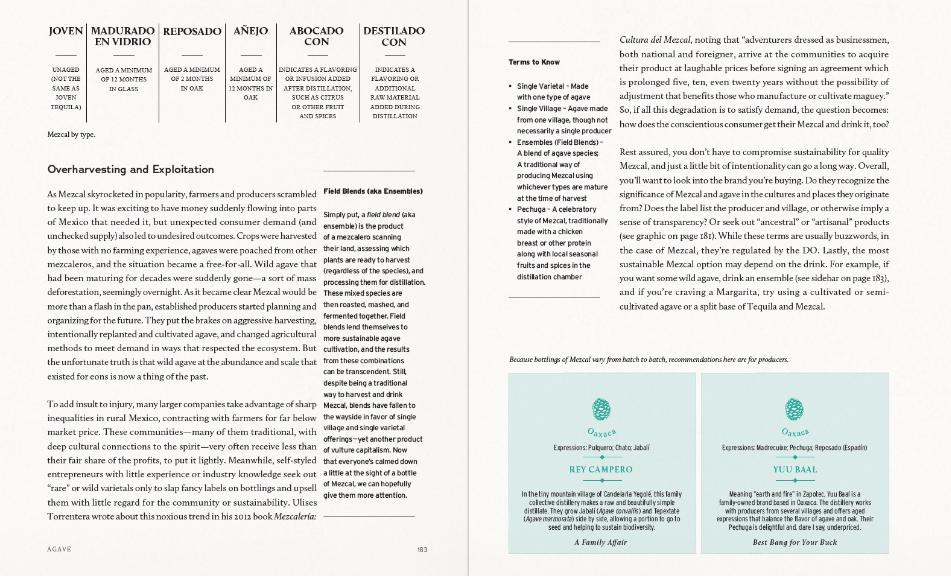
In the agave chapter, they do acknowledge that the DO for mezcal is flawed. In a sidebar called “the Double-Edged Sword of the World’s Largest DO,” they write: After officially receiving a protected status, its international profile rose so sharply it fostered continual changes to the category, including the expansion of states authorized to produce Mezcal and allowances for more industrial producers to get certified. As such, the DO (which is now the largest in the world by territory and includes 10 Mexican states and various municipalities) struggles with being a victim of its own success by “diluting the brand,” so to speak.
While I certainly agree that the Denominacion de Origen de Mezcal (DOM) is flawed, this passage doesn’t actually make sense to me.
Does allowing industrial production methods dilute mezcal’s “brand”? Maybe. Does a giant DO make sense? Absolutely not. But allowing people in states that historically produced mezcal to call their spirit mezcal is not diluting the “brand.” It would be extremely unfortunate if Oaxacan palenqueros had sole ownership over the word mezcal. The problem isn’t more states being allowed in–its the concept of trying to create a limiting DO for a spirit that was already produced under that name in most Mexican states.
While the author doesn’t always hit, I remain impressed.
At present, I have the luxury to focus most of my professional attention on one country and one genus. And even so, the possibility for error is neverending. Localized expertise is possible, but hard to come by when one studies agave spirits in general–the geographical differentiation in vocabulary alone is terrifying for a stickler like myself. It is very, very easy to make mistakes that may seem small to the layperson but are like fingernails on a chalkboard to regional insiders. (A very simplistic example of this is applying the word palenque to say, a taberna in Jalisco.)
My point is that in tackling the many layers of significance–from botanical origin to legal history–of multiple grains, fruits, root vegetables and other plants and the hundreds of liquor industries these materials have inspired around the world, the author was incredibly ambitious. And as such, I can only be impressed with their ability to express nuance and retain a high degree of accuracy while writing with humor and agility.
As someone who reads constantly but learns slowly, Spirits Distilled was a great way to brush up on some fields of interest. While I am disappointed that it doesn’t have an index, the formatting makes it easy to flip through and I anticipate it will become one of the more oft-visited books in my reference library. I recommend this to bartenders and other industry folks who navigate across spirits categories, drinkers who want guidance at the liquor store, and anyone who enjoys reading about plants or contemplating the broader ramifications of a mash bill or a bottle of booze.








Leave a Comment