
On the refrescadera, the Oaxcan community that invented it, and the deeper significance of regional innovation
It happened at Mexico Agavero, one of many fairs in Mexico City where you move from table to table with a copita and try to pay attention to what you’re tasting rather than to the noise around you. I kept finding myself stopping at certain mezcals because of something in the profile itself. Something more expressive on the nose, more immediate in that first moment of contact. When I asked, the answer kept coming back to the same thing: refrescadera. A distillation method I had heard mentioned in conversations for years, understood only vaguely, and never fully grasped until I decided to go looking for it properly.
The refrescadera is a specific type still used in a cluster of communities in the sierra sur of Oaxaca. It produces a measurably different mezcal. If you want a technical description of how the still works — the physics of internal rectification, what it does to congeners, the difference between versions with and without internal plates — Omar Muñoz has writtena detailed entry in our encyclopedia.
It has a documented lineage, a geography, a family of coppersmiths who have built these stills for three generations. And it is nowhere in the regulatory framework that governs the denomination of origin (DO).
Amatengo, the origin of the mezcal refrescadera
There’s no written record of when the refrescadera was invented. This is not unusual in the world of mezcal — knowledge travels by apprenticeship, by family, by watching and doing, not by document. What I went looking for was the stories, and the place they all point back to: Amatengo del Valle, eastern Ejutla, around 1,900 people, roughly two centuries of mezcal production.
Cornelio Pérez, who leads the Mezcólatras collective, has documented the geographic spread of the method: Agua del Espino, La Compañía, La Chopa, Amatengo, La Noria, El Sauz, Yogana, Zeguiche, San Vicente Coatlán. A cluster of communities running through the eastern sierra, sharing a technique, a landscape, and a relationship to scarcity that may have shaped the method itself.
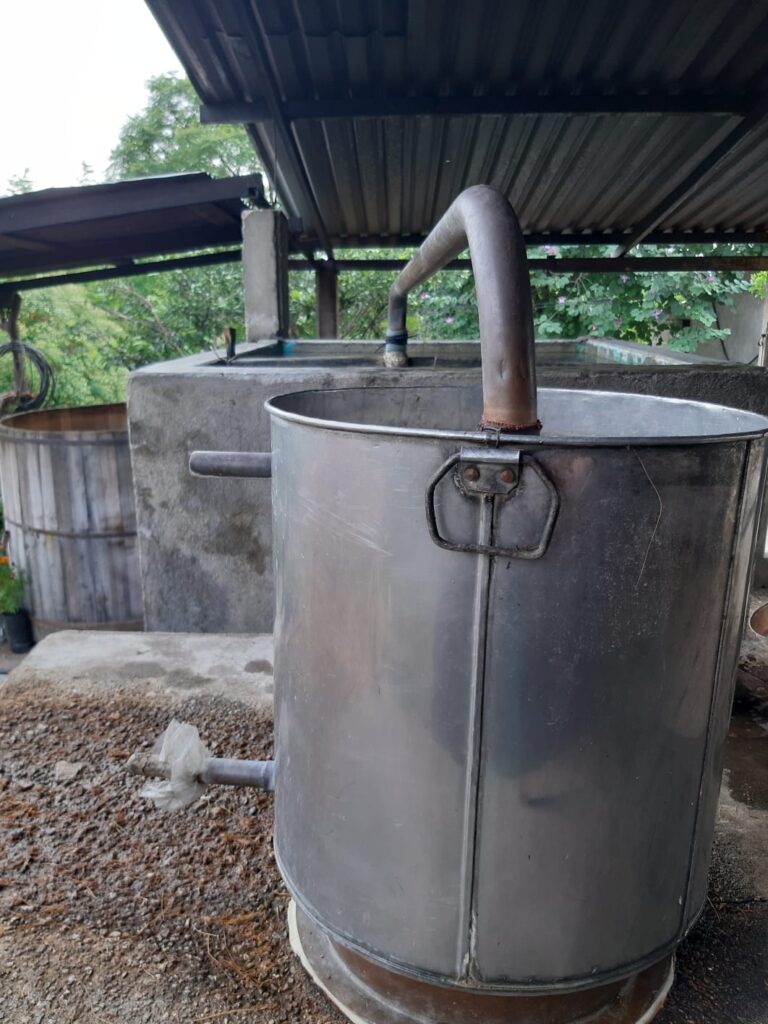
The name most associated with the refrescadera’s invention is Heliodoro Reyes, a craftsman from Amatengo who, according to Sergio Juárez — known as Tío Sergio, co-founder of Gozona Mezcal — was working in the 1940s making barrels, fermentation vats, and copper stills. Whether Reyes invented the refrescadera from nothing or adapted an existing design is uncertain. What he did, according to Tío Sergio, was attach a basin — a cazo — to the top of the still’s cap, the montera, so that water sitting above the still head would intercept the rising vapors at the point of condensation.
Tío Sergio explains it this way: when the first vapors begin to rise, they meet the cold water and make a small swirl — a remolino — then fall back down. Only when more heat is applied do the higher alcohols rise as true alcoholic vapor, pass through, and continue toward the coil and condenser. “This way,” he says, “you achieve two condensations in one. You don’t need a second distillation.”
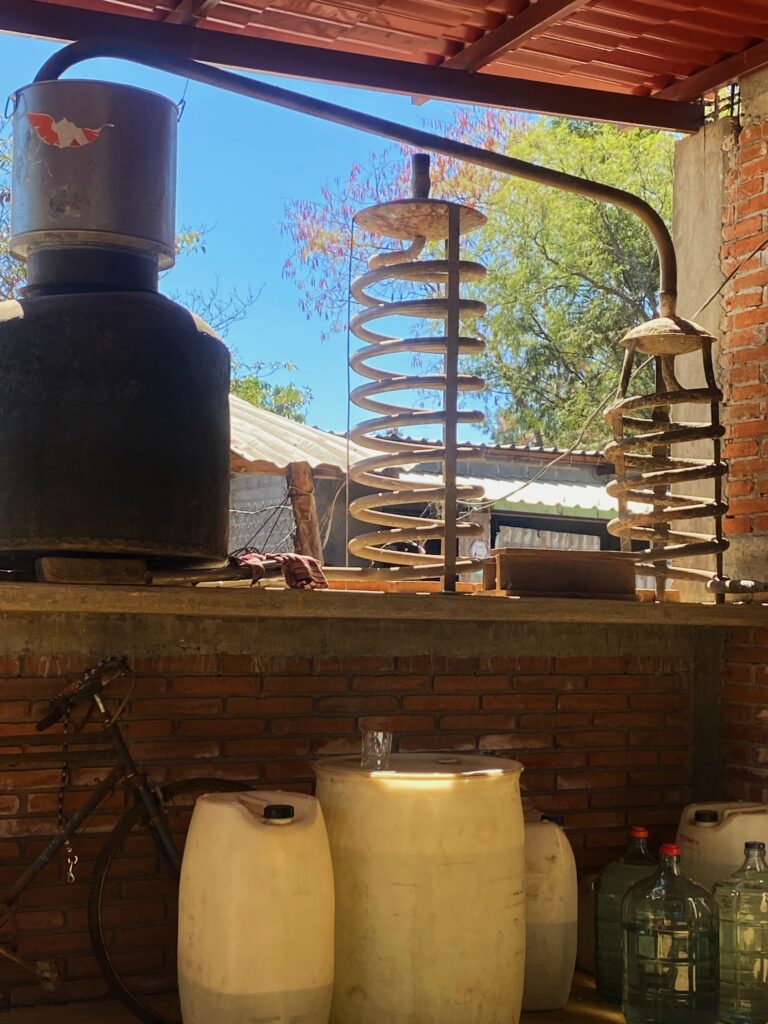
Before the refrescadera, Amatengo distilled in clay pots — ollas de barro — using a small copper basin of water above the vessel to cool and condense, but requiring a double distillation. The refrescadera was, in part, a solution to a resource problem: Amatengo has limited water. The method’s efficiency — its ability to produce a complete distillation in a single pass — was not just an aesthetic choice. It was an adaptation to their territory.
“Amatengo doesn’t have the recognition it deserves,” Tío Sergio told me. “It doesn’t have the name that Miahuatlán has. But mezcaleros from Ejutla learned here. It has been making mezcal for around two hundred years.”
How the still actually works and how four different people explained it to me
I talked to different producers and I was curious on how differently each producer described the mechanism. They all described the same physical process but with different emphases, different entry points, different metaphors. Which is itself a kind of evidence: this is knowledge that doesn’t live in manuals because it is part of a daily practice.
Tío Sergio leads with the remolino. The swirl, the moment of return. Vapor goes up, hits cold, comes back. Only the alcoholic fraction gets through. He focuses on physics.
Edith Cruz of Murzok — whose family produces in both Miahuatlán and Ejutla — told me a story that works more like legend: a still was sitting near a river, the river rose and swept it away. They found it downstream, tumbled through cold water, and the mezcal hadn’t escaped. When they saw what the cold had done, they understood. Maybe this happened, maybe it didn’t. Either way it holds a truth: the cold water is part of the process.
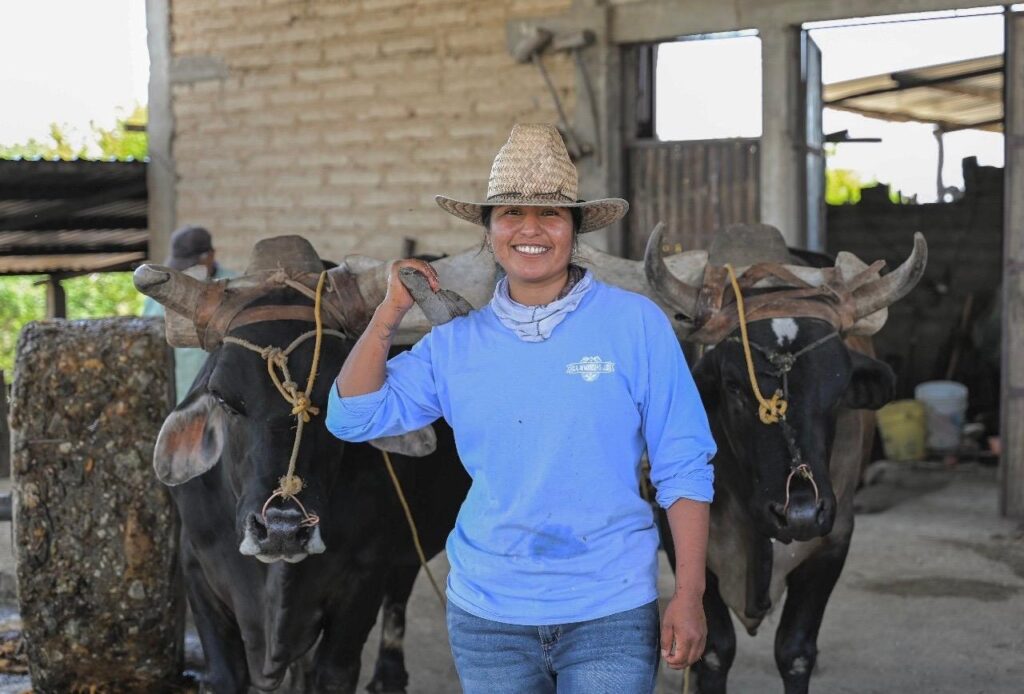
Refugio Cortés “Cuca” who produces for the brand Huaxe, has been distilling with her father Rodrigo since she was young and now runs five ollas with refrescaderas in Santa María la Pila, Mengolí in Miahuatlán. Thirty years ago, she says, things were very different: before the stainless steel containers were commonly used as refrescadera, her father’s generation would wrap a wet blanket around the montera to provoke cooling. The principle was identical — interrupt the vapor with cold at the point of condensation — but the technology was whatever was at hand. When she eventually bought her first still with a proper refrescadera fitted, she had to learn how to use it by watching other palenqueros. The logic she already understood. The equipment was new.
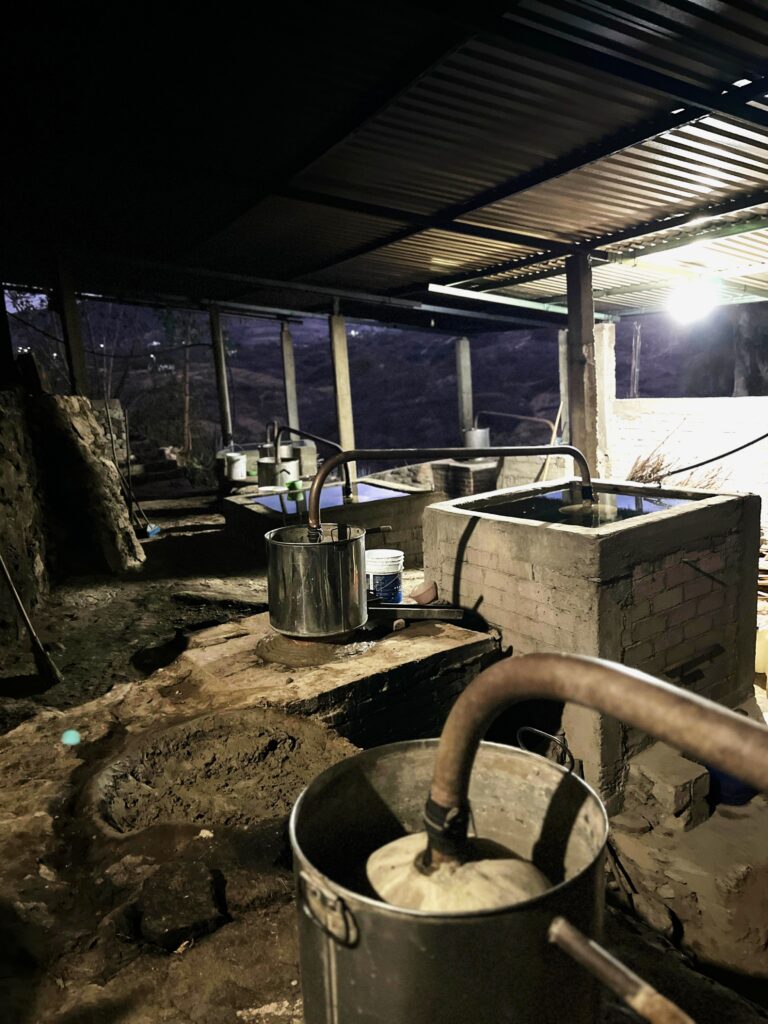
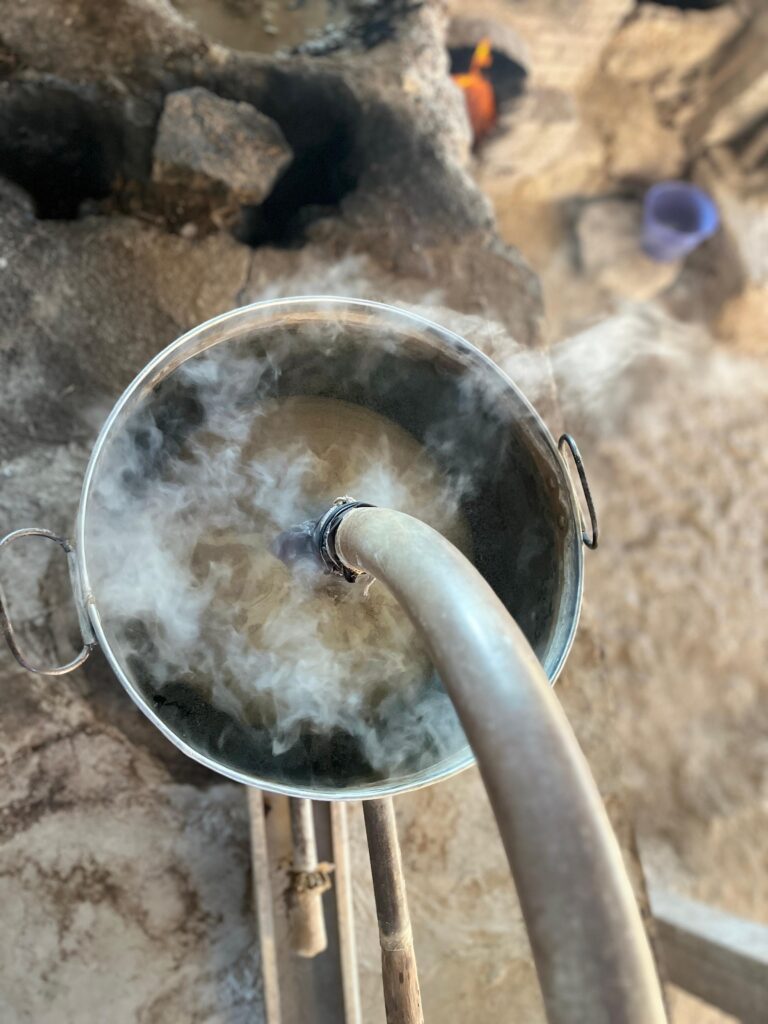
She describes the timing now with the precision of someone who has done it thousands of times: you begin cooling the turbante first, pulling a half to a full liter to clean the system. Then, between the third and fourth hour, you start adding water and begin tasting. “Everything depends on how you run it,” she told me. “Each still will give you a slightly different percentage.”
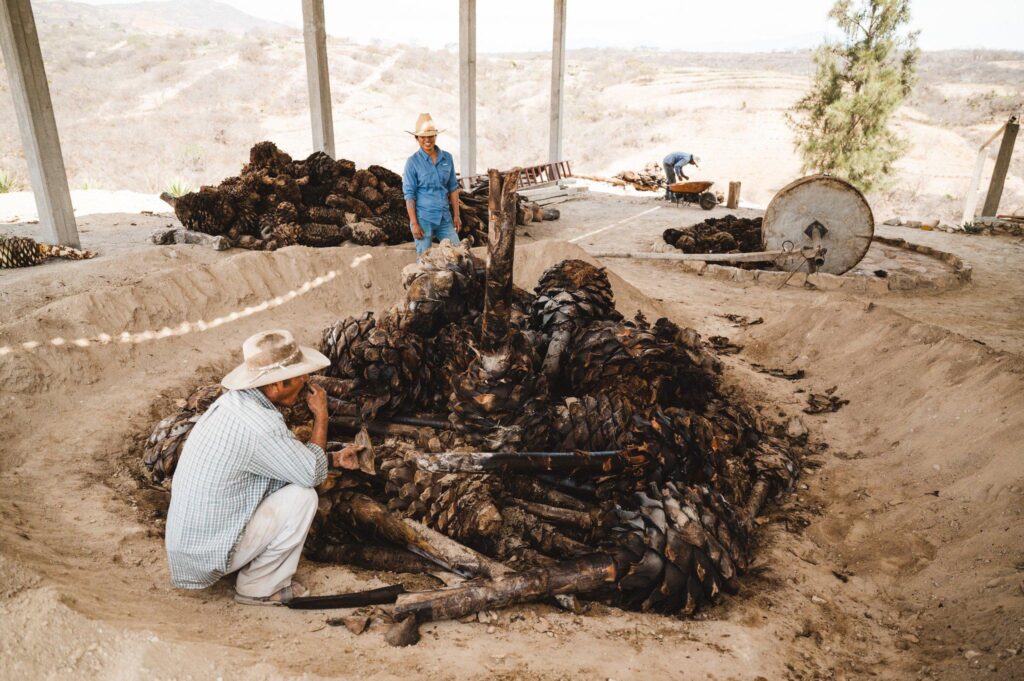
Caín Bohórquez Ramos, who founded Catorce Fuerzas and has been working with maestro Melitón Jarquin for five years, describes the fire management in terms I found unexpectedly precise: “When the fire is controlled, you can see there’s no flame — just embers, like when you’re cooking meat on a grill and you let it go to pure coals, in Oaxacan cuisine is called rescoldo. “A postura — a single charge of fermented agave — takes ten hours or more. You don’t walk away from it.”
What they all agree on: the refrescadera produces a more aromatic mezcal. “From the first impression,” Caín says, “it hits you at once and from there you start identifying multiple things.” He contrasts this with conventional double distillation: less aggressive on the entry, but still intense on the palate. Different tools for different drinkers.
What they also agree on: the method requires constant vigilance. Cuca starts at 4 am and finishes at 12 hours later. She has one person dedicated to tending the fire, and she stays close because a single moment of inattention — the fire too high, the temperature unchecked — means a loss of the cordón, the thin thread of distillate that tells you the process is running right. Lose the cordón and you may need to do a second distillation anyway, undoing the efficiency you were working toward.
“It’s not ‘save yourself some time,'” Caín told me bluntly. “It’s actually slower per charge. You need a very controlled fire to maintain the alcohol degree at the beginning of the run.”
The efficiency is real — less water used, potentially less firewood over time, one distillation instead of two — but it is the efficiency of mastery, not the efficiency of a shortcut.
The Santaella family, stellar coppersmiths
If you ask enough people who made their refrescadera, eventually every road leads back to the same family in Ocotlán: the Santaellas, known throughout Oaxaca as los cobreros del estado — the state’s coppersmiths.
José Mario Hernández Santaella is third generation. His grandfather Taurino started the business, shaped partly by a friendship with an Arab merchant he met at gambling tables — cubilete, cards, cockfights — who opened his eyes to the trade in sheet metal and copper. The family learned by doing: starting small, cutting tin for basic household goods, and eventually, by the time José Mario was seventeen, beginning to understand what he calls “this art.”
Today, at sixty-three, José Mario has no sons to hand the business to, only a daughter. He has responded to this not with hoarding but with sharing his knowledge with anyone who wants to learn. “My grandfather taught me because he thought it was important that more people know this,” he told me. “One must do good work. Not try to get rich overnight. Be just.”
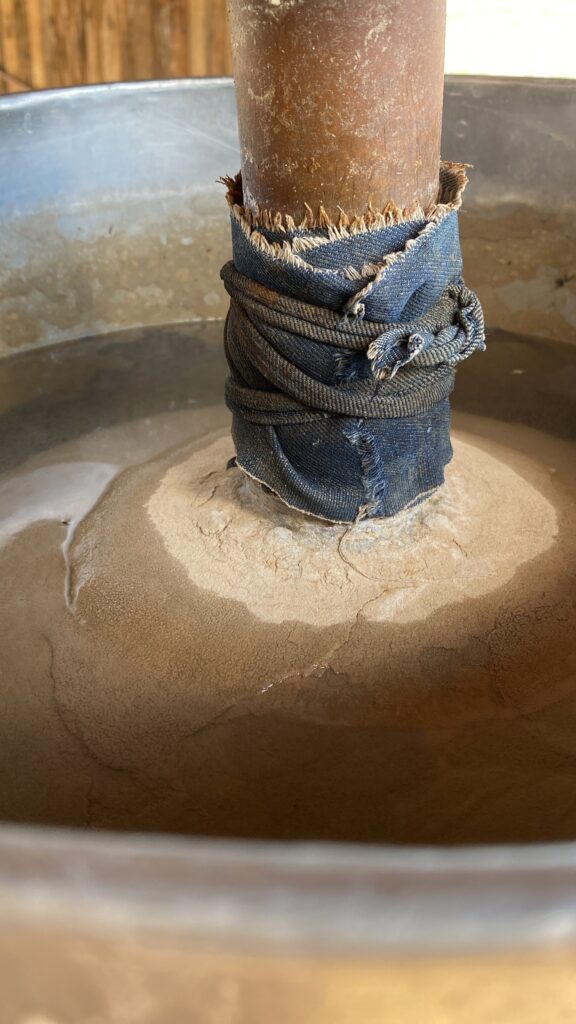
According to Hernández, about twenty years ago, the sierra sur started asking for refrescaderas. His brother handled the clients from Ejutla, and one day someone came in asking for a still suited to mezcal de “un hervor” — a single-pass distillation. The regional difference between versions, he explains, is the montera. The one used in Miahuatlán is hollow inside, with cooling only on the exterior — a water jacket around the outside of the still head. The refrescadera con platillos, the version associated with Ejutla, adds internal plates that function as traps, slowing the vapor’s passage and letting compounds settle before continuing. Each plate creates a delay. Neither version is more advanced than the other — they are regional adaptations, each shaped by the materials, habits, and producers of a particular place.
He also notes that the refrescadera wasn’t always used for mezcal. Distillers of cane spirits — aguardiente — use a version with four plates and a top stop. The vapor of fermented cane is highly volatile; the plates impose a pause, a resting point. The physics are consistent across spirits, even when the plants and traditions differ.
Caín confirms this in his own terms: Tío Meli uses the traditional version, the one he has worked with for forty years. They’ve also experimented with a newer montera design and had run three batches. The aromas change. The opening changes. They’re not abandoning the old version — they’re learning what the new one does and their customers like it.
This is how knowledge evolves in a palenque: not by declaration, but by experiment and comparison, by keeping what works alongside what works differently.
What the tobacco left behind
One of the things I love about these conversations is that they refuse to stay on topic in the way a journalist would want them to. What seems like a casual aside turns into a local history lesson — and those lessons tend to illuminate the thing you actually came to understand.
In Amatengo, the history of the refrescadera cannot be separated from the history of tobacco. TABAMEX was created in the 1970s when the Mexican government nationalized the tobacco industry, taking control back from international companies like British American Tobacco. The logic was sovereignty — keep the profits in Mexico, support the campesino producer. In practice, it ran a contract agriculture system that included seeds, agrochemicals, credit, and a guaranteed buyer then collecting the cured leaf. The returns were good enough that producers pulled out agave they’d already planted to make room for tobacco.
TABAMEX didn’t collapse cleanly. The Ejutla and Zimatlán regions had been important producers of the aromatic tobacco needed for cigarettes, but fluctuations in the international market gradually shifted the center of production toward Nayarit, whose geographic conditions made it more competitive. Oaxaca was slowly displaced. According to research on the period, the company itself had accumulated a historic debt over decades — the result of political clientelism, excessive paternalism, and a system that prioritized control over productivity. Producers who held fertile, irrigated land and had real productive potential never got to develop it.
The combination of market displacement and structural dependence destabilized the zone socially, politically, and economically. When TABAMEX finally wound down, they were left without tobacco, without the maguey they’d uprooted, and without the conditions to build something independent. The knowledge of how to make mezcal survived in families — but it survived despite the system, not because of it.
Today, Tío Sergio says, close to 80% of Amatengo’s population knows how to make mezcal. Roughly thirty palenques exist; about fifteen work regularly. The tradition survived the interruption — people came back to what they knew. But those lost decades may be exactly why Amatengo never built the name that Miahuatlán did. While other communities were accumulating recognition, Amatengo was growing tobacco.
What the NOM doesn’t see
The refrescadera is already a form of differentiation. It produces a measurably different sensory result. It’s tied to a specific geography — eastern Ejutla, radiating out from Amatengo. It has a documented lineage, a family of coppersmiths who have been building these stills for three generations, and producers who have been using them for longer than the denomination has existed.
It’s also nowhere in the current regulatory framework.
Luis Nogales, director of the Centro de Estudios sobre el Maguey y Mezcal (CEMMEZ), proposed a state-by-state denomination in 2018 to protect specific production forms such as minero, campanilla, dioseño but didn’t mention the refrescadera. Researcher Carlos Lucio has pushed the argument further: the NOM as it stands homogenizes processes it should differentiate. Instead of broad tiers, the law should identify mezcals by agave variety, region, and the specific processes of roasting, fermentation, and distillation. The goal is recognizing mezcal as a living system of knowledge, not just a product category.
The refrescadera is exactly the kind of thing both proposals are trying to make visible.
Whether it’s possible is another question. Edith Cruz was honest about it: “It’s difficult to find a criterion that encompasses everything and put it into a standard, because conditions are very particular.” Caín put it plainly: recognition for the production method “would give us an advantage — but achieving it would be complex, because everyone would have to agree.”
Why this matters
Cuca thinks the method is slowly disappearing — though there are no numbers to back that up, only her years of watching the trade. Brands chasing commercial profiles need speed and consistency. Whether that pressure is what’s driving producers away, or whether it’s something else, is harder to say.
What’s certain is that the choice exists, and people make it differently. Onofre Ortíz, a producer from Miahuatlán, distills with double distillation. His father used refrescadera. That may be a market decision, a personal one, or both — the point is that nothing in the current framework makes that difference visible.
I’m not making the case that the denomination should immediately create a refrescadera subcategory. I’m saying the conversation is overdue.
Alcohol consumption is down, and not just because of preferences — the economic moment is difficult and it’s hitting the category. At the same time, agave as a drought-resistant plant is being cultivated in more and more countries, and that’s being read in some places as an opportunity and in others as a threat to everything that mezcal is supposed to mean. The denomination of origin was built to protect geography. Geography alone isn’t going to be enough.
The method has meaning. The refrescadera is the knowledge of when to add the water and when to hold back. It’s knowing how to read the cordón without instruments. It’s understanding how a madrecuixe behaves differently from a tepeztate at hour three. It’s what Heliodoro Reyes was solving and what the river supposedly did to the still before anyone thought to ask.
.






Leave a Comment