Anna Bruce on brand owner César Garcia’s clever pivot. Photos by Anna Bruce.
I met César Garcia while visiting mezcalero Rolando Angeles in Santa Catarina Minas. That first connection was fleeting, just a raised glass to how much we enjoy Rolando’s mezcal, followed by months of back and forth–trying to meet up again.
César is a busy man! On top of consulting for Volkswagen in Puebla, where he lives, he is the founder of two brands: Puntiagudo and Despatriado, sold respectively as an “agave distillate” and certified “mezcal.”
We finally caught up again in Oaxaca city, at a house he is considering turning into a mezcal tasting room. He dove right into his story: how he’d found himself not only at a crossroads in life, but at a pivotal point in the world of agave, as the industry began to boom.
Growing up in the 70s, César was the middle child of three, and the oldest boy. His father managed a bus route from Oaxaca to Sola de Vega. César learned about mechanics and how to manage sales while helping his father. “I’m a very curious person,” he says. “I’m always trying to understand how things work.”
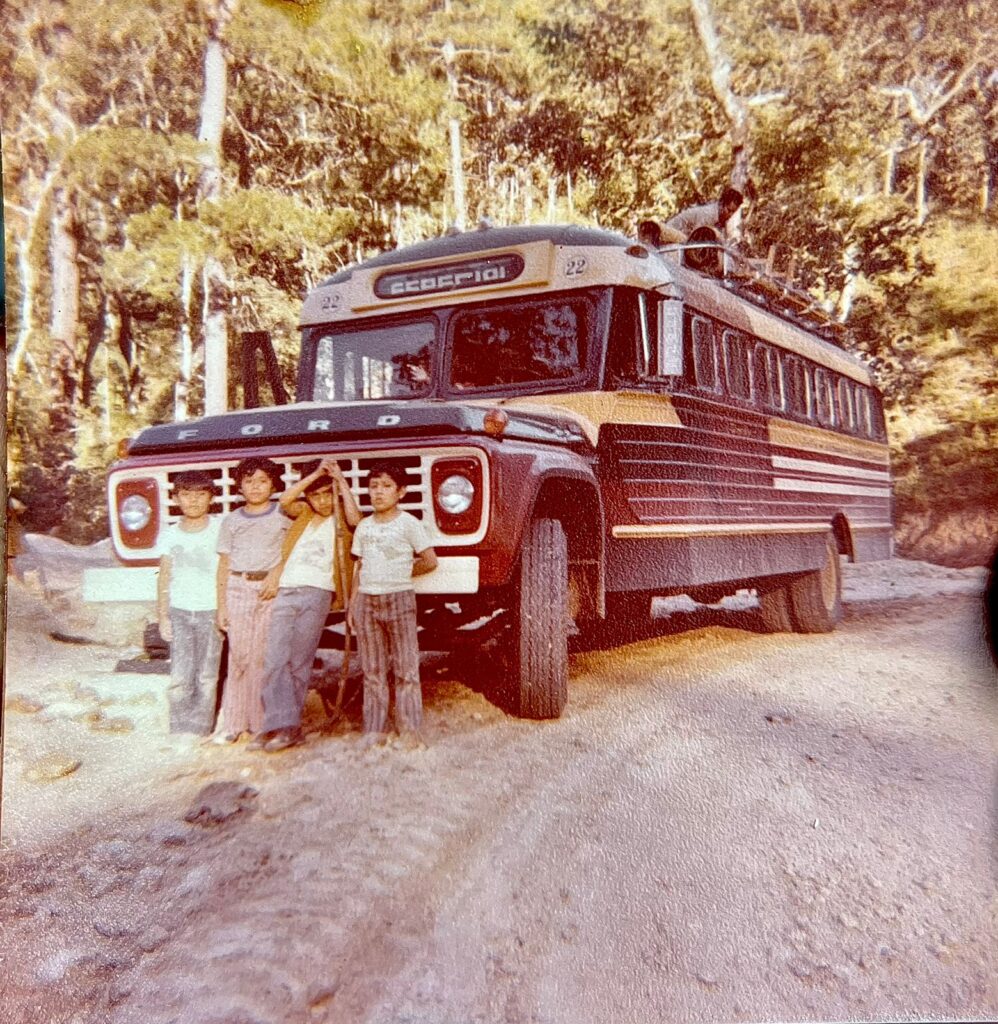
By the time he was eight or nine, he was helping his father supervise the workers who hustle passengers onto the bus and take money for the tickets. He says he learned the boundaries between friendships and work at a young age.
César thinks it was these formative experiences that first led him to the automotive industry, and subsequently inspired his approach to working with mezcal. “From that experience, I’ve reflected, trying to understand why I was always kind of into quality, into inspection, into supervising,” he says.
His father enjoyed mezcal, and would bring back bottles from Sola de Vega. Although César grew up in mezcal country, with the beauty of the land and culture all around, his father’s drinking habits overshadowed this experience. César says he used to “hate” mezcal because sometimes his father would not come home after work, instead staying in the cantina till late into the evening. As a child, César knew all the bars because he would have to go find his father and help him home.
When César was 18, he moved to Puebla for college. While in school, he got an internship with Volkswagen in Germany. He quickly rose up the ranks, taking on more and more responsibility. César loved the job. However, he thinks it was the ceaseless pressure of this highpower career which led to a crippling heart attack, putting him in hospital for over a week.
The sterile silence of this recovery room inspired him to make a major life change. “Inside my room, everything was aluminum, stainless steel. Perfectly clean. But it was dark and cold.” Through the window, he could see palm trees, and the sun rising. Below, he saw people rushing to work. Watching this scene, he reflected: “There is a huge difference between being inside this window, this room, where everything is dark, silent, and dead. And I don’t want to be here. I want to be outside.”
César had an uncle with some semi-abandoned land about fifteen minutes from the Oaxaca airport. Even though he was meant to be taking some down time, César saw the land and his mind went to how he could utilize this space and support his uncle. “Before my heart attack I had learnt that agave farming was very profitable at the time. I wanted to combine spending time outside with helping my uncle earn a good return on his plantation.”
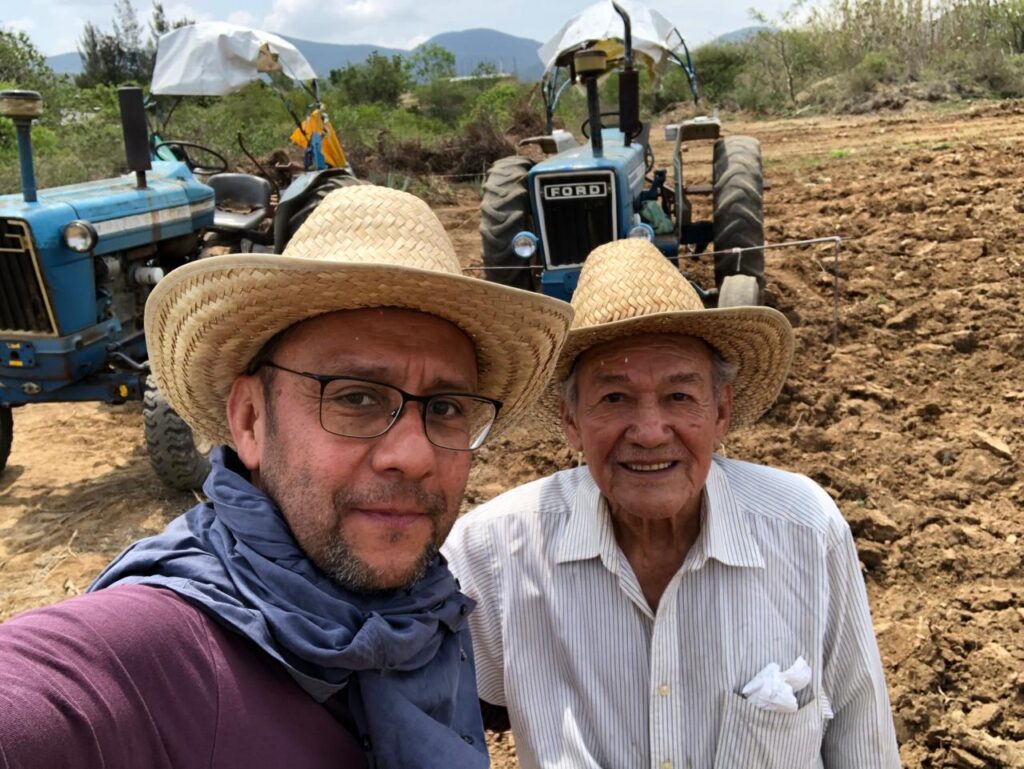
Together they started to work this land, growing agave and fixing cars together, really embracing the physicality of the outdoors. At that time, in 2018, César was only looking to tend to the land and the plants, with no plan to process the agave for spirits. “I just wanted to be outside. I wanted to go back to my country, my homeland.”
During his initial months of working back in Oaxaca with his uncle, he began to shift his thinking on mezcal. “With my uncle, I saw the positive side,” he reflects.
Around that time, he was approached by a young man who had been helping them purchase and plant agave. This was Rolando Angeles from Santa Catarina, Minas.
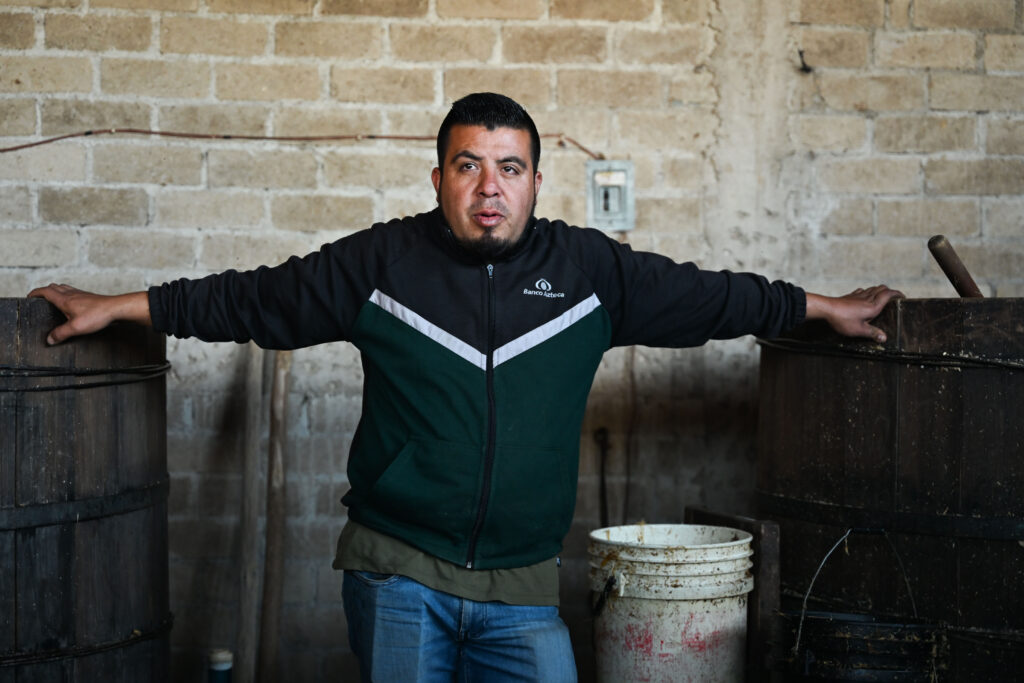
Rolando told César that he was leaving Oaxaca. He was planning to go to the US illegally, because he needed to look for income for his family. Rolando had two daughters at that time, two and five. César, who also has two daughters, was drawn to Rolando’s story, asking him; “What do you need to not go?”
Rolando explained that although he came from a family that had always worked with agave, he had only worked for other producers. He wanted to be his own boss, and make his own mezcal. Although he had some apprehensions about stepping into the world of liquor, César saw an opportunity to help.
He proposed to Rolando that they work together, César putting up the capital to build the palenque and cover the costs of getting production up and running. In exchange, he got 50% of the mezcal produced to pay back the expenses.
César says they didn’t put anything on paper. “I didn’t sign any documents with him. No, it’s just trust. And that’s how we started working together in 2019.”
Although initially César hadn’t wanted to be involved in the production side of mezcal, his engineering background got the better of him. He found himself immersed in the building of the palenque: seeing this endeavour come to life–brick by brick.
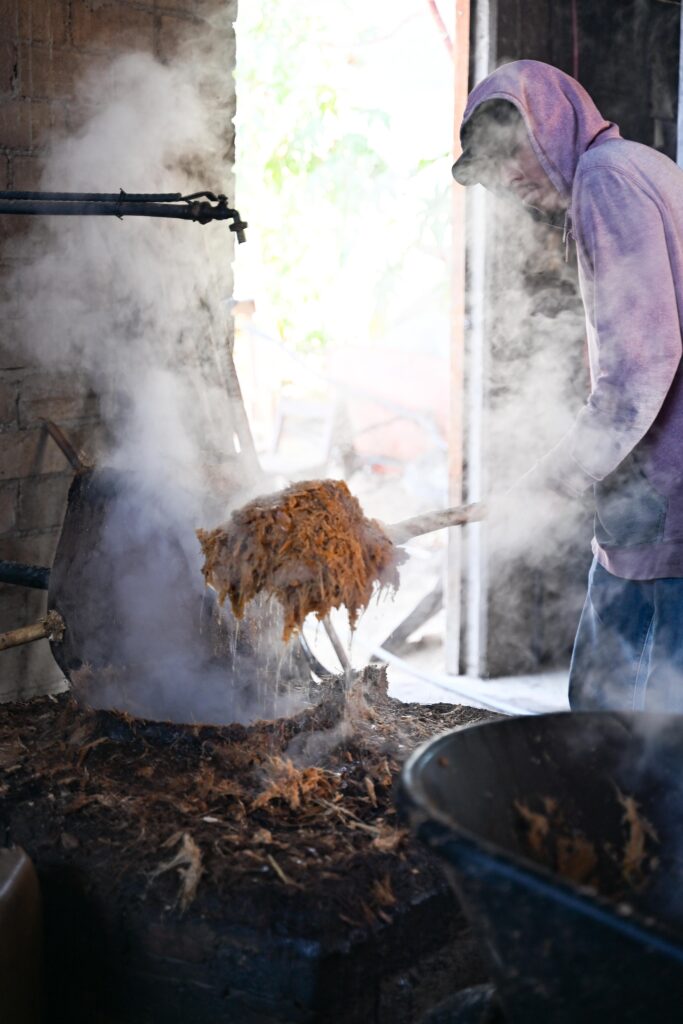
In 2020 they launched the first brand, Despatriado, a clay pot-distilled mezcal. Despatriado refers to someone away from home. This reflects César ’s time away from Oaxaca. It also refers to the tangible moment when Rolando and César met, as Rolando was preparing to leave his family behind.
To begin with, César was keen to make a fully certified product, managing all the legal paperwork himself. However, he and Rolando were met with challenges in their application. In particular, the fact that the ancestral process was producing more methanol than complied for the certification.
Although they were able to pass certification through rigorous cuts, César began to have his doubts. “I understand the rules, the way that federal regulations work to keep people safe and all of that, but if you just put a blindfold on someone and said, tell me which one you like, they don’t know the difference,” he says.
César began to dig into the specifications for mezcal production vs other spirits, and then specifically the health regulations for spirits. He found that many other spirits had less rigorous parameters. For example, brandy regulations allow for much higher levels of methanol than are permitted in certified mezcal.
Although he heard about some “tricks” people were using to pass the certification, he didn’t want to go down that route.
Friends in the industry were talking about another way. César began hearing about brands bypassing the NOM, instead referring to their product as “destilado de agave.” César had some batches that hadn’t passed certification, and he began to find that clients were just as interested to try the uncertified batches. He was surprised! “I still believe the certification should bring some trust, some confidence to the American customers,” he says.
On consideration, César thought “destilado de agave” might be a better way to preserve the real traditions of mezcaleros like Rolando, instead of changing production methods to pass the NOM. “And besides, the levels of methanol and furfural are also up to certain limits that I define myself as perfectly healthy…I did research and I defined my own limits: 450 points of methanol,” César says.
César is against striving to make each batch of agave spirits as similar as possible.. “It’s art,” he says. He makes a comparison between agave spirits and his career in the automotive industry, explaining that with Volkswagen they make 2000 cars per day. But the company also owns the luxury brands, Lamborghini and Bugatti.
“We produce, I would say 70 Bugatti a year. 71. One and a half cars per week, more or less. So when you look at those cars, they are different from each other, even though the materials and the design are the same.” They are hand-worked. This is how he sees mezcal.
“The type of wood you use, the amount of wood you put, the time that you cook the thing, the amount of dirt you put on top. So many things that you cannot control. It is ridiculous that we are trying to make Mezcal pass a norm,” he says.
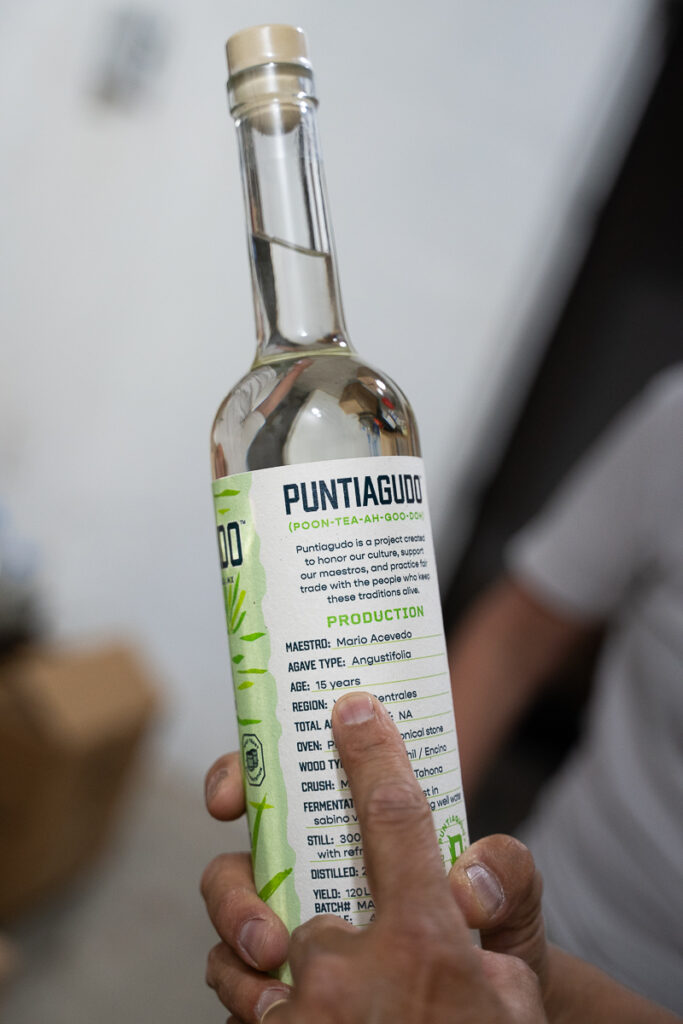
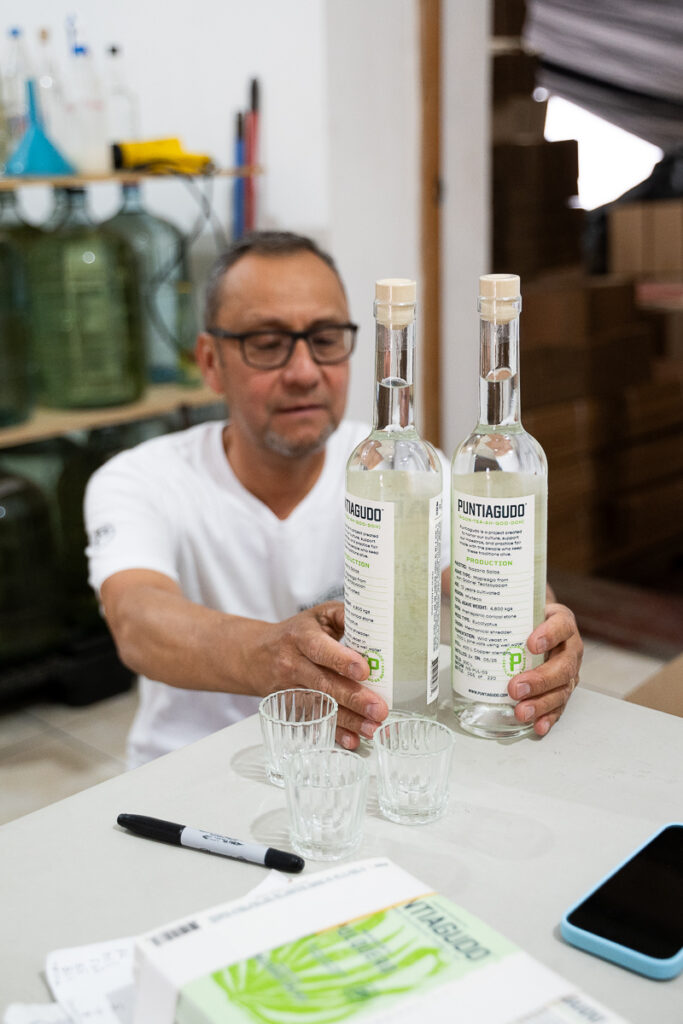
This concept led to the development of the second brand, Puntiagudo. This is made up of limited edition batches of agave spirits from several producers.
The name “Puntiagudo” (meaning “pointed”) has a double meaning: it refers to the pointed shape of wild agave leaves and stalks (quiotes), and it honours the “puntas”, which are the first and highest-proof portions of the distillation process. The original label shows a wild boar, expressive of the brand’s wild character.
Following the success of the collaboration with Rolando, César was open to working with other producers. Now, the spirit batches that César has selected for Puntiagudo showcase Oaxacan and Pueblan diversity, told through the hands of maestros: Rolando Angeles from Minas, Onofre Ortiz Ortiz from Miahuatlan, Rubén Lopez Diego from Albarradas and his wife Bertha (a master mezcal maker in her own right) and Nazario Salas Rosas from Puebla.
Nazario and César met in 2021 and have been collaborating since 2022 to improve production conditions by providing the necessary equipment to better control yields, quality, and costs. Nazario works with varieties like Pulquero (Salmiana), which is a massive agave (up to 170kg) that can produce a distillate that is surprisingly fresh, light, and minty.
For César, the priority isn’t just volume; it is social stability. He paid maestros in advance, carrying the financial burden of the batches, and encouraging the producers to be independent. He helped Nazario register his own brand and introduced him to accountants to handle the complex tax paperwork of the industry.
A primary goal of the brand is to provide financial stability and business advice to Oaxacan producers, helping them become self-employed so they can provide for their families without leaving their communities. This includes paying maestros in advance and helping them register their own brands.
César expresses concern about the extractive nature of mezcal production, with too many brands claiming sustainable measures, without really doing much. He also sees big companies driving down the prices as a significant problem for the industry.
He thinks the reality behind the price points for these big productions is additives and cane sugar, which makes it an unfair market for brands that work with pure agave. Having worked with chemical profiling with chromatography machines at Volkswagen César believes it’s something that can be tested for.
César says: “The corruption in the mezcal industry damaged the reputation so much that nowadays the certification doesn’t mean enough and is almost opposite to the original intentions.” He believes COMERCAM will have to make big changes if they want to prevent the mezcal category from being supplanted by agave distillates.
Discussing the future of mezcal, César says he would love to see companies help and invest in the infrastructure of the towns; water treatment or digging wells and reforesting. “I would also like to see COMERCAM pushing those companies, saying okay, 5%, 3%, 2% of your profits should be reinvested in things like reforesting or water treatment,” he says.
Despite challenges in the industry, César is optimistic about the future of agave spirits, and is excited to share the next steps of this journey with his daughters Emma and Julia–who is interested in working on the sales side of things in the US. Julia is inspired by her fathers tenacity and the relationships he has built with the maestros. She says he looks for the “why” more than anyone else she has met. He “brings the passion of an artist with the methodology of an engineer,” she says. This is apparent with every batch of Puntiagudo.
César says,“There is more recognition for the women involved in the mezcal production, some legitimate and some fake for business purposes. There is also more involvement in the bar industry, marketing, and media.” He is curious to see if these developments will test the traditionally “macho” character of the industry.
Reflecting on Julia’s entrepreneurial spirit, César looks back to his father. “Are these passions from nature or nurture? Despite a complicated relationship with alcohol early on, César thinks his love for mezcal stems back to their relationship: “Knowing that he was also a mezcal lover.”
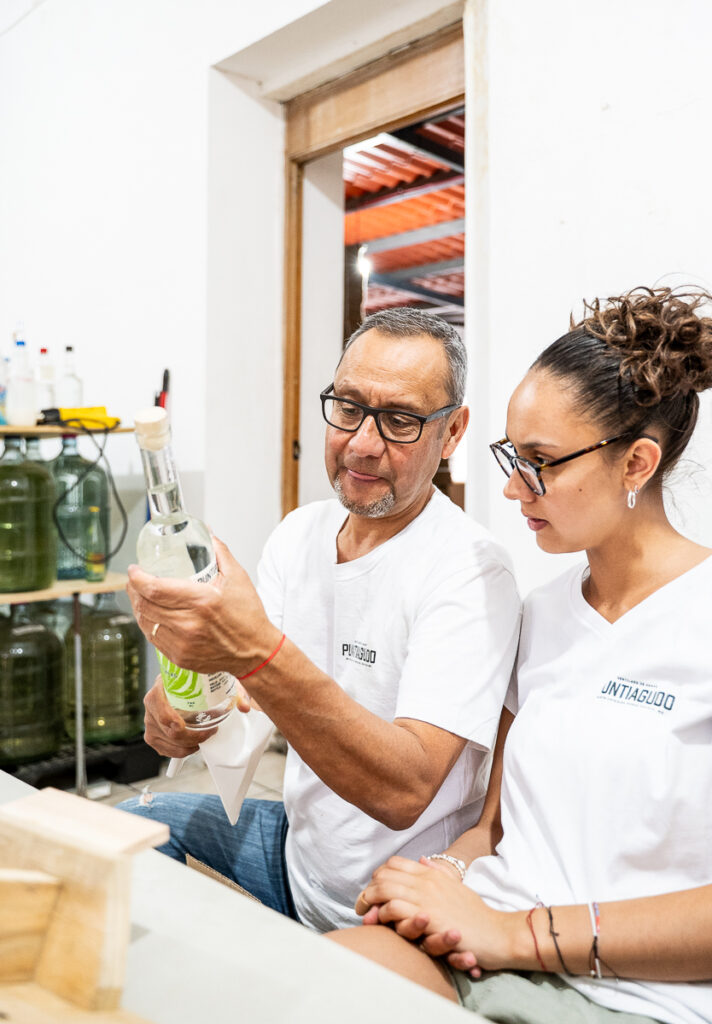
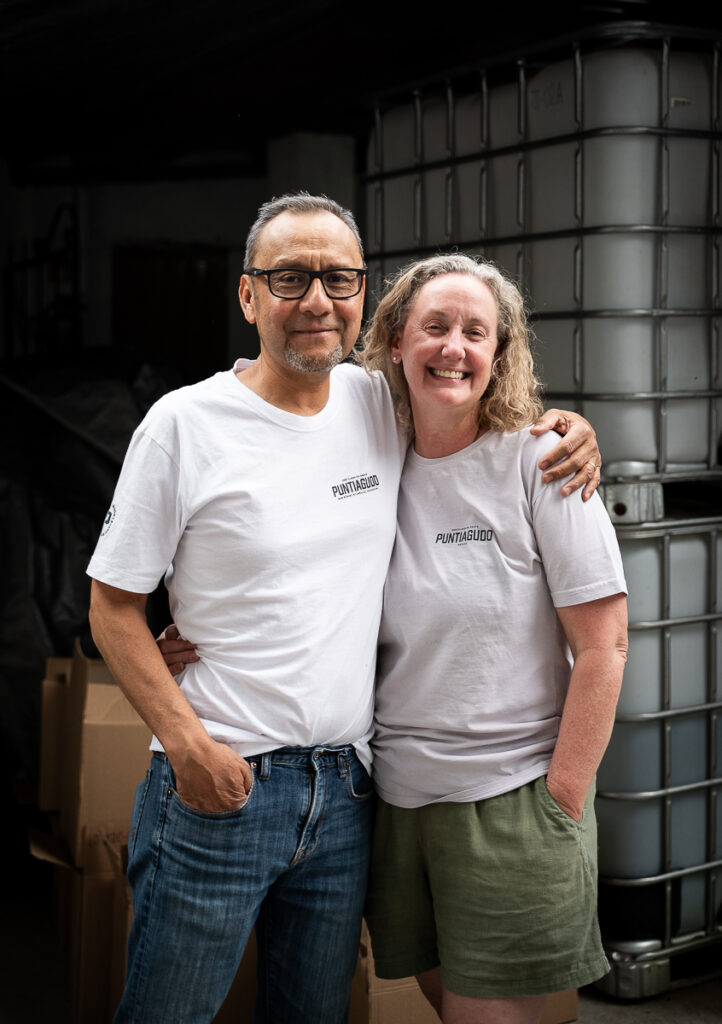
I joined César, his wife Holly, and his daughter Emma while they personally filled and labelled almost one thousand bottles at their storage facility in Oaxaca. The new range they were packing for Puntiagudo is made up of several limited edition batches, each with a unique label designed around the plant or the story of the particular batch. These labels were taken from sketches done by Julia, printed on beautiful cotton rag paper.
One of the most interesting expressions from the new range is the Niños Viejos, a tiny batch made from Angustafolia that took around fifteen years to mature. This batch was produced by Mario Acevedo, from Santa Maria Velato, Oaxaca.
Once they finished filling and labelling bottles, César, Holly, and Emma boxed them up, and then perfectly configured on palettes. César showed me how he uses an app to maximise the quantity of boxes that can be stacked together, a puzzle that perfectly expresses his enthusiasm for every detail that goes into the production of a brand.
César’s incentive is not financial–he has that stability from his career with Volkswagen. “My mission is to promote the culture, to help maestros to become independent and to let them go at a certain point, meet new maestros and help them again.”
Rolando says that working with César has given him the confidence to make a quality mezcal and he is keen to continue working with César and Julia, “to maintain the quality of ancestral mezcal, as it’s an art and heritage from our ancestors.”
César believes that while a team is necessary for production, the quality of the spirit is the direct result of the maestro’s wisdom. The master distiller is the one capable of “calling the numbers” to define the profile of the spirit. It is his goal with each batch of Puntiagudo to celebrate this skill and passion.
What makes Puntiagudo unique in the crowded mezcal landscape is the synthesis of César s “German mentality”—a legacy of his decades at Volkswagen—with the traditional “wisdom” of the Oaxacan maestros. For thirty years, César lived his life as an engineer, with precision and corporate deadlines, now he is working with family and celebrating his Oaxacan roots, sipping on the best agave distillates around!
From the mineral-rich soils of Minas to the minty freshness of Puebla’s Pulquero, Puntiagudo offers a window into the diverse landscapes of Mexico, curated by a man who survived his personal journey and physical trauma to re-embrace the sunsoaked landscapes of his agave rich homeland.
For the mezcal enthusiast, Puntiagudo is more than a drink; it is a testament to perseverance, engineering, and the deep, “pointed” soul of the agave.




Leave a Comment