This March in Oaxaca, the Mujeres del Mezcal association hosted a rooftop feria, led by president Angélica García Vázquez, with presentations and tastings offered by other leading mezcaleras.
Last week I went to see Angélica with a group from the Master Mezcalier course. There was an air of excitement from the students, who were keen to meet this maestra they recognise from an iconic image of mezcaleros (which she has hanging in her tasting room).
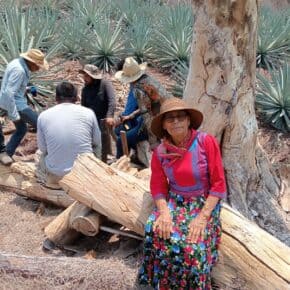
In this black-and-white photo, she stands front and foremost, wearing traditional dress from her pueblo, hair in a turban and her arms crossed in front of her. She is the only woman. At first glance she is serious, staring intensely at the camera. But there is the twinkle of a wry smile in her eyes.
Doña Angélica on taking refuge in making mezcal
On meeting Angélica, it’s clear she is still the strong woman from that photo. She has to be, having taken on the role of maestra in the palenque, a traditionally male-dominated environment. However, her smile and soft-spoken generosity also make an impression.
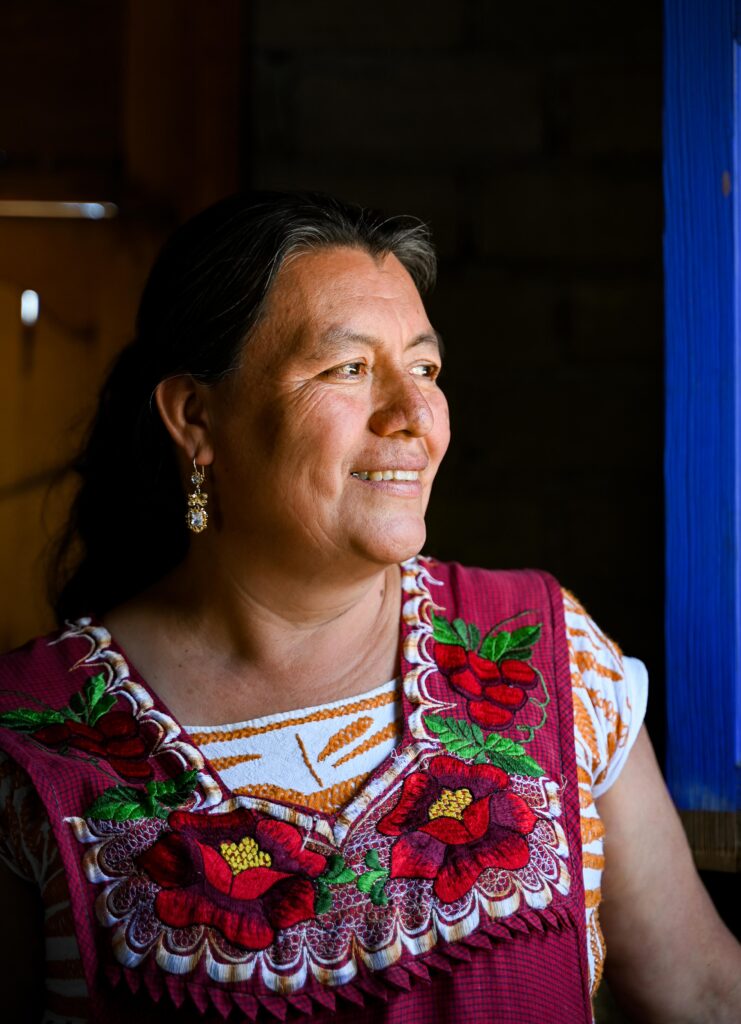
Angélica is a third-generation mezcal producer from the Zapotec community of San Baltazar Chichicápam, Oaxaca. She is the owner of the brand Yzacubi, which means “New Calendar” in Zapotec. In addition to her own label, she sells mezcal to other brands, including “Besos de Angélica” in California.
Angélica is also the daughter-in-law of Bertha Vasquez, a woman often described as a legend of mezcal, and credited with raising the profile of women in the industry.
Growing up in a mezcal-producing family, Angélica watched her grandparents and parents transform agave hearts into spirit. In 1997, she co-founded the “Palenque El Torito” with her husband. (Her husband was given the name “El Toro” due to his stature, and their son was affectionately nicknamed “Torito.”) For years, her involvement was indirect; while her husband worked as the mezcalero, she managed the household and cared for their children.
When her husband passed away, Angélica took over the distillery. Left with four young children and no other source of income, she says she “took refuge” in the production of mezcal to support her family. Although she had always been around the palenque, she had to become fully integrated into every stage of the production chain, from planting and cutting agave to the final distillation.
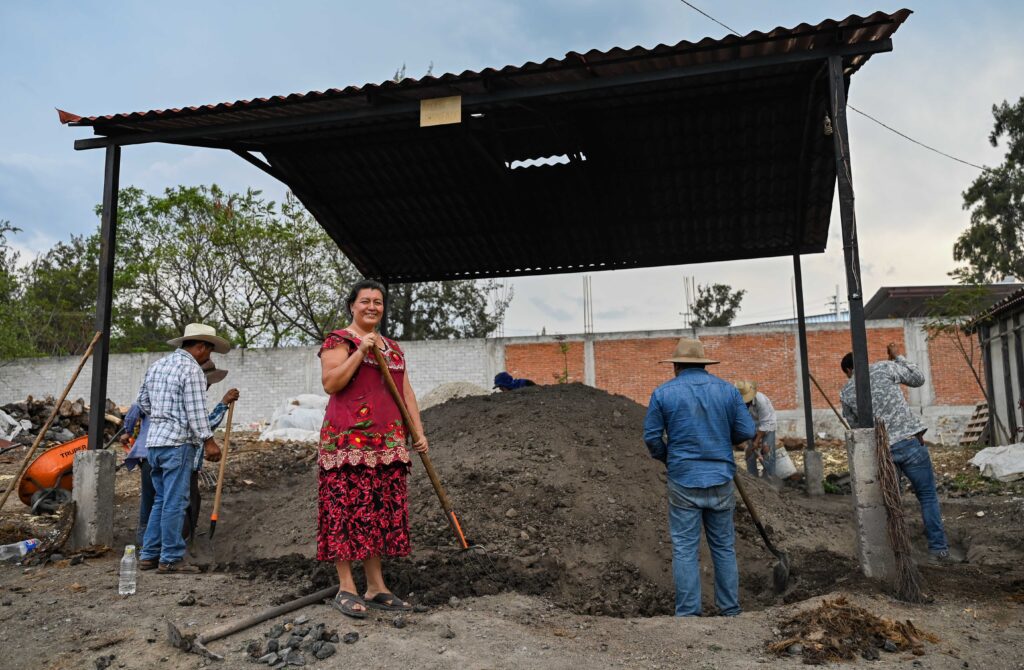
Angélica’s favorite part of the production process is distillation, which she views as a time for community and sharing stories with elders. She is highly skilled in sensory evaluation, meticulously tasting the “cuts” of the distillate to achieve a precise 46-degree alcohol content.
Despite an affinity for the process, Angélica faced challenges early on. She remembers that when people saw her working alone, they treated her badly. “They don’t want to work for you, they don’t want to deal with a woman selling mezcal,” she says.
She also had to contend with the belief that a woman’s presence in a palenque would cause the production process to fail or prevent the agave from cooking properly. Some men refused to work for a woman, and Angélica encountered male buyers who preferred to negotiate with a man rather than a woman. “They used to say that women couldn’t work at a palenque because their mezcal wouldn’t be profitable, that it wouldn’t turn out well,” she says.
Despite this resistance, she persevered, building a reliable team that includes her son and son-in-law. Today, she continues to manage her palenque with the support of all her children, ensuring the family legacy continues into the next generation.
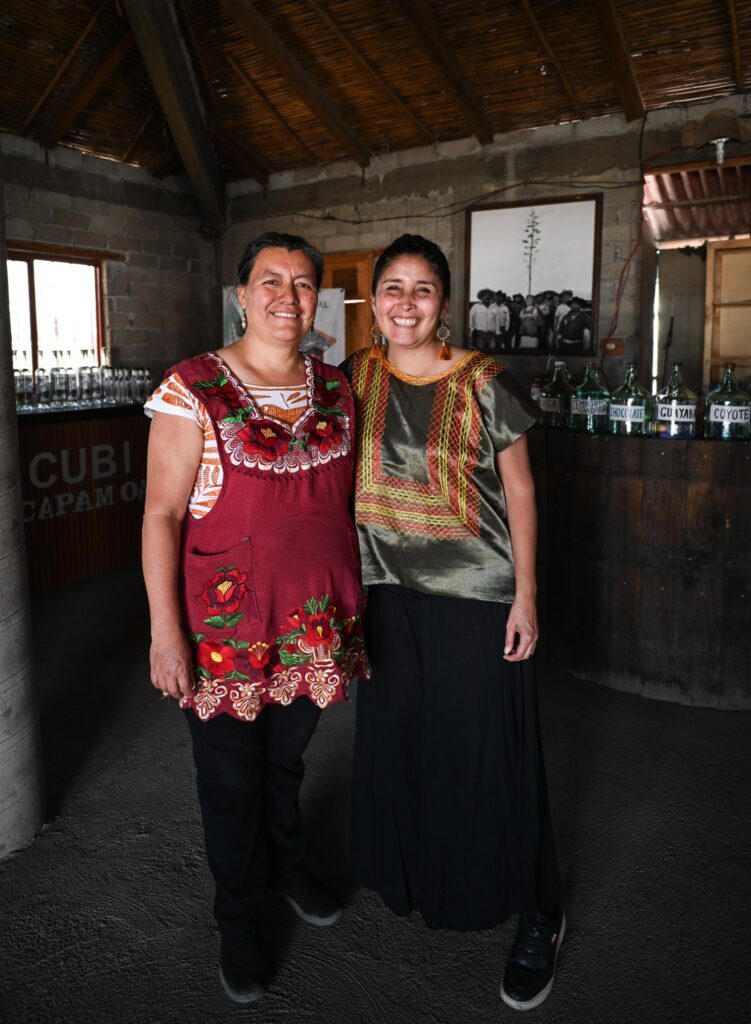
While taking over the entire production chain, from cutting agave to distillation, Angélica made a point to disprove myths and prejudices. If she had a production issue, she would make a note about the real cause–technical factors like a damaged oven or lack of firewood, rather than her gender.
Now Angélica is recognized as a pioneer for women in the mezcal industry. In 2021, she was the only woman among ten maestro mezcaleros to participate in her community’s first Mural Festival, an event that helped to formalize her recognition as a master producer. (This is where we get the iconic photo of her that hangs in the palenque.)
Mujeres del Mezcal provides a network of support for female producers and woman-owned mezcal brands
Mujeres del Mezcal was founded in 2021 supported by CANAIMEZ, Comercam, and a national movement of women in the spirits industry. In the ensuing years, the group has grown from 22 founding members to over 250 women across the country. Their mission statement proclaims: “We have always been present in the agave mezcal production chain and now, together, we are visible.”
Angélica says joining the Mujeres del Mezcal association provided her with “the freedom and opportunity” to make her work known, offered logistical support for branding and labeling, and eventually led to her appointment as president. In her role as president, she continues this work, providing other female mezcal producers with training, logistical support, and increased exposure.
Angélica explains, “The purpose of the event on March seventh was to showcase the work of the women who are involved in everything from the initial agave cook and milling to fermentation, distillation, and sales, and to introduce our different varieties of mezcal.”
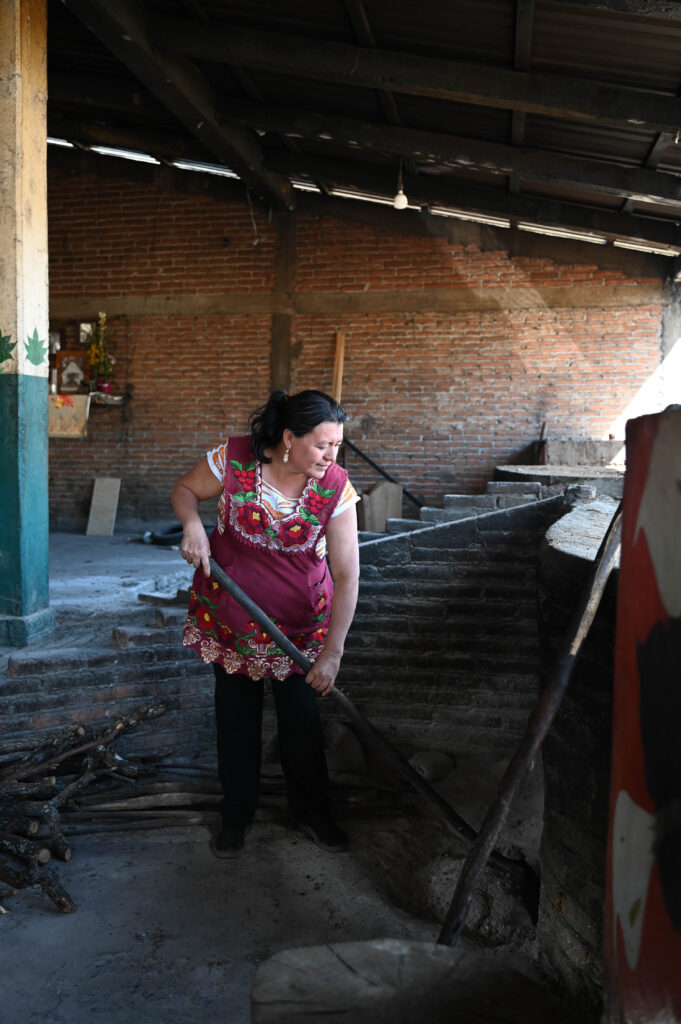
The event illustrates an emerging leadership of women within the traditionally male-dominated mezcal industry. Reflecting on the event, Angélica said: “I learned that together we are more visible and empowered in the mezcal production chain.”
The group provides training in branding, labelling, and legal certification, helping women move from selling bulk liquid to owning identifiable mezcal brands. Through digital platforms like WhatsApp, members offer daily assistance with logistical challenges, such as finding suppliers for labels or navigating shipping.
Dena Chagoya on the changing roles of women in mezcal
Dena (Denise) Chagoya is a fifth-generation mezcal maker and former president of the Mujeres de Mezcal Association. I was lucky to bump into her at Angélica’s palenque and share a mezcal with them both.
Dena is an academic, and speaks clearly and candidly on the cultural barriers women have faced in the mezcal industry.
Dena remarks that while women have historically been integral to the tradition and culture of mezcal, they were labelled as “cooks” or “housewives” rather than “mezcal producers.” In the past, she and other women working in the industry were sometimes unfairly labelled as “drunks” or “loose” because of the environment they worked in.
However, she believes the biggest challenge is often the women’s own fear of judgment in their communities. She describes how difficult it can be for a woman from a deeply rooted community to identify as a mezcal producer because of the fear of what others will say, of other people’s prejudices. The association works in very remote areas, including the Mixteca region, the northern and southern Sierra, the coast, and the Isthmus.
Dena emphasizes that groups like Mujeres y Mezcal are vital. She explains that the women in the association are “gaining confidence, supporting each other, and changing the mindset so that we are recognized as the mezcal producers we are, gaining credibility, and fostering support networks among ourselves.”
She proudly identifies the current era of women as the “first generation of visible mezcal producers.”
In her thesis, “Sensory Studies as a Competitive Advantage for Small Mezcal Producers,” which she researched with Dr. Gabino Martínez from the National Polytechnic Institute, Dena highlights how women are more likely to be “super-tasters.” She explains how they often have a better sense of smell–not to mention a more developed sense of responsible consumption than men, which provides a competitive advantage in creating high-quality products.
She describes other key areas where women excel, such as innate dexterity when planting seeds and caring for young plants, and the famously attributed female skill of “multi-tasking.” Women balance rural agricultural work with housework, administrative money management for the distillery, and the physical, mental, and emotional labour of raising children and teaching new generations.
Due to what she calls an “instinct for preservation,” Dena views women as natural ambassadors for sustainability. They often promote responsible agricultural practices,such as polyculture (planting corn and beans alongside agave to nourish the soil), andadvocate for the balanced use of natural resources to protect the industry for future generations.
Dena calls for a broader definition of mezcalera
Dena defines a mezcalero as: “someone dedicated to any link in the agave-mezcal production chain, from the primary link (the plant) to commercialization.” Therefore “the female mezcal producer can be urban (generally involved in marketing or promotion) or rural, living in rural communities (generally dedicated to farming and household chores, mezcal production, sales from home and at fairs and expos, teaching her children, and often adapting the traditions and work methods to which she was accustomed, thus contributing to the development of the culture).“
Until recently, it was rare to meet a leading mezcalera. A couple of “legendary” women like Dona Bertha led the way, but in a way, highlighting these individuals just proved the lack of representation. Today, the role of women in the mezcal industry is undergoing a significant transformation, with female producers taking ownership of their work across the entire production chain, from planting agave and scientific research to distillation and marketing.
Dena writes of female mezcal producers: “Participation in the world of mezcal challenges stereotypes, and despite the prejudices that can arise from working with an alcoholic beverage, they themselves are now seeking greater recognition and visibility in the mezcal industry, celebrating their heritage and contributing to the local economy.”
As we celebrate contributions of women to the mezcal industry, it’s important to recognize the challenges they have overcome and continue to face. As Dena puts it: “In the symbolic world constructed in the palenque, there are tensions and contradictions, especially when it comes to mezcal women.” Producers like Angelica, Dona Bertha, and Dena herself have overcome preconceptions about their capacity to manage a palenque, produce quality mezcal, and social stigma in the mezcal industry. Now they are preserving cultural heritage, while driving economic growth and environmental stewardship. Their collective efforts are transforming the palenque into an inclusive space, honoring both ancestral traditions while pursuing modern commercial success.




I believe actually a correction is justified. I believe Berta’s role in starting the palenque is being left out. I believe that Berta who was the more active mezcal maker at the time and she is actively co-founded and ran the palenque with her son who was married to Angelica. The property was put his name, as the male, -/ but at that time he was making mezcal with his mom. why leave her out of the founding? it honestly wouldn’t exist without her, it was in her son’s name so then when he died it passed to Angelica.
Hi Amy – we’ve been through this piece a few times and cannot see where a correction needs to be made. The contribution of Bertha Vasquez to the world of mezcal is well documented on our pages and in this piece. There are a lot of complicated family dynamics and we will leave it at that.
Really appreciate how you make everyone feel included and welcome in this space 🌟
Thank you!