Inside Moderniza IEPS, an organization fighting to fix the fiscal system that’s pushing Mexico’s small mezcal producers off their own shelves.
In seven years of writing about mezcal, I have developed a habit. Every time I talk with a producer, I ask the same question: are you exporting, or do you want to? Roughly nine out of ten say yes — not always with a plan, not always with certifications or capital in place, but with an orientation that has become the default posture of an entire category. The domestic market is not where they are looking. The reasons why are the subject of this piece.
Moderniza IEPS is a Mexico City-based non profit organization building the case that Mexico’s alcohol tax system — specifically the Impuesto Especial sobre Producción y Servicios, the federal excise tax on distilled spirits — is not merely burdensome for small producers. It is, they argue, architecturally biased against them: designed for industrial scale and never updated to reflect a craft spirits category that has become one of Mexico’s most recognized cultural exports.
The evolution of Mexican liquor taxes
The history of IEPS on alcohol spans six presidencies and more than three decades, and its direction has been consistent. Under Carlos Salinas in 1992, spirits were taxed at 44.5%. Under Ernesto Zedillo, between 1994 and 1999, the system was restructured multiple times, introducing graduation-based tiers that applied progressively higher rates to beverages with higher alcohol content. By 1999, spirits over 20% ABV — which includes virtually all traditional mezcal, raicilla, sotol, and bacanora — faced a rate of 60%.
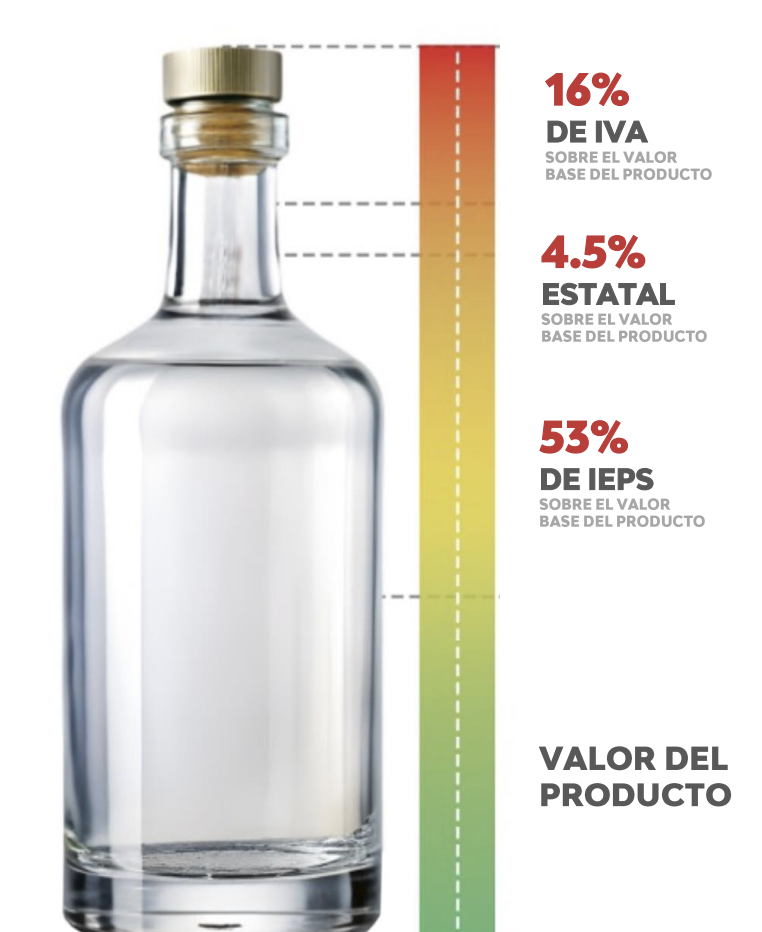
Vicente Fox maintained that structure without modification. Enrique Peña Nieto’s 2013 reform reduced the headline rate on spirits over 20 degrees GL from 60% to 53% and introduced the current ad valorem model, under which IEPS is calculated as a percentage of sale price rather than a fixed amount per liter of pure alcohol.In 2013, mezcal was just beginning its international moment but prices hadn’t followed yet, and the distinction between taxing value versus taxing volume was easy to overlook. Over the following decade, as mezcal’s international profile and prices rose, the government’s IEPS revenue from those same bottles rose automatically — no new legislation required.
Under Claudia Sheinbaum’s administration, three scenarios are under discussion for 2026: an across-the-board rate increase, potentially as high as 83%; mixed schemes proposed by industry associations; and a switch from ad valorem to ad quantum with fiscal credits for small producers — the scenario Moderniza IEPS has been working toward.
Five percent, forty percent
José H. de Lucas, a criminal lawyer who leads the Moderniza IEPS campaign, returns consistently to a single statistic. Industrial beer accounts for approximately 95% of all alcohol consumed in Mexico. Everything else — mezcal, tequila, raicilla, pulque, sotol, bacanora, wine, whiskey — is the remaining 5%. That 5% generates more than 40% of all IEPS alcohol revenue.
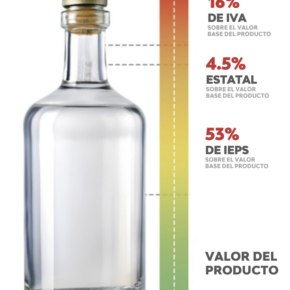
It’s the kind of architecture you get when beer was the only industry in the room when the rules were written, and nobody has rewritten them since. Industrial beer doesn’t require a marbete, the tax stamp that distilled spirits producers must obtain and affix to every bottle. The 4.5% final-sale tax on spirits applies in 18 Mexican states but explicitly excludes beer. At 53% ad valorem, a 900-peso artisanal mezcal generates far more IEPS per bottle than a 30-peso industrial lager — a palenquero making 500 liters a year and a multinational brewery moving billions, taxed by the same percentage.
“The floor is uneven,” de Lucas says — the phrase that has become shorthand for the campaign.
Euromonitor studies commissioned by Moderniza IEPS estimate that around 20 billion pesos in IEPS revenue are lost every year to informality, non-compliance, and the structural barriers that keep producers outside the formal system. Which makes you wonder if fixing the floor is really about political will, or are there other interests in government making sure nobody runs the numbers again.
The proposal
What Moderniza IEPS is calling for is, in global terms, closer to standard practice than what Mexico currently has.
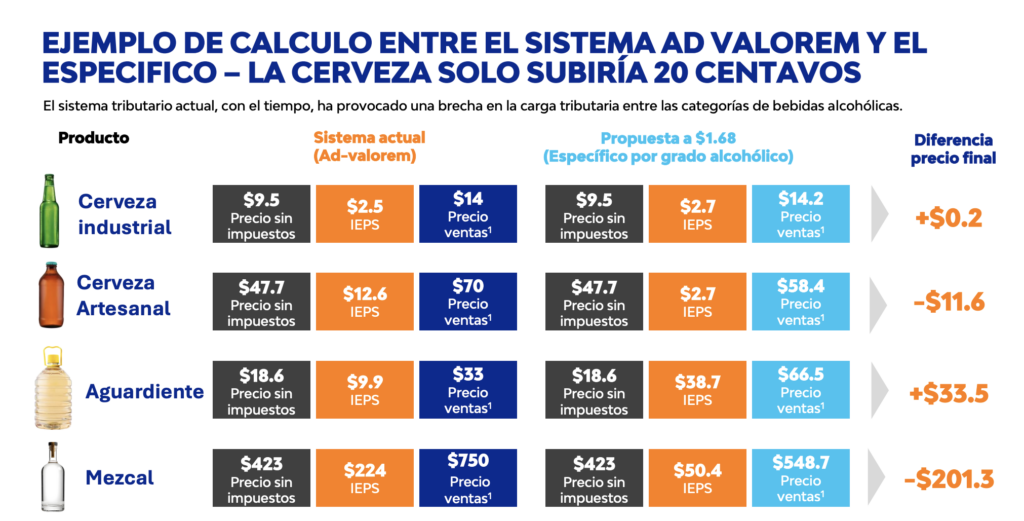
Take a bottle that sells for 423 pesos. Under the current ad valorem system, the 53% IEPS adds 223 pesos, bringing the final price to 753 pesos. The tax scales with price which means the premium that quality commands is also the mechanism by which the fiscal burden grows. A small producer who makes something exceptional and prices it accordingly gets penalized for that quality in a way an industrial producer, with lower per-unit prices and far greater volume, never does.
Under ad quantum, the tax is calculated on the volume of pure alcohol — a fixed amount per liter of ethanol, regardless of what the bottle costs. At a rate of $1.68 pesos, that same 423-peso bottle would owe 50.4 pesos in tax instead of 223. A 47-peso bottle of craft beer, on the other hand, would go from paying almost nothing under ad valorem to owing 2.6 pesos — eleven pesos less than the mezcal example loses, but for beer, a real increase from a baseline of close to zero.
Fiscal credits for certified small producers would add the differentiation the current system doesn’t have at all.
The World Health Organization (WHO) recommended ad quantum structures in 2006 and again in 2010. The Organization for Economic Cooperation and Development (OECD) reports that 33 of its 37 member countries use ad quantum or a hybrid. The EU harmonizes alcohol taxes across member states through volumetric special taxes per hectoliter of pure alcohol. The US applies a federal ad quantum excise tax with reduced rates for small distillers — a protection that’s been central to the American craft spirits boom.
“The argument to Hacienda (also known as Secretaria de Hacienda y Crédito Público is the equivalent to the IRS in the U.S. ) is not ideological,” de Lucas says. “It’s technical, it’s supported by international data, and it shows the reform pays for itself. The question is whether there’s political will to make it happen.”
What Mexican liquor industry insiders see
Xavier Amayo runs Destilería Tlacolula and oversees the export of Los Amantes mezcal to the US and Europe. He’s navigated the system successfully, and he’s blunt about why most producers can’t. Many, he says, simply stop paying taxes — the combination of the tax burden, certification costs, and SAT compliance makes formality irrational for a small producer without his kind of vertical integration. He also points out something that’s easy to miss if you don’t live here: foreign wines are more accessible to Mexican consumers than domestic mezcal. For producers who’ve built export relationships, the math is simple — lower tax burden abroad, better margins, a market that pays for what the product actually is. “It helps to own the full supply chain,” he says.
For the producers who do make it onto those shelves, the economics still don’t get easy. Café de Nadie carries Real Minero because the reputation of the bottle justifies the risk of it moving slowly. A shot runs 400 to 420 pesos depending on the expression, a price the bar sets high enough to protect itself against slow turnover. “The producer can’t lose money,” Mapo says. “So the bar takes the risk.” In eight months, they go through about six bottles. Conclusion: the bar bets on the brand, prices for patience, and hopes quality eventually does what marketing can’t afford to.
Stephen O’Halloran, an agave educator and brand ambassador in San Diego, sees the same thing from the other side of the border, in reverse. Mexican visitors at his bar stop in front of the mezcal shelf, surprised by what’s there. They try things they’ve never had at home. They ask him about producers from their own country — and he’s the one answering. And sometimes, standing in front of a selection that would hold its own against the best bars in Mexico City, someone asks: do you have 400 Conejos? The one bottle that’s actually easy to find back home.
The corporate bar tab
Walk into a lot of bars and restaurants in Mexico and you’ll notice the same things repeating: the branded glassware, the fridge with somebody’s logo on it, the staff shirts, the ice buckets, the posters for an event that happened six months ago. None of that is free. Big spirits and beer companies pay for it, sponsorship by sponsorship, and what they’re buying is loyalty before a single bottle gets sold. They can also extend payment terms — 30, 60, 90 days — on what the bar orders. For a company moving millions of cases, that’s a marketing line item. For the bar, it’s credit, and credit tends to buy more loyalty than quality does.
Even well-known restaurants carry debt to large distributors. That debt shapes what shows up on the menu and what quietly disappears from it, in favor of whoever is already paying for the fridge.
The small mezcal producer has none of this. A limited batch, payment needed on delivery, no budget to send a bartender to a national competition. What they have is what’s in the bottle. In a market where visibility is purchased, that is not enough to guarantee survival.
One of the things de Lucas and Moderniza IEPS keep pushing into these conversations is a concept I’d genuinely never heard discussed before talking to them, and it turns out it’s already written into Mexican law. Under NOM-142-SSA1/SCFI-2014, a bebida estándar — a standard drink — is defined as any serving containing 16 milliliters of pure ethanol. A 330ml (11.2 US oz) beer at 5% has 16ml of pure ethanol. So does a 140ml (4.7 oz) glass of wine at 12%. So does a 40ml (1.35 oz) pour of mezcal at 40%. In terms of actual alcohol, a beer and a shot of mezcal are the same drink. The norm has existed since 2014, and I am not sure how many people know it’s there.
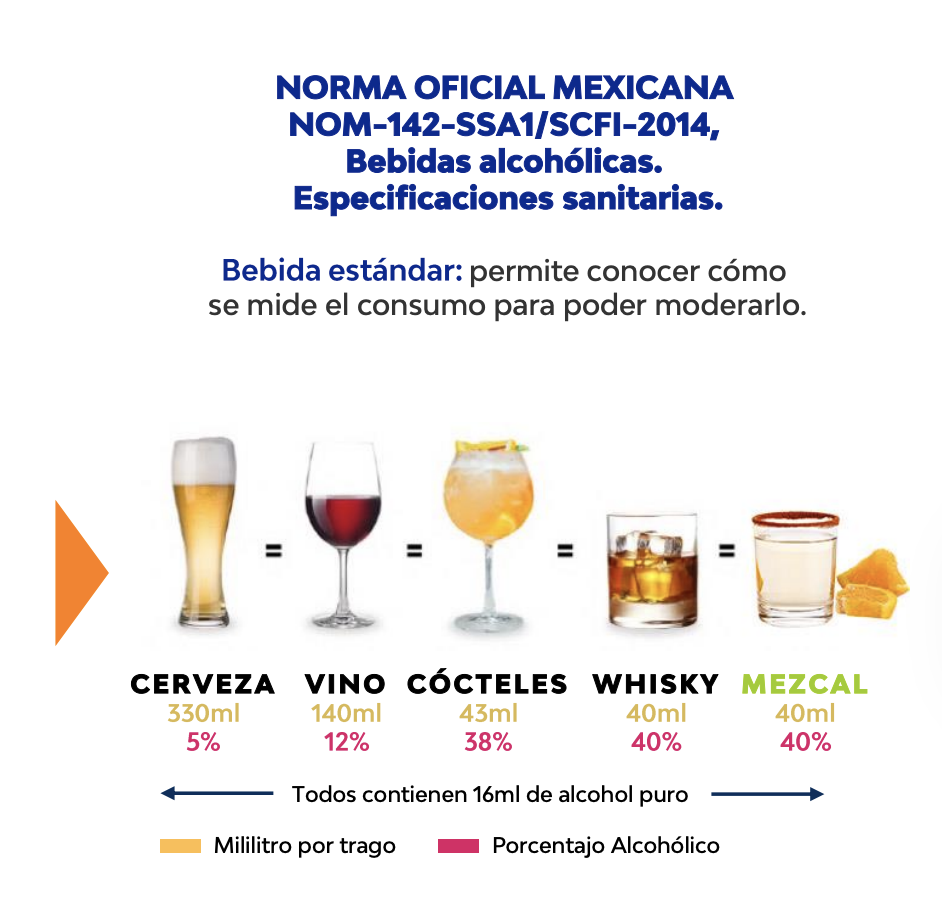
That gap matters, because the fiscal result follows directly from it: a 40ml pour of mezcal generates a lot more IEPS than beer with the same amount of alcohol in it, purely because it costs more. The tax isn’t really about alcohol. It’s about price. And the industry that’s kept its price the lowest carries the lightest load.
Heineken has announced a new plant — 40 hectares, on the Mérida-Chetumal highway. Beer isn’t going anywhere in Mexico, and the companies that dominate it have no reason to want the rules to change.
A vicious circle
The system Moderniza IEPS wants to change has, in a sense, created its own justification for not changing. In a lot of rural producing communities, not formalizing isn’t tax evasion in any simple sense. It is a response to a social contract that has not been honored.
More than half of every sale disappears in taxes. Then the producer looks around: the road that floods every July, the electricity that comes and goes, a clinic that’s open three days a week if you’re lucky. When that’s the exchange, staying informal stops looking like a moral failure and starts looking like common sense. And then the government points to exactly that informality as the reason these producers don’t qualify for support, don’t show up in the statistics, and don’t get factored into reform. The system is too extractive to make participation worth it, and the lack of participation becomes the excuse for never making it worth it.
SAT registration doesn’t help. Receipts for everything. On-site inspections you have to schedule. Monthly filings — miss one and you’re out of the registry, no second chance. In a community where the Internet is unreliable and not everybody has an accountant on call, staying formal is a constant, precarious effort. When people can’t manage it, someone always shows up offering to “help,” for a fee.
“If you want people to pay taxes, you have to make it possible for them to pay taxes,” de Lucas says. “And you have to make it worth it.” Moderniza IEPS has been taking legislators directly into producing communities, because some things you have to see to believe — the road, the clinic, the gap between what the law assumes and what’s actually on the ground. It’s worked, to a point: there’s been legislative movement in Michoacán, Durango, Oaxaca, and Jalisco, with local legislators pushing initiatives up to the federal level to show this isn’t just a Mexico City conversation.
The political wall
The proposal has data, international precedent, and a multi-state legislative coalition. What it does not have is Hacienda’s consent.
The ministry’s concern is revenue loss — the fear that structural change, even one backed by evidence of net fiscal gains, creates a short-term collection gap that is politically unacceptable. Moderniza IEPS argues this fear is not supported by the numbers, and that industrial beer’s demonstrated price inelasticity makes it less credible still: taxing beer more heavily under ad quantum would not meaningfully reduce consumption or revenue.
What sustains the status quo is lobbying. The corporations whose effective tax burden would increase under ad quantum have resources that no civil society organization can match. The phrase that circulates in policy conversations about this reform is ugly and revealing: ¿qué van a tomar los pobres? What will poor people drink? The logic — that cheap industrial beer must stay cheap, and that small craft producers must carry the fiscal weight of that arrangement — has been the operating principle of Mexico’s alcohol tax architecture for thirty years.
Pushing the rate to 83% would not fix this. It would accelerate informality, shrink the taxable base, and gut the small-producer ecosystem that already punches far above its weight in IEPS revenue. “You cannot solve informality by making formality more expensive,” de Lucas says.
The future Is already here
Moderniza IEPS doesn’t frame this only as fixing an old injustice. There’s also a competitive argument here, and it’s one I found myself thinking while interviewing de Lucas.
Mexico does not hold a monopoly on agave. Ecuador, Peru, Israel, Venezuela and producers in the United States are already making agave-based distillates with genuine craft ambition. The category is growing, international consumers are curious, and the premium that Mexican mezcal commands — built on cultural recognition, geographic identity, and the quality of its best producers — is not automatically permanent.
There’s a second layer to this that has nothing to do with agave at all, and everything to do with timing. This article is being written as the United States-Mexico-Canada free trade agreement – the trade deal that governs how Mexican products, mezcal included, reach American shelves- is currently under review, with Trump saying he’s “not looking to renew” the deal and, more bluntly, that the US doesn’t need “anything” Mexico has to offer. Whatever happens at the negotiating table, the rhetoric alone has consequences: it adds to the uncertainty of Susan’s recent piece on the 2025 mezcal production figures.
For an industry that has spent the last decade building its growth strategy almost entirely around export, that’s not a small thing. It doesn’t mean export stops mattering. But it’s one more reason why a model that depends on producers reaching foreign markets to survive is a model with a fragility built into it that nobody seems to be pricing in.
The producers best positioned to weather any of this — the ones making wild-harvest, ancestral-method, single-village mezcals that genuinely can’t be replicated anywhere else — are also the ones the current tax system hits hardest. Smallest scale, heaviest proportional burden, highest compliance costs, least visibility at home.
Turning a campaign into a movement
Exporting mezcal has been, by almost any measure, a success story. It brought recognition and income to producing communities, and it helped place Mexico on the world stage of gastronomy that no tourism campaign could have engineered. I don’t think that’s something to walk back, and neither does anyone I spoke with for this piece. But I’ve come to think it’s also been a release valve — one that’s let a structurally broken domestic market go unaddressed for years, because there was always another market to sell into.
Export absorbed the pressure that should have forced a conversation about why the pressure existed in the first place. With the US relationship entering a period of real uncertainty, and with other countries starting to plant their own agave, that release valve looks less reliable than it did even two or three years ago. If there’s a moment to also start building the domestic market alongside exports — it’s now. And fixing the tax structure that makes a bottle of mezcal a luxury item in the country that makes it is, as Moderniza IEPS has been arguing for years, where that starts. Not because it solves everything. But because right now, it’s one of the only parts of this that Mexico actually controls.







Leave a Comment