Although we cover all the basics, this comprehensive guide to pulque contains details that may surprise even seasoned fans of this emblemic Mexican drink.
Pulque is not just a beverage; it is territory, soil, oral tradition, and daily practice. To truly understand it, you have to travel into pulque territory: walk the maguey fields, watch the raspado at dawn, taste aguamiel before it ferments, and understand the patience demanded by the plant and the tlachiquero.
This guide offers a clear foundation, but consider this an invitation to go further and add pulque production to your bucket list of things to see.
What is pulque?
Pulque results from the spontaneous fermentation of aguamiel, the sap extracted from mature maguey plants. Aguamiel is rich in sugars and minerals, lightly cloudy, thick, and intensely sweet. The moment it is exposed to air, fermentation begins through native bacteria already present in the plant and the environment.
The origin of this traditional drink is deeply intertwined with the cosmovision of the peoples who inhabited the territories where pulque is still made today. In a previous story, we revisited the myth of Mayahuel, a goddess of the Mexica people whose body became the agave plant itself. Pulque, in this telling, emerges from sacrifice and transformation.
Mayahuel’s partner was Patecatl, a deity associated with medicine and knowledge, credited with understanding how to mix neutli—fresh aguamiel—with roots and herbs. This act could be the mythological precursor to what today is known as la semilla, the fermentation starter. Together, Mayahuel and Patecatl are said to be the parents of the four hundred rabbit gods of intoxication, each one embodying a different expression of drunkenness, excess, and altered states.
What does pulque taste like?
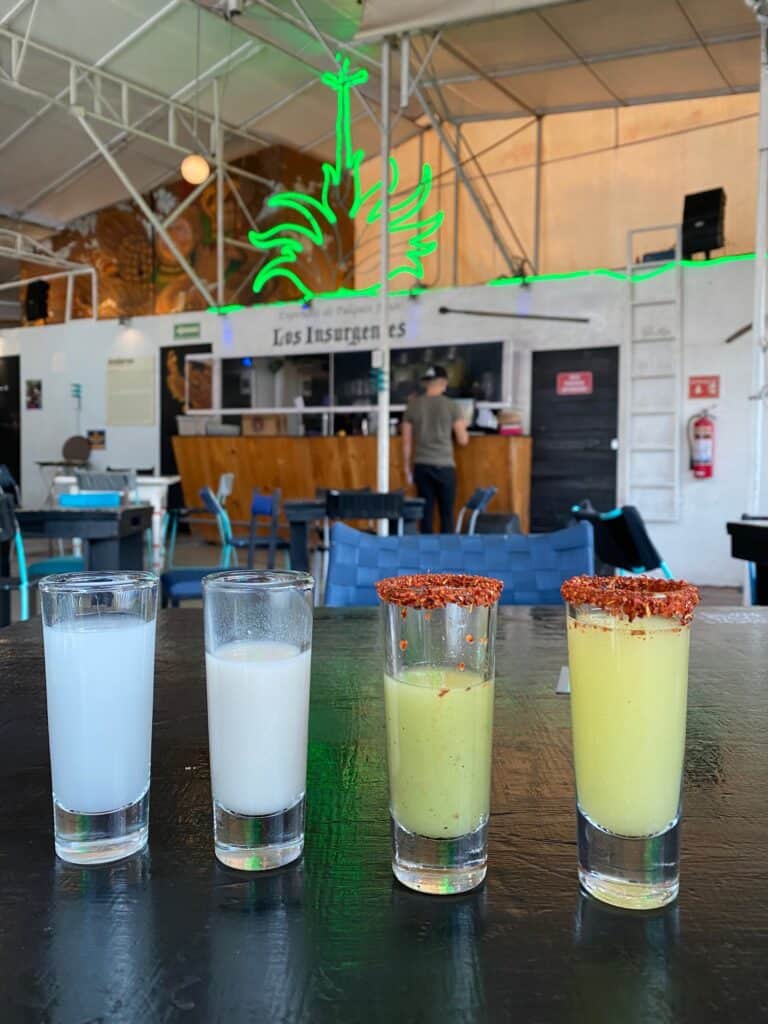
Fresh pulque is lightly acidic, milky and viscous, herbal, vegetal, and yeasty. It´s sometimes slightly funky, and it is always alive. Flavor changes hour by hour as fermentation continues.
What is curado and how is it made?
Flavored pulque, or curado, is now very popular. In order to add flavor to a natural pulque, you can blend the fruit, cereal or nuts into one part of the pulque and even add a sweetener.
Does flavored pulque taste better?
While many curados are delicious, the process is often used to mask pulque’s natural texture, extend shelf life, or compensate for lower-quality base pulque. This popularity of curados has contributed to a persistent problem within the category: the use of additives such as saccharin, nopalillo, or industrial sweeteners.
Where is pulque made?
Pulque is produced in the Central Mexican Plateau, primarily in Hidalgo, Tlaxcala, Puebla, Morelos, Michoacán, and Querétaro.
Hidalgo is the most important producing state, accounting for 78.14% of national aguamiel production. Pulque production remains artisanal and small-scale, typically in rustic, roofed spaces, using methods that have not fundamentally changed since pre-Hispanic times.
According to a study of pulques potential as an agribusiness, labor represents up to 80% of production costs, reflecting the skill, constancy, and specialization required.
What types of agave is pulque made from?
The most commonly used species include: Agave salmiana, the most widely used with highest yields, Agave atrovirens, Agave americana, Agave mapisaga. Other species are also used regionally such as Agave hookeri, A. teometl, A. weberi, A. altissima, A. compliala, A. gracillispina, A. malliflua
Each species produces aguamiel with different volumes, rhythms, and flavor profiles, further complicating any attempt at standardization. For example, in Estado de México, a maguey Mexicano produces about 2 to 3 liters of aguamiel a day and is scraped for about two to three months. The Ayoteco, a variety of Salmiana, is scraped up to five months with a yield of 3 to 6 liters a day while a maguey Verde is scraped for two to three months and yields about 2.5 liters a day.
How is pulque made?
Pulque begins with mature maguey plants, usually between eight and fifteen years old, and with the work of a tlachiquero—the person responsible for harvesting aguamiel. While the role has historically been associated with men, women tlachiqueras have always existed, even if they are less visible and harder to find today.
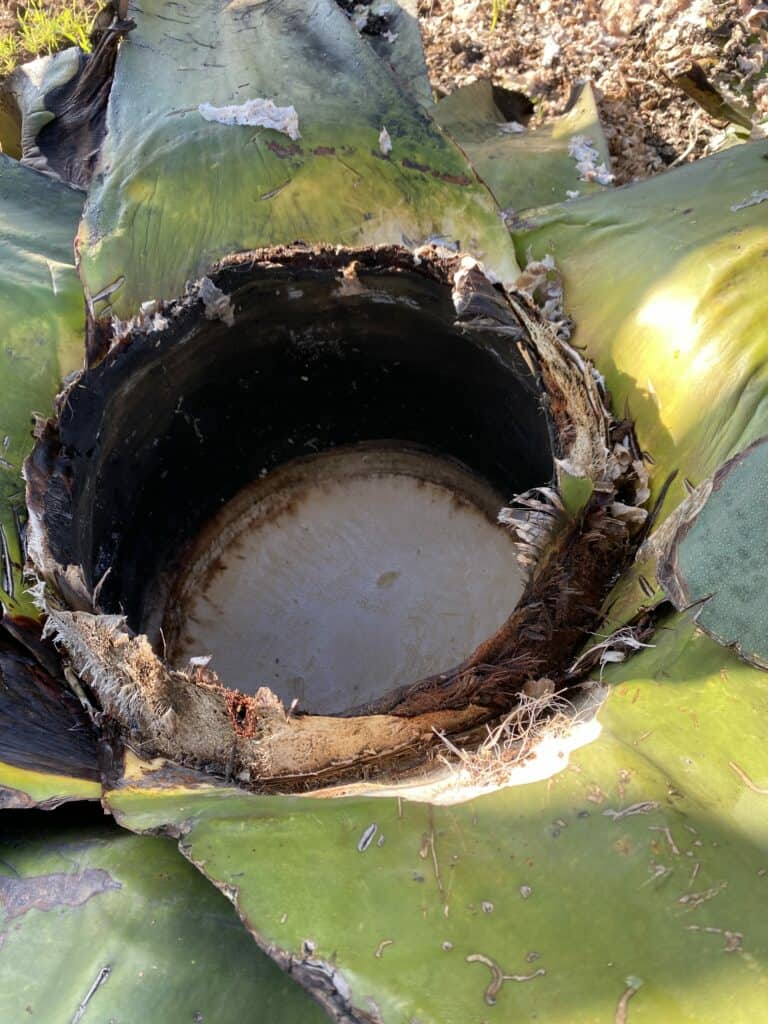
Once the plant reaches maturity, the floral bud (quiote) is cut in a process known as capado, forming a cavity called the cajete. The tlachiquero removes the central heart of the plant—the meyolote—and carefully scrapes the interior. The cavity is then covered and left to rest for several months, sometimes up to a year, allowing sugars to concentrate.
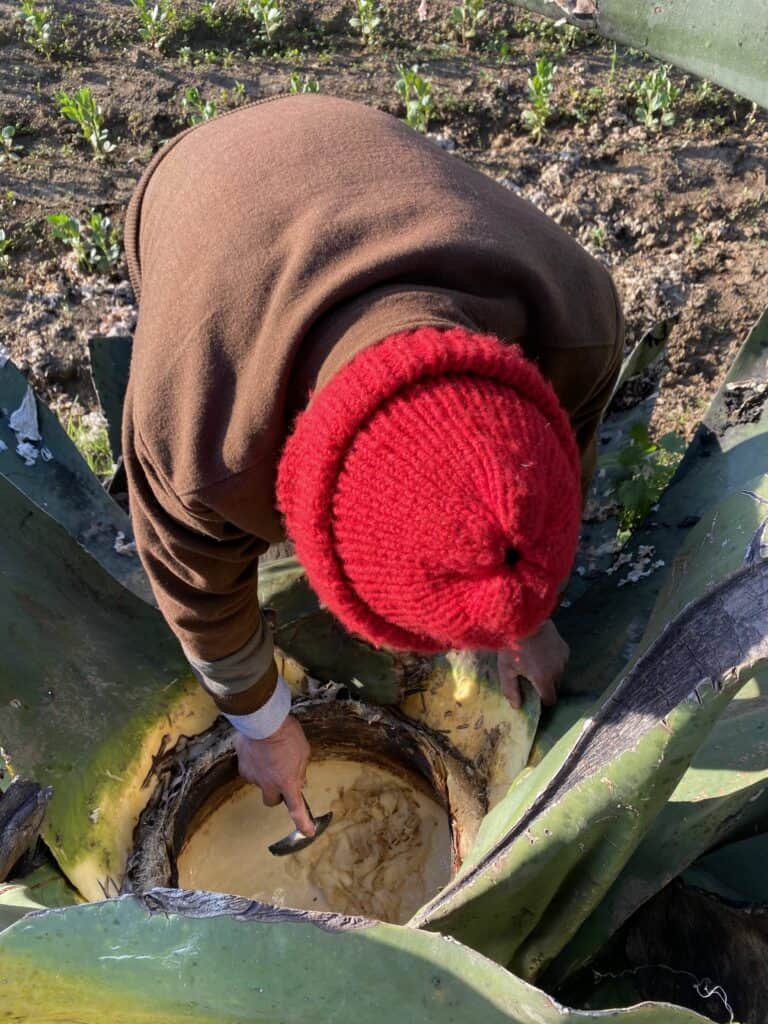
From that point on, the work becomes relentless. Once a maguey is opened, aguamiel must be collected twice a day, morning and afternoon, without interruption. Incorrect scraping causes the plant to rot or “chiquearse,” ending production entirely. The sap is extracted using an acocote, a hollow gourd, and traditionally transported by donkey to the tinacal, where it is stored in large containers.
Fermentation is natural, spontaneous, and ongoing, driven by lactic and acetic bacteria. Within one to three days, aguamiel becomes pulque: white, viscous, lightly foamy, alive. Fresh aguamiel is added daily to feed the ferment, allowing it to grow rather than reset. Pulque is never static; it is always in motion, changing hour by hour.
Tools like the raspador and acocote are essential, but more than tools, pulque depends on constancy. The tlachiquero cannot miss a day. If raspado stops, the maguey cicatrizes and stops producing sap. It is a practice that demands presence 365 days a year, binding plants and people in a relationship that cannot be paused.
What is the difference between pulque, mezcal, and other agave distillates?
Pulque shares raw material with mezcal and tequila but it is not distilled and even the fermentation process is very different. There is no cooking, no Maillard reaction, no methanol concern. Fermentation begins inside the plant itself, as aguamiel accumulates in the cajete throughout the day. Each maguey is visited daily for months, an intensity of labor unmatched by most fermented beverages. Distilled agave spirits, by contrast, extract sugars in a single operation after cooking the agave.
What does the word pulque mean?
Before Spanish, the drink was known by many names that emphasized its relationship to agave, color, and vitality. In nahuatl, octli means inebriating drink and the Mexica knew pulque as metoctli—from metl (agave) and octli (wine) or iztacoctli, “white wine”; and neutli, the name for aguamiel itself. Among Otomi speakers, aguamiel and pulque are called seí or juaseí; in Purépecha, urapi. Each term situates the beverage within a living linguistic and territorial framework.
The most commonly cited origin of pulque is poliuhqui octli, in which polioqui means “spoiled” or “rotten. Yet this interpretation is questioned by historian Rodolfo Ramírez Rodriguez who argues that it is unlikely that such an important and culturally significant drink would have been named using a term with negative connotations. Rather, this reading reflects the way Spanish chroniclers perceived pulque through their own cultural framework.
In this sense, Ramirez explains that the act of naming crops such as maize, amaranth, maguey, and beverages like pulque in Spanish was a deliberate strategy of colonization. Language was not merely translated, it was restructured to sever ties between Indigenous peoples, their territories, and their belief systems.
Is there a denomination of origin for pulque?
Back in 2021, we ran a piece about the future of pulque in which a few producers agreed that a traditional DO was not viable due to pulque’s daily, decentralized, and popular nature. Certifying every tlachiquero and pulcata seemed unrealistic so they were looking into the possibility of creating a geographical indication. In August 2025, the state of Hidalgo approved its own Geographical Indication called “Aguamiel Región Aguamielera de Hidalgo,”covering 44 municipalities of the state.
In 2024, pulque was declared intangible cultural heritage by Mexico’s City government to preserve this tradition. However, in early 2025 more than 10 pulquerías were shut down by local authorities so it is unclear on how this kind of recognition improves the appreciation of pulque and their producers’ way of life.
What norm regulates pulque?
The production of pulque is regulated as a fermented drink by the NOM 199 SCFI 2017. Under this norm, pulque is categorized as:
- Pulque natural: the fermented beverage obtained exclusively from aguamiel without the addition of flavorings, colorants or sweeteners. This is pulque in its most basic form.
- Pulque curado: pulque to which ingredients such as fruits, cereals, seeds, nuts or vegetables are added to modify aroma or appearance.
How has pulque been consumed throughout history?
Before European contact, pulque was deeply embedded in the daily diet and ritual life of Mesoamerican cultures. It was an important source of nutrients and a drink with strong symbolic and sacred meaning. Because of this, its consumption was carefully regulated. Pulque was not freely available at all times; it had symbolic and sacred connotations, and was shared with the general population only for communal celebrations.
As noted by Álvarez-Ríos et al. in a 2016 study, pulque was rarely consumed alone. It was often mixed with plants, roots, flowers, and fruits for ritual, medicinal, or nutritional purposes. Fruits of cactus species gave rise to nochoctli, a pulque flavored and colored with prickly pear while blue flowers of Commelina tuberosa produced matlaloctli. These practices show that flavored pulque existed long before modern curados, tied to seasonality and local knowledge rather than commercial appeal.
With the arrival of the Spanish and the profound transformations that followed, pulque lost much of its sacred framing. Its consumption was secularized and democratized. It became a beverage of general consumption, particularly among Indigenous and mestizo populations.
The history of pulque from the Spanish Colony to the 1930s is marked by different moments of prosperity and decline. From 1521 to 1821, pulque was one of New Spain’s most important economic activities and even the most consumed inebriating beverage. The haciendas pulqueras were large estates dedicated to the cultivation of agave, and the production and commercialization of pulque.
Between 1629 and 1786, its production and sale were intermittently prohibited, framed by colonial authorities as a source of social disorder and public health problems among Indigenous populations. These bans proved difficult to sustain. Pulque was economically indispensable and, even under prohibition, continued to compete with European wines and sugarcane spirits controlled by Spaniards. By 1786, the ban was lifted, driven less by tolerance than by fiscal necessity.
Pulque experienced a period of unprecedented prosperity tied to politics, infrastructure and modernization of the economy. Before Emporer Maximiliano started railroad construction, the consumption of pulque was regional. This changed during the rule of Porfirio Diaz, whose modernization plans included the completion of the railroad system that connected different regions with the coast–spurring the growth of pulque production into a national industry. By 1870 the production of pulque moved to what is called “llanos de Apan” a valley that crosses three states: Puebla, Hidalgo, Tlaxcala. This area had better access to transportation so it became the most important productive area of pulque.
The Porfiriato is known for being the “golden age of pulque,”, and it created significant wealth for elite businessmen—essentially a pulque aristocracy.
This prosperity was short-lived. The Mexican Revolution (1910–1920) dismantled the hacienda system that had sustained large-scale pulque production, as land redistribution targeted estates owned by the upper class. Although the industry rebounded briefly, pulque soon faced a familiar convergence of pressures: restrictive alcohol policies, devastation of agave fields, and the rapid consolidation of beer as Mexico’s modern national drink. By the late 1930s, pulque was no longer Mexico’s most important drink. It endured, but as a marginalized beverage, restricted to local production and shaped by decades of stigma rather than disappearance.
Can pulque be exported?
Industrial pulque is exported by companies like Pulque Hacienda 1881, located in Tlaxcala.
They make a pasteurized and filtrated version that tastes like a pulque soda.
What is the alcohol content of pulque?
According to the NOM, it should be between 4–7.5% ABV.
Where can I buy pulque?
The best place to buy pulque is a traditional pulcata in any of the producing regions.
In Mexico City, visiting long-standing pulquerías that sell fresh, unadulterated pulque is a challenge but here is a list of places that are worth your time.
If you are interested in touring pulquerias in Mexico City, check out this piece by Leigh Thelmadatter with more information on how to do that. And if you want to visit pulque production, check out these tours in Tlaxcala.





Leave a Comment