Why is there a monument to Irish soldiers in a Mexico City square? For St. Patrick’s day we’re taking a deep dive into the surprising history of the Irish in Mexico, which predates the famous San Patricio Batallion.
There’s not much rhyme or reason to the celebration of Saint Patrick’s Day in the United States. It’s hard to say when the American version of the holiday lost touch with its Catholic roots, but by the time Chicago started dyeing its river a lurid shade of emerald, enthusiasm for the holiday had long left the patron saint behind.
The historical Saint Patrick was a British-born Roman missionary who was kidnapped by Irish pirates in his youth, and escaped back to Britain the first chance he got. He returned only to proselytize his new faith. In Ireland, the holiday celebrates the triumph of Catholicism over paganism. In the US, it’s mostly about binge drinking while wearing the color green. But south of the border, celebrations honoring the patron saint of Ireland also commemorate the political contributions of Irish nationals, who, despite their relatively small numbers, have made an outsized impact on Mexico’s national identity.
The great saga of the Irish diaspora began in the late 17th century with the Protestant Ascendancy, when the Anglican ruling class devised a draconian set of anti-Catholic laws to suppress the majority population. At their most restrictive, the Penal Laws barred Catholics from political office, all legal professions, the military, inheriting Protestant land, owning a horse valued over five pounds, marrying Protestants, and voting in parliamentary elections. Protestants in power could be ruthless; under their rule the exploitation of the peasantry reached new depths, and, even for the Catholic upper classes, the future was bleak. Seeing little alternative, those with the means to leave Ireland went to seek their fortunes in Catholic countries across the Channel.
Irish men of ambition diffused themselves throughout continental Europe, a process referred to by historians as the Flight of the Wild Geese. Many pursued commerce, settling in bustling Atlantic ports such as Nantes in western France. Others joined the Irish Brigade, a branch of the French military, with the hope that Louis XIV would lead an expedition to restore Britain to Catholic rule. But this dream died in 1715 with the Sun King, who left behind a badly overextended treasury and a war-weary population without much political ambition. Eager for opportunity, the Wild Geese turned to Spain.
At the outset of the 18th century, the Spanish Empire was not exactly thriving. Its vast territorial expanse notwithstanding, economic stagnation had stymied the imperial machine. The Spanish approach to economics was passé; the light from Spain’s 16th century Siglo de Oro was dimming amidst a swiftly changing global economy. The 18th century Atlantic world was dominated by voracious traders, whose growing prosperity came as a direct result of ever-expanding plantation economies. For all the many trade goods that criss-crossed the Atlantic during the Age of Enlightenment, slavery was the defining enterprise in what is often more politely referred to as the “triangle trade,” bringing untold wealth to trading empires like Britain, the Netherlands, and the Kingdom of Dahomey. Spain, however, was given to indulging its gothic aristocracy’s aversion to commerce, relying instead on precious metals from Mexico and South America. But after two centuries of rapacious mining, the gold and silver veins were running out, and Spain was falling dangerously behind its European rivals.
In 1715, the Bourbons took the throne. To counter their waning imperial power, they looked to recruit talented and ambitious young men to help carry out the vision of a newly ascendent Spain. With their hard won military expertise, the Wild Geese fit the bill. They entered the new Spanish naval academy, founded powerful trading houses in the port city of Cadíz, and made their mark in international politics. When Charles III took the throne in 1759, it was his Irish prime minister, Richard Wall, who helped him carry out extensive reforms both in Spain and across the Atlantic, where colonial governments had long been slipping their leash.
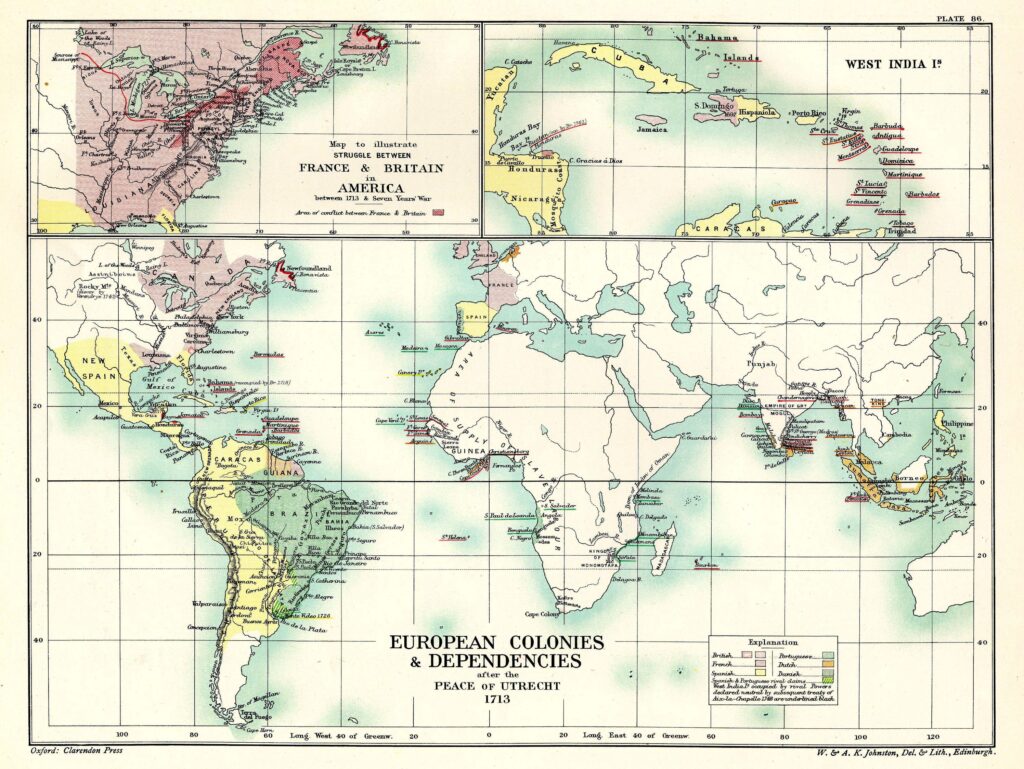
For Bourbon rulers, reversing this trend was top priority. Spain needed money, and without gold and silver filling Spanish coffers, the colonies would have to get busy supplying an alternative. And so Charles III and his advisers crafted the Bourbon reforms, fervently hoping to reduce bureaucratic bloat and bring the unruly American-born elites known as criollos to Peninsular heel. Easier said than done. The Viceroyalties governing New Spain, South America, and the Caribbean were hopelessly corrupt, and the power hungry criollo elites resented Peninsular intervention as a matter of principle. As the Irish prime minister opened doors for his countrymen in Spain, they came to play a crucial role in colonial reform. As historian Tim Fanning writes in Paisanos : The Irish and the Liberation of Latin America, “Because of their military experience, Irish administrators, engineers, and soldiers were centrally involved in the project of remaking Spanish America.”
If Spain was going to be taken seriously again by its colonies, something needed to be done about its languishing military apparatus. The job fell to the Irish-born Alejandro O’Reilly, who, seeing no future in Ireland, pledged his loyalty to Spain in a war against the Austrians, and rose quickly in the ranks. In 1763, he was sent to Cuba to analyze its defenses, beginning his tenure as a kind of colonial enforcer for the Spanish Empire. He started with rebuilding Cuba’s defensive fortifications and installing a permanent garrison, before reorganizing Spain’s armed forces in Panama, Peru, and New Grenada. With the colonial military whipped into shape, he was next sent to Louisiana as the second Spanish governor, the first having been quickly run off by colonists unwilling to accept Spanish rule. His severity in wrangling the rebellious criollos earned him the moniker of Bloody O’Reilly, a reputation that squashed further resistance. His decisive approach proved crucial to the implementation of the Bourbon reforms, and slowly but surely the imperial machine found itself back on track.
Mostly, that is. In the wild colonial borderlands stretching into the high desert of New Mexico, the Spanish empire was largely an abstract concept. Regardless of what it said on European maps, the sparse collection of missions and military outposts beyond Texas hardly constituted imperial control; Spanish presence was largely ignored by much of the native population. To reassert Spanish sovereignty in what was referred to as northern Mexico, Alejandro O’Reilly’s cousin and Dublin-born protégé Hugo O’Conor was appointed governor of the region in 1767. O’Conor had been stationed in Mexico City under O’Reilly, reorganizing the military of New Spain. When he was reassigned to the northern border, his successful campaigns against Spain’s old enemy, the Apache, and the Comanche, a rising and formidable regional power, put him in line for the governorship. Nicknamed “Captain Red” by local natives for his red hair, O’Conor was a capable military leader and administrator who succeeded in pushing the Apache back into northern New Mexico, bolstered frontier settlements, and founded the presidio which is now the city of Tucson, Arizona.
Despite the tradition of loyal service to Spain, the Irish were also key players in the fight for independence. Bernardo O’Higgins was Chile’s first head of state, and Bolívar’s army included a regiment of Irish volunteers. In Mexico, the liberal officer Juan O’Donojú placed his political values over his loyalty to the crown by accepting the honor of being the last jefe político superior to represent the Spanish government in Mexico. When confronted by local military leaders seeking independence from Spain, he agreed to their demands, and set Mexico on the road to official independence by signing the 1821 Treaty of Córdoba. Defending his actions in typically high-minded liberal rhetoric, he asserted the right of any nation to “declare its liberty,” and that Peninsular resistance to “that sacred torrent, once its majestic and sublime course had begun,” would be futile. As Fanning writes, “the treaty put into effect the Plan of Iguala and became the basis for a newly independent Mexican empire.”
But for all the astonishing contributions the Wild Geese made everywhere from the imperial administration of the Americas to Mexican nationhood, it’s the Irish volunteers of the San Patricio Battalion that hold pride of place in Mexican history. Their contribution is a rare bright spot in the painful memory of the US-Mexico War, through which Mexico suffered the loss of 55 percent of its territory, major casualties, and the indignity of an invasion of their capital by US forces.
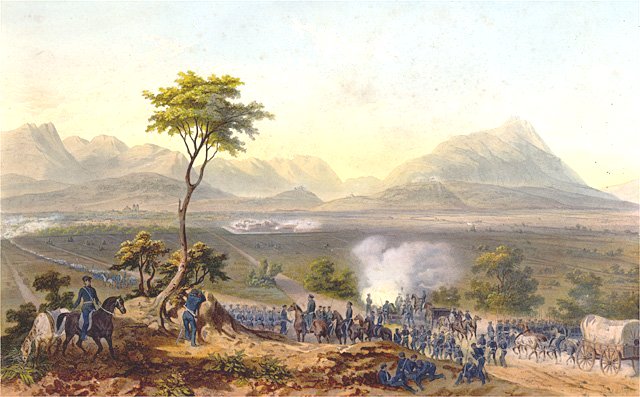
As historian Robert Miller writes in Shamrock and the Sword: the Saint Patrick Battalion and the U.S. Mexico War, “For Mexico, the war was a series of tragedies.” Even across the battlelines, it was hardly viewed more favorably. The US military’s desertion rates during its war with Mexico reached an all-time high, with double the desertions from Vietnam. And when an entire battalion of predominantly Irish soldiers decided not only to desert, but to fight for Mexico against the United States, the solidarity was as gratifying for contemporary Mexican observers as it is to those who commemorate the sacrifice of the San Patricios today.
Within the US, the aggression against Mexico was fiercely opposed by many. Henry David Thoreau was so outraged by it that he served jail time rather than pay a tax that would help fund the war. After he was released, he wrote the seminal text, Civil Disobedience, and underscored his opposition to unjust war. “Witness the present Mexican war, the work of comparatively a few individuals using the standing government as their tool; for, in the outset, the people would not have consented to this measure,” he wrote. Echoing the sentiments of those contemporary Americans who oppose the actions of their government towards their Latin American neighbors, he asks,“How does it become a man to behave toward this American government today? I answer that he cannot without disgrace be associated with it.”
For the Irish soldiers who joined the fighting forces of the United States, ideological alignment with the war effort was hardly a motivating factor. By the outset of the war, a potato blight was ravaging Ireland—and much of continental Europe—taking the already destitute Irish peasant population past the brink of starvation. Their Anglo overlords refused to intervene, continuing to export food away from Ireland, close the ports to foreign imports, and demand punishing payments from stricken Catholic tenants. Between 1845 and 1871, 2.1 million people desperately fled Ireland.
In the United States, their reception was not a warm one. Poverty in urban slums was scarcely an improvement on conditions they left behind, and the national attitude toward the new arrivals could be openly hostile. As Robert Miller writes, “The decade before the Mexican war was one of intense nativism and anti-Catholicism in the United States.” Just as it had been for the Wild Geese a century before, the military offered one of the few opportunities for social advancement. But unlike their countrymen who served the Spanish Empire and nascent American nations, these Irish soldiers received very little respect within the military apparatus, whose Anglo-Protestant officer corps perceived them as little more than canon fodder.
The Mexican army began a clandestine distribution of pamphlets among the Irish infantry, urging soldiers to defect. They reasoned that there was no point in foreign-born soldiers fighting for bigoted aggressors, and offered tracts of land to sweeten the deal.
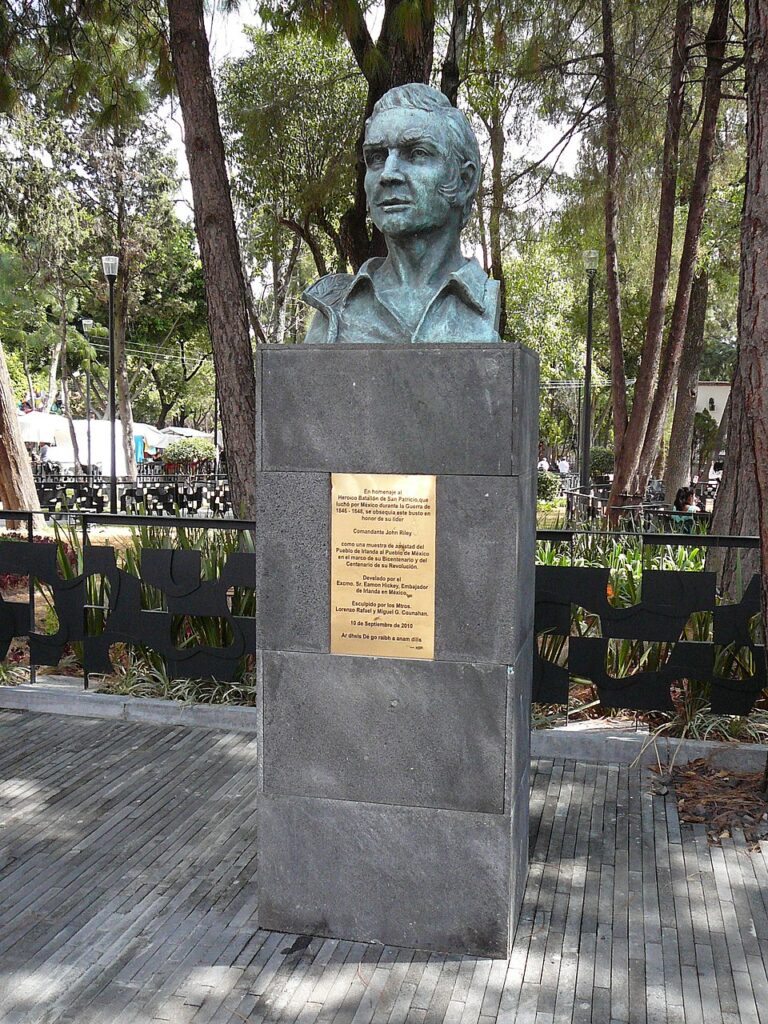
The primary organiser of the San Patricio Battalion was John Riley, who came to the US from County Galway, and spent his first two years in the country as a menial laborer in Michigan. In 1845, he signed a five-year term in the United States Army. When his regiment was stationed across the Rio Grande from Mexico, the sight of a bustling town on the other side of the river inspired plenty of defections from the squalid conditions of the army camp and the brutal discipline of commanding officers, who were known to whip common soldiers raw for even the most minor infractions. An enthusiastic defector, Riley set about organizing the troop of Irishmen, who would march for Mexico under a shamrock banner which Riley designed himself. When he started, they had less than fifty in the regiment. But by July of 1847, their numbers surpassed 200.
The San Patricios would discover, along with the rest of the Mexican forces and dissenters in the US, that righteous indignation over US aggression wasn’t going to turn the tides of war. After a series of crushing losses, 50 members of the San Patricio battalion were captured by US forces in 1847 and sentenced to death. The battalion itself survived, and its remaining members were offered places in the country’s standing army. And so it was that after the 1848 Treaty of Guadalupe Hidalgo finalized Mexico’s defeat, many of the San Patricios continued to play an active role in post-war national politics.
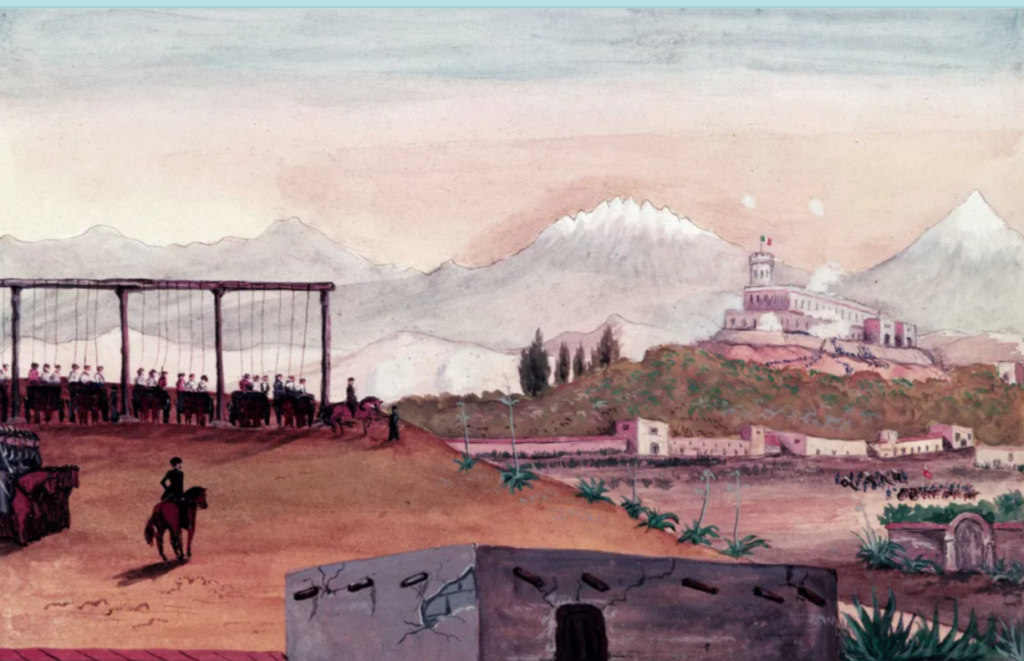
Today, the memory of the San Patricios is kept alive in various ways; in Mexico City, a plaque in the San Jacinto Plaza lists the soldiers who were executed by the US for desertion, describing them as “martyrs who gave their lives for the Mexican cause.” Some Mexican cities honor them with celebrations on both September 12, the anniversary of their execution, and Saint Patrick’s Day; Mexican Saint Patrick’s Day parades often include tributes to the battalion.
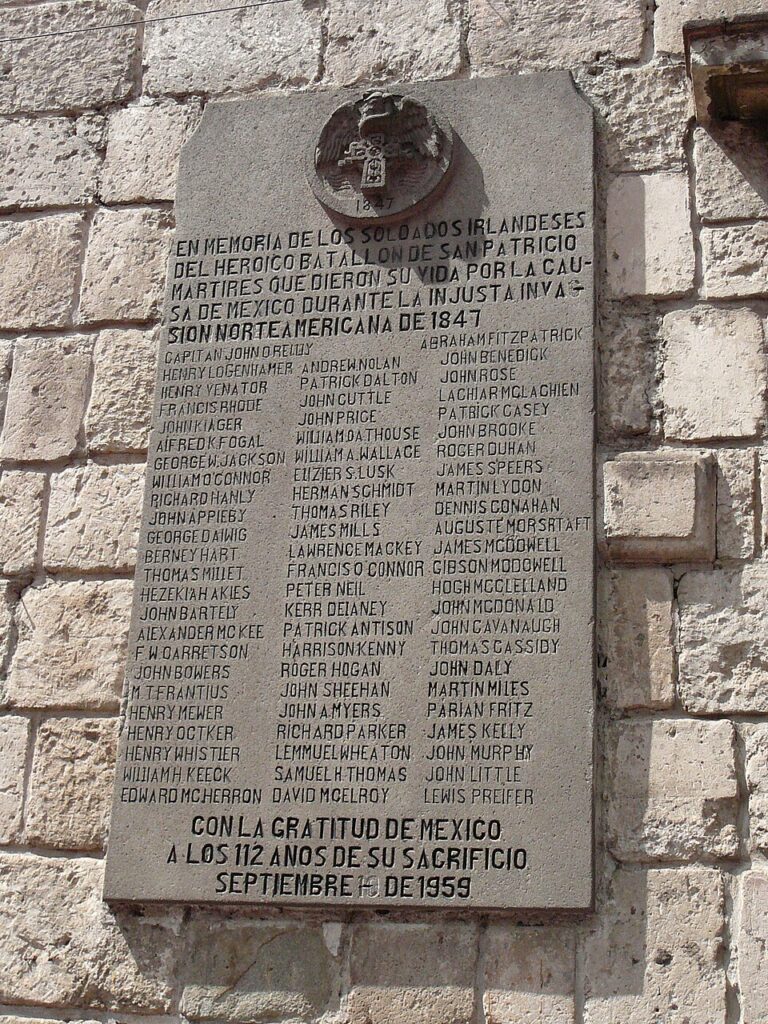
Though their relatively small numbers made their military contributions essentially negligible, their symbolic power remains significant. To celebrate the memory of the battalion subverts the United States’ habitual equation of might with right. However big and bad the American military likes to think it is, the willingness of the San Patricios to turn against their own officers reveals its internal weakness, the inevitable consequence of a bullyish culture.
So this Saint Patrick’s Day, consider celebrating the Irish the Mexican way: by acknowledging which North American country has always offered the Irish respect and opportunity in equal measure, and which country chose to profit off Irish labor while hurling insults, until they finally consented to be wooed by a holiday offering mass consumption of green beer and the chance to pinch women with impunity.




Leave a Comment