Mesoamerican botanicals are gaining visibility thanks to some of America’s most acclaimed cocktail programs.
Where the bar industry is concerned, Mexico is most definitely having a moment. In recent years, Mexican bar professionals and Mesoamerican ingredients have garnered increasing visibility and respect both nationally and abroad–the result of thoughtful, culturally relevant programming and innovative cocktails. From showcasing the country’s diverse array of spirits to incorporating ancestral beverages and Mesoamerican ingredients, these establishments are using a liquid medium to craft a narrative of heritage and identity.
These indigenous plants have found a place behind the bar as much for their ability to initiate meaningful conversation as their innate sensory attributes and the resulting depth and complexity they add to beverages. Some of these botanicals, like mesquite, were ubiquitous dietary staples of Indigenous peoples, while others, like cacao, were considered sacred–a concept explained with greater nuance by Dr. RA Kashanipour, Mesoamerican expert and assistant professor at the University of Arizona’s Department of History.
“It really depends on what’s meant by ‘sacred,’ he says. “If the meaning is, used in ritual practices, then yes, many of these botanicals were used in the contexts of restricted religious practices, but the usage varied by region and availability. I come to this topic as a non-Native and academic, so to me, what gives meaning to sacred objects is belief and the practices that make them so.”
Some of these plants are also being used at terroir-centric American bar programs, notably in the Southwest. Creosote, for example, is native to the Mojave, Sonoran, and Chihuahuan Deserts and was historically used as a medicinal by the Indigenous peoples of those regions. In Arizona, creosote is gaining traction as a cocktail component for its invigorating aroma and flavor.
“I love seeing these ingredients cross borders, as they bring cultural identity to the drinks,” says Eli Martínez Bello, internationally acclaimed bartender and co-owner of Tlecān, a mezcaleria in Mexico City. “Bars worldwide, including Mirate (Los Angeles), Ayahuasca (Dallas), Viajante (London), and Coa (Hong Kong) are using them, and Mexicans are proud to see these plants represented this way. It’s important to include them because it allows us to speak about the richness and diversity of our culinary and botanical heritage. There’s nothing we love more than sharing the flavors that shape our culture and presenting them in a way people can easily understand and enjoy.”
Kashanipour emphasizes that there can be a downside to the use of such ingredients, however. “Capitalist and cultural appropriation are real and problematic,” he says. “It’s vitally important to note that current usage isn’t reflective of historical practices, but rather taking inspiration from local and historical contexts, which is important and valuable.”
What follows is a sampling of the many Mesoamerican ingredients now being used by the bar industry. “I think that drawing attention to these native ingredients and practices is generally a good thing, as we need more appreciation of the deep and complicated histories of the people and environment in the Americas,” says Kashanipour. “It would be great if what happens in the bar could serve as a conversation-starter about the complexities of the past and present.”
Creosote
For Bar 1912 co-owner Blaise Faber, a sense of place is integral to the establishment’s programming. “We’re in Phoenix, so we’re always trying to celebrate Arizona’s terroir in a way that feels thoughtful and accessible,” he says. Faber’s 14 Year Drought, for example, features creosote in a Vesper riff made with mezcal, gin, Cocchi Americano, housemade creosote blossom extract, and orange bitters.
“I created it as a way to capture the feeling and smell of the desert just after a rain, a scent known as petrichor,” says Faber. “Anyone who grew up in the Sonoran Desert knows it well; humidity rises, rain hits, and the air fills with that unmistakable creosote aroma…But it’s used very deliberately here; when overdone, it can taste or smell industrial or metallic. It’s about evoking place rather than asserting itself as a flavor; for this drink it adds herbaceous and citrus elements.”
Creosote is a flowering bush that is also known as gobernadora or hediondilla (“little stinker”). It shouldn’t be confused with the petroleum-based coal tar derivative used as a wood preservative, says Dr. Paul Hyder, an El Paso-based ecologist and educator who did his dissertation on creosote. The wood preservative known as “creosote” is highly toxic if ingested, inhaled, or left on the skin; it can also contaminate groundwater and soil and is frequently confused with the creosote bush, which isn’t inherently harmful. According to Hyder, the preservative got its name because its odiferous compounds smell similar to the plant.
“While (creosote bush) is a potent antifungal and antimicrobial with some antiseptic properties, I can’t imagine a scenario where you’d get enough in a drink to be harmful,” says Hyder. “Its main compound is a powerful antioxidant called NDGA (nordihydroguaiaretic acid), which is why the plant was used as a medicinal by the Indigenous peoples of these regions.” The plant was described in Spanish colonial accounts of the O’odham people of southern Arizona (who have been called the Pima), as an analgesic for muscle aches and cure for skin afflictions and ulcers, and also used by the Mexica (Aztecs) as a curative.
NDGA is concentrated primarily in the leaves and resinous stems of the plant, says Faber, who notes that at Bar 1912, creosote infusions are done to “capture volatile aromatic compounds, not to create concentrated medicinal extracts.”
Creosote’s leaves also add a fresh, aromatic element to drinks like the Casa Verde, a beguiling margarita made with mezcal, creosote, lime, orange bitters, and sal de gusano, which serves as the house cocktail at Tucson’s lauded mezcaleria, Bar Crisol. At The Century Room at the nearby Hotel Congress, bartender Ryne Hoffman uses both creosote and mesquite in his Rainy Daisy, which was also inspired by petrichor.
The libation combines La Gritona reposado tequila, Cointreau, elderflower liqueur, mesquite bean syrup and lime, served up. The final flourish is a spritz of creosote tincture, released as the drink is served. “You get two hits of the Sonoran Desert at once,” says Hoffman. “It has a nostalgic factor for locals, as it’s the smell of summertime. I also like to combine creosote with absinthe as a rinse for gin-based cocktails.”
Hoffman makes a tincture by adding fresh creosote cuttings to a neutral liquor base in a glass jar and aging the concoction in a dark place for one month. For the mesquite syrup, he harvests ripe beans from his backyard, then dehydrates and grinds them into flour, which is then added to simple syrup. The earthy, honeyed notes of the mesquite play off the oaked tequila, but the plant is also an excellent pairing for Mexican rum or whiskey.
Mesquite
Lauren Beckman, beverage director of San Antonio’s Michelin-starred Mixtli, frequently uses mesquite and other Mesoamerican ingredients in drinks. For her Southern Outlaw, she fat washes bourbon with a housemade foraged mesquite butter to impart flavor and clarify the cocktail, which also contains rich muscovado syrup and spiced cacao bitters. Beckman’s recipe requires steeping the pods in water and adding equal parts sugar by weight before incorporating one tablespoon of syrup at a time to one pound of softened, unsalted butter.
Known as the “tree of life” by various Indigenous peoples, mesquite is a thorny leguminous tree native to the American Southwest and parts of Mexico. Its wood was used for fuel and shelter, the sap as antiseptic and a cure for everything from headaches to gastrointestinal upset. The long, slender pods were roasted, and the subtly sweet beans were ground for use as flour, gruel, atole, or fermented beverages.
According to preservationist Aaron Wright of the nonprofit Archaeology Southwest, “Mesquite was one of the most significant dietary staples for Indigenous communities of the Sonoran, Chihuahuan, and Mojave Deserts.” Roasted, the pods and beans exhibit compelling chocolate, coffee, and baking spice notes which are today used for infusions, syrups, and tinctures, as well as a flavoring agent for everything from Crown Royal to Bulleit Bourbon.
“Plants like mesquite aren’t one-trick ponies,” says Hoffman. “Indigenous peoples have been using these botanicals for thousands of years, and mesquite is a great example of their versatility. Every part serves a purpose.”
Pixtle
While mesquite has indisputably gone mainstream, other Mesoamerican ingredients remain resolutely esoteric and rarely seen outside of their native geographical realm. In southern Mexico and parts of Central America, a fruit known as mamey sapote is prized for its creamy flesh and seeds. The latter, when prepared via a process akin to nixtamalization to separate the germ from the exterior endocarp, are known as pixtle.
Pixtle is used in sauces, stews, and for medicinal preparations. Its preparation is described by the Slow Food Foundation for Biodiversity as a “ritual dish…part of the ancestral knowledge held by the communities of the Sierra Norte de Puebla, where it has been preserved over generations as a symbol of identity and culinary memory.” The germ is strung together with thread and smoked to yield an “earthy, toasted flavor…intertwined with subtle notes of almond, damp wood, and mountain herbs…it holds particular importance in the period leading up to June 24th, the feast day of San Juan.”

While challenging to source Stateside, pixtle is being used at select bar programs that highlight Mexican heritage. At Mixtli, Beckman uses it in an N/A beverage called The Maker’s Palm, where it’s steeped with fresh figs to form a syrup and combined with an Assam-porcini tea, lime, and masa saline. The latter incorporates red and white masa into a 20-percent saline solution, which adds “subtle body” to the drink, says Beckman. “I’m fortunate to work in a kitchen that sources exceptional ingredients,” she adds. “When they used fresh mamey sapote for a mole, I repurposed and processed the seeds for the bar, which is how the drink came to be.”
At Guadalajara’s El Gallo Altanero, ranked one of North America’s 50 Best Bars, pixtle is cleverly used in orgeat for the Mamey Tai, which incorporates Charanda Uruapan Añejo, mezcal, mamey liqueur, lime, and bitters.
“We love working with pixtle because its flavor is truly unique and deeply rooted in tradition,” says Martínez Bello, who uses the seeds in a mezcal Old Fashioned at Tlecān. The bar sources pixtle and other ingredietns from local producers, but Martinez notes that, “We don’t ask them to grow exclusively for us, as supporting what already exists within communities is part of our philosophy.”
While challenging to obtain, even in Mexico, Martinez says that using ancestral ingredients like pixtle is equal parts flavor and cultural recognition. “For me to talk about an ingredient, it first needs to be properly integrated into the cocktail in a way that allows it to be the true protagonist.”
Hoja santa
Also known as yerba santa, acuyo, Mexican pepperleaf, root beer plant, and “leaf of the gods,” hoja santa is native to Southern Mexico. Its large, fragrant, heart-shaped leaves are redolent of licorice in aroma and flavor due to a compound called safrole, a volatile oil also found in sassafras.
A member of the peppercorn family, hoja santa appears in the Florentine Codex, a 16th century ethnographic compilation of Nahua religion and culture. “The plant was known as mecaxochitl in Nahuatl and while the text detailing it is rather sparse, it was noted as a helpful medicinal herb for coughs, joint pain, mood disorders, and, consumed as a tea, for digestive ailments. It was also used for ritual purposes,” says Kashanipour. The Aztecs also incorporated hoja santa into chocolate beverages as a flavoring agent.
In modern usage, hoja santa is a popular addition to sauces, stews, and other dishes. The leaves are also used to wrap tamales, meat, fish, and cheese, and in the manufacture of a liqueur called Verdin, which hails from Yucatan and Tabasco.
The herb is also used in a variety of ways behind the bar. At Ayahuasca in Dallas, the Santero features hoja santa-washed Condesa Clasica gin with Campari, and palo santo. At Selva in Oaxaca City, the recipe for its eponymous cocktail calls for hoja santa puree, mezcal, lemon, agave syrup, Ancho Reyes Verde, juniper bitters, quesillo, and basil.
At Tlecān , the Mojito Quetzal gets a Mesoamerican twist with the substitution of mezcal for rum and hoja santa for mint; the addition of damiana liqueur adds a hint of sweetness. Native to Mexico, damiana was popularly used by the Mayans as a medicinal and aphrodisiac.

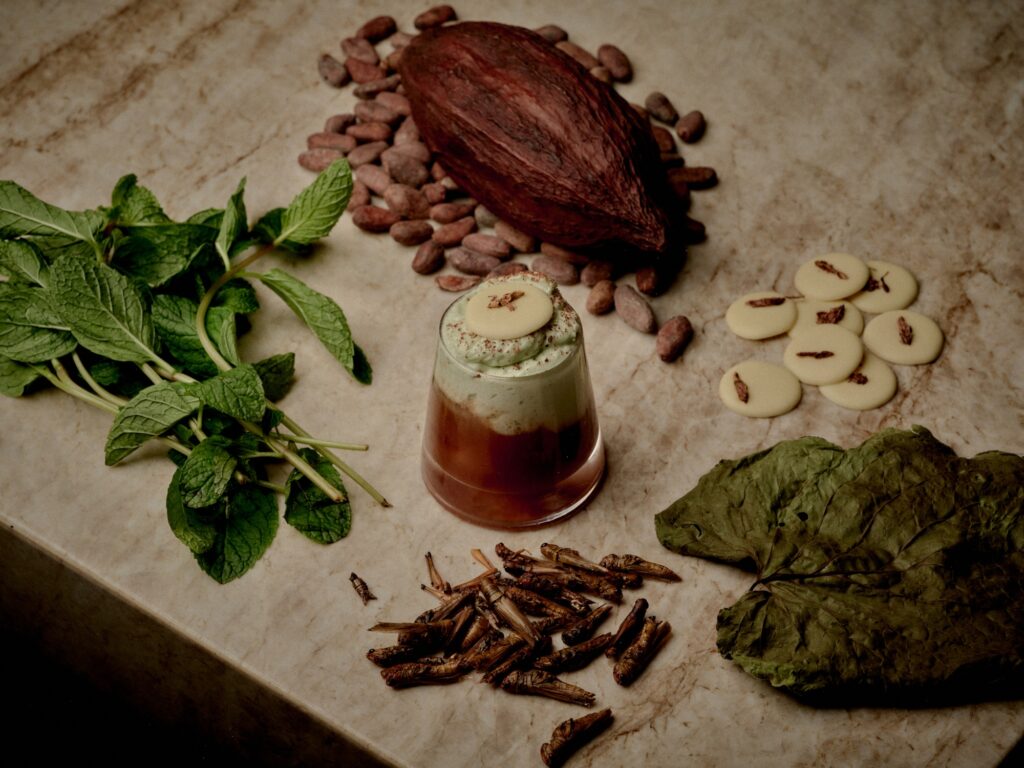
Fresh hoja santa adds a refreshing, peppery quality to Bar 1912’s Grasshopper, listed under the establishment’s “Bebidas Prehispanicas” section. Combined with mint, extra añejo sotol, cacao tea, and crème de cacao and finished with an xtabentún cream float and white chocolate chapulin garnish, the classic early 20th century cocktail transforms into a Mesoamerican-coded beverage.
Cacao
Cacao lends itself beautifully to an array of cocktail applications, such as with Bar 1912’s Grasshopper. Faber makes cacao tea by pressure cooking whole cacao pods and using the resulting liquid as the dilution for the drink.
The plant was prized for ritualistic use throughout Mesoamerica. “It’s certainly accurate to call cacao sacred,” says Kashanipour. “It was a high-value commodity that was produced in Guatemala and Soconusco, Chiapas, but archeological and documentary records show that it was consumed as far north as modern New Mexico and across the Caribbean. It was exclusively consumed by those of noble birth, largely in ritual contexts on sacred days, during ascension ceremonies, weddings, and the like.”
At The Charleston in Antigua, Guatemala, the bar program honors local and ancestral ingredients. La Pocha is made with fermented cacao pulp, a housemade liqueur of fresh blue criollo corn tortilla infused in unaged Guatemalan rum, and Guatemalan-grown cardamom tincture, and served in a jicara.
Similarly, Martínez Bello uses fermented cacao in Tlecān’s Tascalate Sour, a mezcal cocktail that showcases Chiapan tascalate–an ancestral beverage made from toasted, ground maize, cacao, achiote-lemon agave syrup, and egg white.
Ingredients as a beautiful bridge
As their use in beverage programming increases and access potentially becomes easier, bar professionals and chefs should be mindful of how these products are used and represented, notably within the context of Mexican or Latin-leaning programming.
“We love it when nationals as well as international guests are surprised by an ingredient they don’t recognize,” says Martínez Bello. “That moment gives us the opportunity to explain it, share its story. Curiosity is a beautiful bridge between culture and flavor. It’s really about balance, and intention.”




Leave a Comment