
A review of Sobre los orígenes de las bebidas espirituosas y su presencia en México by Jose de Jesús “Pepe” Hernández López
In an industry currently preoccupied with authenticity and denomination of origin, Sobre los orígenes de las bebidas espirituosas y su presencia en México invites us to look beyond purity and toward process. Mexico, in this book, is not where distillation began. It is where multiple histories meet. And what we drink today is not a fixed inheritance—but the evolving result of centuries of encounter.
Hernández López, known among peers as Pepe Tequilas, holds a PhD in Social Anthropology and serves as Professor-Researcher at the Center for Human Geography Studies at El Colegio de Michoacán. His research spans cultural landscapes, denominations of origin, and political cultural ecology—particularly in the production of agave, tequila, and mezcal. For years, his work has defended small-scale producers navigating complex legal frameworks while examining how territory, regulation, religion, and rural economies shape agave-based spirits. This is his twentieth book.
What we drink today was not the result of a single invention or a carefully designed trajectory. It emerged from an evolving process shaped by experimentation, translation, trade, epidemics, empire, and rural ingenuity.
The book is structured around four major traditions that developed in regions with political boundaries that have shifted over time. Hernández López is careful not to project modern national borders onto ancient or colonial processes. When the narrative reaches what is now Mexico, it distinguishes Mesoamerica as the pre-colonial cultural region shaped by Indigenous fermentation traditions and New Spain, the colonial territory where European and Pacific distillation technologies converged.
Rather than presenting Mexico as the birthplace of distillation, Hernández López positions the territory that would later become Mexico as a site of convergence. He resists assigning a single birthplace to distillation. The point is not debating ownership. The point is mapping out how this process flows through territory according to local needs. Distillation, in his telling, is not a fixed origin story but a process in motion.
From esoteric alchemy to medical technology: the Greco-Egyptian thread
The book begins in what might feel like unexpected territory for mezcal readers: the Greco-Egyptian world of Alexandria.
Here, the actors were not distillers in the modern sense, but alchemists, scholars, healers, and metalworkers experimenting with matter in search of purification. They were trying to isolate the essence from plants, minerals, and metals due to a belief that within each substance there was a more potent, incorruptible core. Their work was medicinal, cosmological, and technical at the same time.
A step-by-step look at an origin of distillation
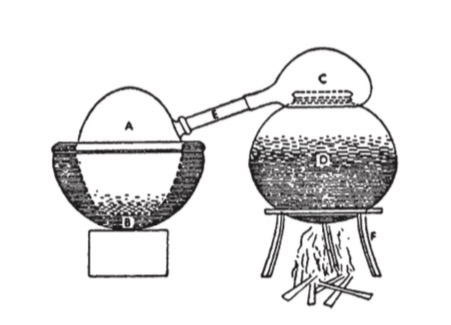
One of the foundational tools of this experimentation was the bain-marie, attributed to María la Judía (Maria the Jewess), cited in the book as the first documented female alchemist. The bain-marie introduced indirect heating: placing a vessel inside a bath of water so heat would transfer gently and evenly. This mattered when working with volatile substances that could burn or destabilize under direct flame. It set a precedent both for women’s central role in early alchemical practice and for the understanding that temperature control was essential to transformation.
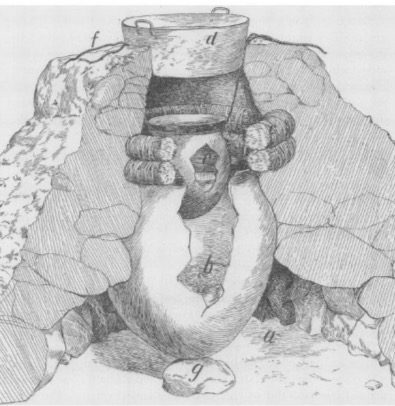
The development of the alquitara, or cabeza de moro, marks the next step. Unlike the water bath, the alquitara allowed the liquid to be placed directly over fire. Structurally, it consisted of a lower vessel for heating, a domed head to capture rising vapor, and an upper cooling surface where vapor condensed and dripped into a receiving container. The key innovation was not simply heating—it was controlled condensation. Vapor was captured, guided, cooled, and returned in altered form.
In moving from the mediation of the bain-marie to the direct fire contact of the alquitara, alchemy became more technically assertive. Mysticism was in fact a series of practical solutions to material problems. And those solutions would later allow medieval European medical schools–such as Salerno Monastery in Italy–to refine cooling systems further through devices like the deflegmator, making the reliable concentration of alcohol from wine possible.
What Hernández López does, through dense historical references, is guide the reader through this technical evolution–step by step. The narrative can feel layered, even overwhelming at times. But if you have some understanding of distillation, you begin to connect the dots. You see that what look like isolated inventions are actually cumulative adjustments to heat, vapor, and condensation.
His point overall is that distillation did not emerge as a sudden discovery. It was the outcome of incremental problem-solving across cultures and centuries. And that incremental evolution is precisely what later made recreational spirits possible.
The Chinese-Mongol current: mobile technology and distilling
Hernández López builds this section partly through the work of Korean historian Hyunhee Park, whose research offers one of the first global historical studies of soju distillation. Rather than treating Asian distillation as secondary, Park situates it within broader Silk Road exchanges and Hernández López leans into that framing.
He argues that the Chinese still likely predates the Mongolian one. During the Tang dynasty (7th–10th centuries), Chinese alchemical principles traveled westward through hu merchants—Persian and Arab traders who crossed the Silk Road between China and the Islamic world. But exchange moved both ways. The circulation of ideas was reciprocal.
Importantly, Hernández López highlights that early Chinese distillation was about preservation.
Rice (mǐ), sorghum (kao-liang), and millet (shǔ) were dietary staples. When these grains began to ferment naturally due to the climate, there was a need to prevent them from reaching irreversible putrefaction. Distillation emerged as one solution among others, alongside drying and storage techniques, to preserve food and medicinal substances.
This reframes the origin of alcohol production in China as practical rather than ceremonial. There is also the possibility, Hernández López notes, that early producers and consumers included itinerant groups—soldiers, prisoners, merchants—whose mobility required methods to prevent food spoilage. Distillation made preservation portable.
In Taoist contexts, distillation intersected with naidan and waidan traditions, where bodily discipline, cosmology, and material experimentation overlapped. Cooling systems were already understood as central to transformation.
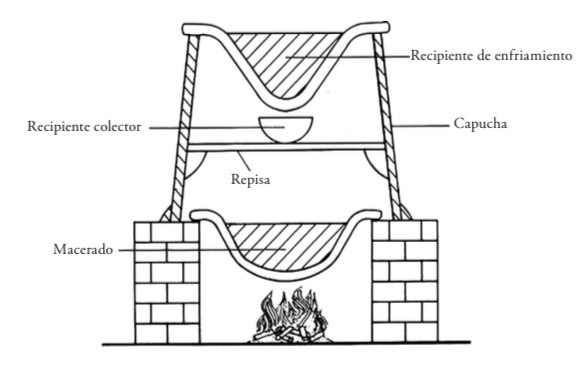
When Mongol expansions accelerated in the 13th and 14th centuries, these technologies became even more mobile. Portable stills traveled with nomadic cultures. Fermented mare’s milk and grain spirits were part of subsistence and ritual life.
What Hernández López emphasizes here is that much of this knowledge appears to have circulated through family units and farming communities. Distillation was not exclusively the domain of elite scholars or monasteries. It was embedded in agrarian practice. Farmers adapted techniques out of necessity, not ideology.
This challenges the top-down narrative we often inherit from European histories of science.
For Hernández López, the Chinese-Mongol current demonstrates that distillation did not always descend from universities or courts. In many cases, it rose from the base of the social pyramid. Technology, here, did not move through universities. It moved through conquest, migration, and survival. And when Mongol influence extended toward Southeast Asia, distillation knowledge followed.
Early distilling in India?
In the Punjab region, ceramic distillers discovered in Taxila and Gandhara suggest early experimentation within Silk Road exchange networks. Whether these apparatuses were capable of full alcohol distillation remains debated. Neither device contains metal components—considered crucial for achieving the thermal shock necessary to condense fermented liquid above 78°C and reliably produce ethanol. Some scholars argue these were true alcohol stills. Others maintain they were used for non-alcoholic extractions.
Beyond the material evidence, the Indian case becomes more complex. Hernández López explains that much of what we know about early Indian chemistry comes from medieval texts that reference far older documents. This layered transmission makes it difficult to establish a clear chronological origin. Some scholars have suggested that Indian knowledge of distillation may have developed alongside, or in conversation with, Greek astrological and alchemical traditions, given the trade routes linking India and Alexandria.
The Rigveda, one of India’s oldest texts (composed between 1700 and 1100 BCE), references a drink called soma, described as intoxicating, invigorating, and even life-extending. Some researchers interpret this as evidence of early alchemical thinking; others argue it may have referred to a psychoactive plant or fermented substance rather than a distilled one. The text itself describes pressing and mixing with milk and honey, not distillation. Again, ambiguity prevails.
The debate in India is not only about whether distillation occurred, but whether certain apparatuses represent independent development or converging influences within a region historically shaped by intense circulation between Eurasia and North Africa.
In the Indian case, origin is a contested terrain shaped by textual gaps, overlapping traditions, and interpretive uncertainty. Rather than forcing a conclusion, Hernández López uses this complexity to reinforce his broader argument: the search for a single birthplace of distillation oversimplifies a process that unfolded through intersecting intellectual, commercial, and geographic networks.
Pre-hispanic distilling? Convergence, skepticism, and the myth of origin
The Mesoamerican section feels like the revelation you need after many pages of traveling around the world. This is where all the previous currents meet and where the debate becomes most sensitive.
Before maize was domesticated, maguey was one of the primary carbohydrates in the region. Fermentation traditions in Mesoamerica are deep, sophisticated, and extensively documented. But Hernández López draws a careful line between fermentation and distillation.
He questions the theories that claim fully developed pre-Hispanic distillation. If distillation had been widespread, why do we find no explicit record in codices describing alcohol obtained through an alquitara-type still?
The strongest archaeological evidence cited by proponents of pre-Hispanic distillation includes ground-level ovens found in Oaxaca, Nayarit, and Durango. But Hernández López points out that these could just have been used for fermentation. For him, the evidence is incomplete and descriptions in colonial sources lack technical specificity. There are no confirmed biomolecular markers of distilled ethanol from that period.
Just as found in other traditions, mercury and cinnabar were also used in Mesoamerica for ritual contexts, obtained through sublimation. But sublimation is not distillation of alcohol. Knowing how to separate substances does not necessarily mean ethanol production was occurring.
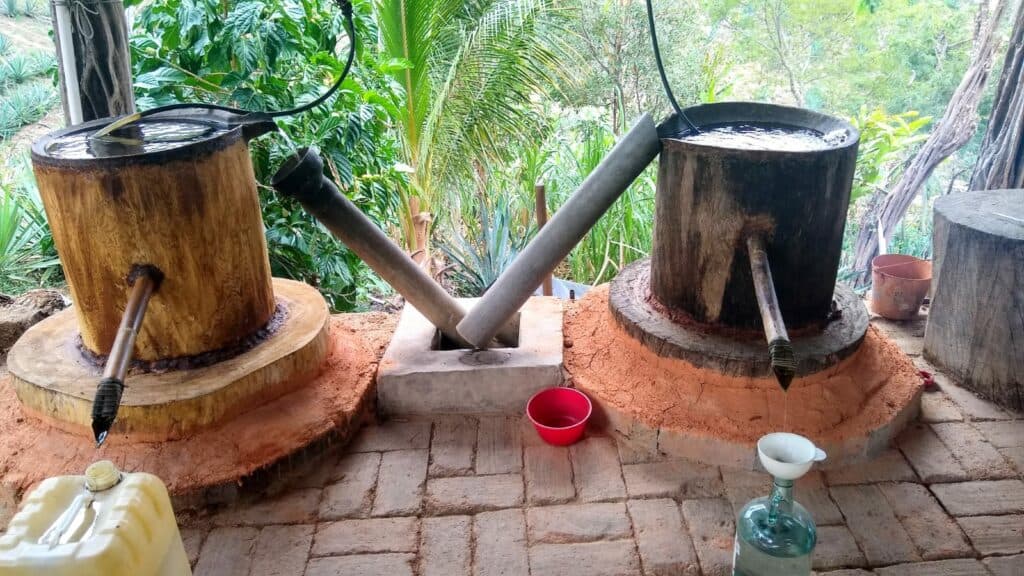
The Huichol (Wixárika) still documented by Lumholtz—the tuchi—bears resemblance to Mongolian apparatuses. The so-called “Filipino still,” identified by Bruman in relation to vino de cocos (tuba in Tagalog), shows Chinese and Mongolian influences. Capacha vessels in San Luis Potosi have been cited as evidence of early distillation, but their size and configuration raise doubts. The presence of fermentation does not equal distillation.
For readers immersed in denomination debates, one of the book’s most provocative contributions is linguistics.
The 1576 ordinance that references “vino de mezcal” is often used as proof of early distillation. But Hernández López emphasizes that “vino” did not clearly distinguish between fermented and distilled beverages. “Maguey” itself is a Taíno term, adding another layer of interpretive confusion. “Vino de maguey” could have meant pulque. It could have referred to fermented tuna or maize.
More importantly, he asks: where is the infrastructure? Distillation requires cooling systems, metal components (in most efficient cases), and a reliable water source. Large roasting pits capable of cooking hundreds of kilos of maguey do not correspond with the small capacity of early stills. The scale does not align.
Hernández López is cautiously skeptical of a fully pre-Columbian distillation tradition. Instead, he traces a different convergence.
The Filipino still arrived through the Pacific via the Urdaneta route, reaching Colima and western Mexico nearly half a century before the European serpentine coil became common. Vino de cocos was the first distilled spirit to truly disrupt the New Spanish market, spreading inland from coastal areas but strategically distancing itself from major ports to avoid direct competition with European brandy.
A regional breakdown of early Mexican distilling technology
One of the most helpful moves Hernández López makes is to simplify the adoption of distillation technologies by region. In doing so, he clarifies what might otherwise feel overwhelming.
Over time, different parts of what is now Mexico absorbed and adapted distinct technological influences: Nayarit reveals resonances of Chinese-style apparatuses; Michoacán consolidated the Filipino-type still introduced through the Pacific; the Tequila region developed around the serpentine coil associated with European refinements; and by the eighteenth century, more complex European stills expanded in tandem with mining and metallurgical development. By mapping these technologies geographically, Hernández López turns abstraction into terrain. The convergence he describes throughout the book becomes visible. Instead of leaving the reader with all the theory, it is easier to picture a regional practice shaped by migration, trade routes, and local adaptation.
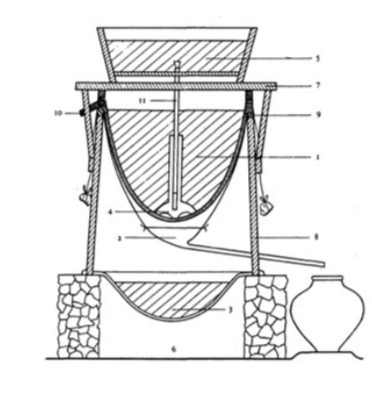
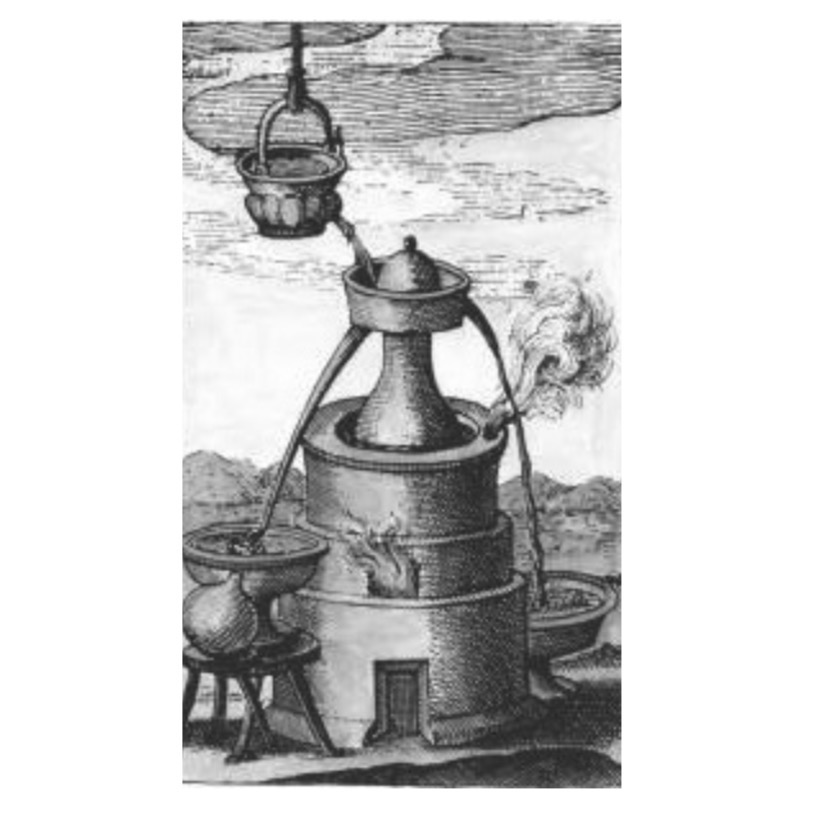
Distillation in Mexico unfolded in phases, shaped by migration. And the migration was not solely Spanish.
Techniques moved not only through imperial command but through itinerant laborers, traders, prisoners, soldiers, farmers. Extracting sap from coconuts and extracting sap from maguey share structural similarities. Technologies met existing agricultural knowledge.
If the origin of distillation is understood geographically then the philosopher’s stone cannot be associated with immaculate purity. No society developed this technology in isolation.
The presence of fermented beverages in the region has far deeper historical roots than distilled ones. And that distinction matters. Because if we understand distillation as a migratory, adaptive process, then the question shifts. It becomes about naming responsibly. About recognizing how knowledge evolves. About acknowledging that what we defend today as tradition was shaped by people solving material problems across continents.
Can one country claim the invention of a technology? Maybe, but no one owns the process of adaptation. And mezcal, like distillation itself, is the product of movement.
What to do with this history?
I finished this book during my last trip to Oaxaca, where I visited three palenques—two of them working with what we call ancestral distillation methods.
Standing in those spaces, it’s easy to romanticize. Clay pot stills, wood-fired ovens, open-air fermentation. It feels intact. But there is a cost to keeping that knowledge alive. I mean material cost that includes labor, firewood, time, physical strain. But also, regulatory pressure, market volatility, road safety, among others.
When we speak of “ancestral” production, we often speak from comfort. From a consumer position. From a 100% capitalist framework in which scarcity, rarity, and difficulty translate into value. Reading Hernández López in that context shifted something for me.
If distillation has always been the product of adaptation where people solve problems with the tools available to them, then purity has never been the point. Survival has.
If Hernández López is asking us to move beyond the obsession with “who invented distillation,” then the real question becomes how historical awareness shapes what happens next.
This book does not hand us a definitive birthplace. It hands us context that, taken seriously, can function as a tool.
It can serve producers who are navigating environmental stress, regulatory pressure, and shifting markets. It can ground denomination debates in historical complexity rather than political convenience. It can remind us that adapting doesn’t necessarily mean betraying history or principles because innovation has always been part of tradition. In the end survival has driven technical change.
Research like this can also recalibrate drinkers. It can be a tool for drinkers who want to move beyond fetishization. A tool for an industry that must decide whether it values rigidity or resilience.
Hernández López shows that what we drink today is the result of centuries of unplanned evolution. Technologies shifted because they had to. Methods changed because circumstances demanded it. The spirits we defend as tradition are, in fact, the outcome of adaptation.
The question now is not where distillation began. The question is how the people making mezcal and agave spirits today will shape what it becomes next.
There is also something else this book reminds us: a remarkable amount of serious scholarship is being produced in Mexico by Mexican researchers—work that does not always receive the recognition it deserves in international conversations about agave spirits. If you want to take a meaningful dive into history, two books stand out. El Vino de Cocos en la Nueva España (2018) by Paulina Machuca, reviewed at Mezcalistas by Clayton Szczech, reframed the discussion by placing the Pacific and Filipino coconut wine at the center of colonial alcohol history. (An English translation is now available.) And now, Sobre los orígenes de las bebidas espirituosas y su presencia en México (2024) by José de Jesús Hernández López expands that conversation even further, situating Mexico within a much longer global arc.






Leave a Comment