
Felisa Rogers reviews Mesquite Pods to Mezcal: 10,000 Years of Oaxacan Cuisines, edited by Verónica Pérez Rodríguez, Shanti Morell-Hart, and Stacie M.King
If you wanted to hide an invaluable yet delicate treasure, where would you go? In this story, our protagonists wisely chose a cave in Oaxaca’s Sierra Sur. This dry cavern was a particularly good choice because the treasure in question was a bin of seeds, which remained remarkably well-preserved when it was discovered at least 700 years later.
Scientists were eventually able to identify the remnants of 127 different plant species, including chiles, amaranth, beans, and other important components of Oaxacan cuisine. The bin dates to the Postclassic or early colonial period. In “Preserving Oaxacan foodways in the face of conquest,” anthropologists Stacie M. King and Shanti Morrell-Hart posit that the bin was an intentional seed bank. “We argue that the bin and its contents are evidence of the extraordinary efforts that people took to protect their traditional ecological knowledge and to ensure food sovereignty and food security during a period of intense conflict and change,” they write.
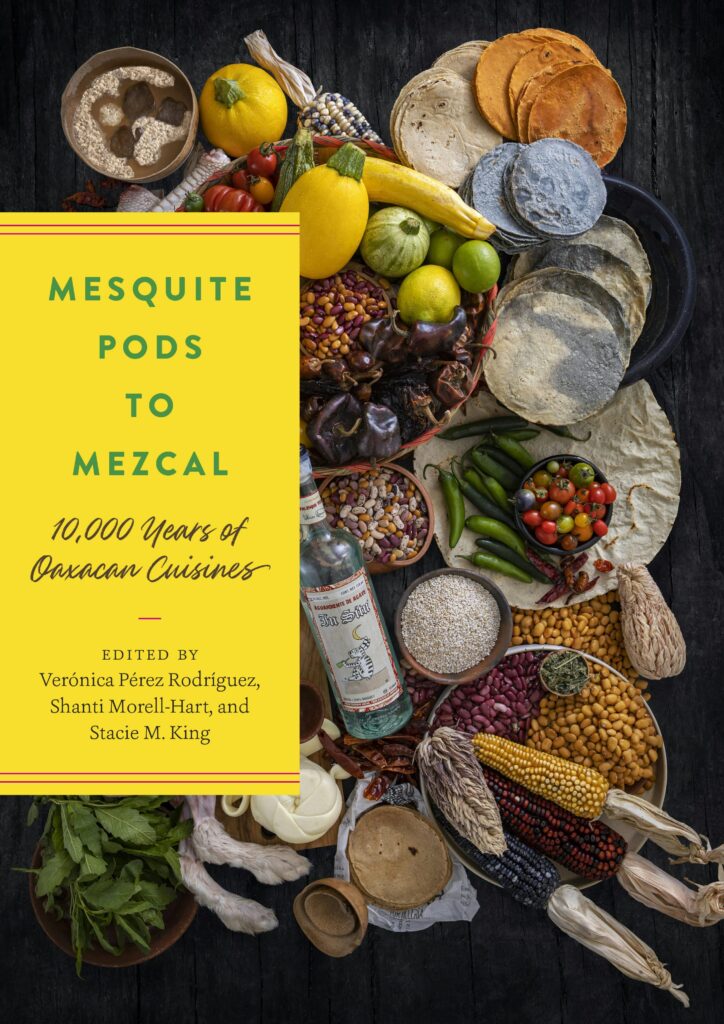
This is just one extraordinary finding documented in Mesquite Pods to Mezcal: 10,000 Years of Oaxacan Cuisines, a compendium of original case studies from prominent scholars of Oaxacan archeology and anthropology, as well as scientists in related fields. From University of Texas Press, this large-format book is arranged chronologically, beginning in the early Holocene period and ending with modern Oaxacan foodways, including a chapter centered on tejate and an evocative exploration of Isthmus Zapotec cuisine specific to Juchitán.
After an introductory chapter that describes the scope of the book, the second chapter sets the tone with a number of remarkably vivid passages, which are rather more impressive when one considers the title: “A 13,000 year perspective from the Yuzanu Drainage of the Mixteca Alta.” Not exactly a sexy topic, but the introduction to barrancas (ravines or canyons) is lively:
“The average villager knows the place yet shuns it as part of the wild beyond the cultivated fields, marginal to the chores of making a living, and potentially dangerous. Some perils are natural, such as being caught by a sudden flood, buried by barranca wall collapse, or confronted by wild animals. The most feared are cultural, the barranca being a place frequented by people who have something to hide, from illicit lovers on an escapade to narcos dumping corpses. The village poor make up the bulk of visitors who descend into the barranca to supplement their subsistence by grazing animals, hunting, gathering fuelwood, or searching for culinary curiosities that may include herbs, mushrooms, and insects.” (Borejzsa, Joyce, Lohse)
The authors continue to breathe life into their findings even when getting granular about their analysis of charcoal deposits.
Which brings me to a salient point. As I am not an archaeologist, anthropologist, sociologist, or scientist of any stripe, some sections of the book were much more accessible to me than others.
The chapter on archaic cuisine at Mitla is intriguing, but the detailed breakdowns of the analysis of botanical residues at the archeological site are wasted on me. Sample sentence: “The sonication was completed using a LaBelle sonicating instrument with a frequency of 30 kHZ.” I’m not dissing–I wish I understood this stuff. I’m sure this level of detail will be a selling point to some of our readers.
For the rest of us, there’s plenty to enjoy. As an editor and a regular (yet sometimes reluctant) reader of academic literature, I salute Verónica Pérez Rodríguez, Shanti Morell-Hart, and Stacie M.King. The editors are clearly masters of their craft. They have somehow managed to encourage 25 academics to write 14 readable (and even engaging) chapters that also contain a wealth of information that will appeal to a relatively wide range of readers–from academic researchers to chefs and bartenders looking for inspiration.
Obviously, we must also credit the anthropologists, archeologists, and art historians for translating their in-depth research into largely accessible text. Some authors include surprisingly personal details to illustrate the relevance of their research. For example, archeologist Nelly M. Robles García incorporates a thoughtful vignette in her fascinating chapter: “Itaca para el camino: Prepared meals for prehispanic and colonial travelers.”
From the get-go, I was intrigued by her premise: In all our talk of exchange via trade routes, very little attention has been paid to the actual traders as individuals. As she embarks on her findings, she adds, “This work also allows me to revisit and reconsider the life of my own grandfather Don Ángel García, who spent many years in the first half of the twentieth century traveling the old camino real between Yosondúa and the coast of Oaxaca, taking his mules loaded with wheat flour to the coast and returning to town with maritime products, livestock, and salt. His personal history exemplifies the lived experience of those otherwise unknown travelers.”
Many paragraphs are so evocative they made me hungry (and thirsty). On the congruence between archaic foodstuffs discovered near Mitla and modern Oaxacan cuisines, anthropologists Shanti Morell-Hart and Éloi Bérubé write:
“Bean family ingredients, such as garlicky guaje seeds (Leucaena spp.) and piquant chipilín shoots (Crotalaria spp.) remain popular condiments, especially when accompanying quesadillas, tlayudas, and tacos…Cooked domesticated beans of course are still a common component of many Oaxacan meals. Sweet cactus tunas (including xoconostle and biznaga fruits) are used to make sorbets and ices sold from pushcarts, as well as high-end cocktails at restaurants in nearby Oaxaca City. Squashes and delicately flavored squash blossoms are featured in quesadillas, stews, and some desserts. Earthy-flavored amaranth is still used in drinks and porridges such as champurrados and atoles, persisting despite religious-based prohibitions placed on amaranth consumption during the early colonial period. The pungent goosefoot or epazote is used to flavor stewed beans, various meats, and even occasionally, cocktails.”
One of the book’s major themes is the diversity of Oaxacan cuisines, and the distinct culinary traditions that vary from community to community. In their chapter on dietary variability in the Valley of Oaxaca during the Classic Period, Gary M. Feinman and Linda M. Nicholas share evidence from their study of archeological sites and document how this variability continues to this day:
“During the more than four decades that we carried out fieldwork in the Valley of Oaxaca, we lived in small villages in different parts of the valley,” they write. “We often had the honor and pleasure to be invited to fiestas in the homes of our local crew members and neighbors. We soon learned that the preferred fiesta foods were not uniform among different villages, except for the hot chocolate that was ubiquitous.” They go on to describe stews, moles, and breads specific to towns, noting, “In Ejutla, for example, we would buy small biscuits from women who traveled there from San Vicente Coatlán, a village in the mountains southwest of the valley; no one in Ejutla made them. Most people thought their village made the best tortillas, but it was only Matatlán that we ate tortillas made in part with the quiote, or flower of agave.”
So what about mezcal?
Speaking of agave, the title of this book is a little misleading, but understandable from a marketing perspective. While you will find a fair amount about mesquite pods, you won’t find much about mezcal. Pulque and maguey appear frequently as nutrient sources, but I didn’t learn anything new on that front–and if you’re an agave nerd, you probably won’t either. That said, if your interest in Oaxacan mezcal is holistic, I certainly recommend this extensive study of 10,000 years of the region’s foodways and traditions.
One thing of note on the agave front:
For those of you who have been following the controversy over allegedly adulterated tequila and whether isotopic analysis can actually determine if alcohol is derived from agave or cane sugar, the sections on isotopic testing may be of interest. In archeology, researchers are using new techniques to study diet via the isotopic and chemical signatures found on ancient pots and bowls, as well in human remains.
In her excellent chapter “Eating in the city: Investigating the dietary impact of urban life in ancient Oaxaca,” Verónica Pérez Rodríguez explains how isotopic analysis is used to determine ancient peoples’ consumption of plant-based foods and beverages. “All plants turn carbon dioxide into glucose (the Calvin cycle) through photosynthesis,” she writes. “There are three metabolic pathways to fix carbon, however, prior to carbohydrate (glucose) formation. The most common pathway is that of the so-called C3(fix) plants that produce a three-carbon compound in the fixation process. The two other metabolic pathways, C4 and CAM (crassulacean acid metabolism), are found in a smaller number of plants that are better suited to hotter and more arid environments. Maize is a C4 plant while agave, nopales, and other succulents are examples of CAM plants.”
In other words, isotopic analysis is used to determine if residue is from a C4 plant or a CAM plant. Since sugarcane is a C4 plant and agave is CAM, this passage supports our understanding that the test results from Eurofins provide legitimate proof that several major tequila brands are adulterated with cane alcohol.
Amid the explanations of isotopic analysis and stretches of dense academic writing, the book brims with interesting facts. Here are a smattering of my favorites:
Rich people were really into eating rabbit. During the early formative era, rabbits and hares were among the most popular fare at celebrations in the Mixteca Alta; in many communities eating rabbit was linked to elite social status. (Chávez, Blomster)
As someone who spent a fair chunk of my childhood clambering around in Oaxacan ruins, I should have already known this; but I was surprised to learn that the Zapotecs once had a custom of constructing masonry tombs beneath the floors of their homes. (Markens, Martínez López)
Speaking of famous ancient cities, Mitla was regarded as a porthole to the underworld; it’s name is derived from the Nahuatl Mictlan, meaning underworld. This was bestowed by the Mexica (Aztecs) when they conquered the province. The city’s Zapotec name is Lyoba: Place of Tombs. (Markens, Martínez López)
Mitla is the earliest known site for the domestication of squash (circa 8000 BCE). (Feinman, Nichols)
Although I’ve read a zillion times that chocolate was a beverage for the elite (and often illegal for commoners), this wasn’t necessarily true in cacao-producing regions. (Levine, Puseman)
In conclusion:
If you’re fascinated by culinary history or the roots and seeds of Oaxacan culture, this book is a treasure.





Leave a Comment