
Ernesto Vargas Mendoza is a textbook example of the success that comes by combining a passion for fine spirit with an intense pride in one’s identity.
Two unknowns: Mexican whiskey and the state of Tlaxcala.
Every micro distiller I have talked to says the same – when they began they were surprised to find out that despite Mexico’s world-famous corn-based cuisine, it had not developed corn-based spirits. Today, a dedicated and growing group of Mexicans are addressing this, taking advantage of the hundreds of native corn varieties that have been developed since long before the Spanish conquest. This includes the region between Mexico City and the Gulf coast, which provides a wide variety of native species and introduced crops suitable for making fine beverages .
So where the heck is Tlaxcala?
Tlaxcala is Mexico’s smallest state, an entity which has fought to keep autonomy since Aztec times. The Tlaxcallans became a key ally to the conquering Spanish and were essential to the fall of Tenochtitlan. But the struggle didn’t end there–since the nineteenth century, Tlaxcalans have fought reorganizations of territory that threatened to fold them into other provinces or states. Today, their struggle is against cultural marginalization. This is best illustrated with the long-running joke of “Tlaxcala no existe.” (Tlaxcala does not exist.) as a jab against the state’s tiny size against its far better know neighbors such as Puebla and the Mexico City megalopolis.
But that marginalization is opportunity – one that a tequila or mezcal-dominated region would not have..
The birth of a Tlaxcalan whiskey
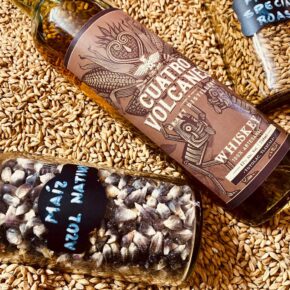
The name is the first clue as to this whiskey’s Tlaxcalan pride. Cuatro Volcanes (Four Volcanos) refers to the four natural landmarks that define the Valleys of Tlaxcala.
While living in the United States, Vargas Mendoza became aware of American corn whiskeys and wondered why Mexico, despite its fame for corn, did not have any similarly famed whiskeys. With a little research, he did find a nascent movement to produce Mexican corn whiskeys and decided to try his hand.
He knew nothing about distillation but convinced some microdistillers in the US to hire him so he could learn. Over 12 years, he went back and forth between the US and his mother’s home in Tlaxcala – learning the basics north of the border and experimenting with them on the native corn varieties of his state.
Cuatro Volcanes was officially established in 2018 and the business took off, eventually taking over the whole house as Vargas created a line of beverages as well as a restaurant/bar. The basis of the business focuses on local ingredients, with careful attention paid to the characteristics of all raw materials and building close relationships with the farmers that produce them.
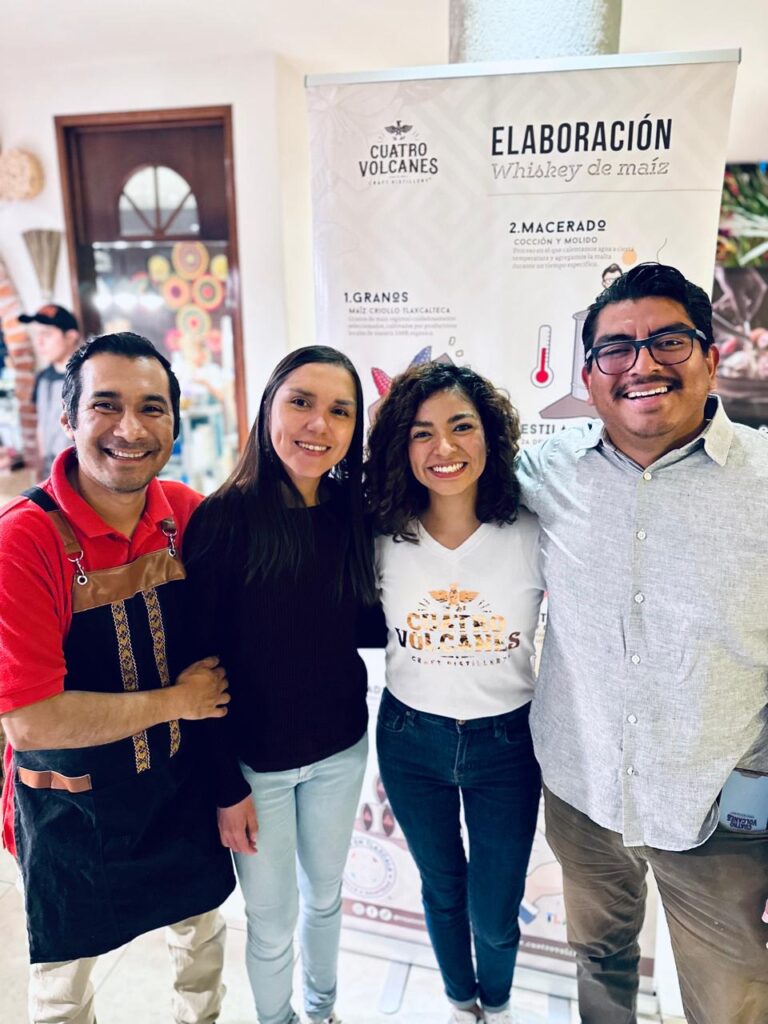
Vargas Mendoza is not so much interested in making a “Mexican whiskey” but rather a “Tlaxcalan whiskey.” All Mexican whiskey producers do use corn grown in the country, but what relationship that corn has with the local area varies by maker. Vargas Mendoza agrees that larger and smaller producers make good whiskeys mixing corns from various parts of the country, but says, “We do not want to make a whisky from mixed corn. It has never been part of the equation of how we want to work.”
All corn used at Cuatro Volcanes is from Tlaxcala, and Vargas Mendoza prefers organic. He aims to create flavors that represent the state and its farmers. So far, this has resulted in whiskeys with mineral and earthy notes. Vargas Mendoza is interested in producing a sweeter, fruitier version when he can find the right corn. However, the focus remains on producing “Tlaxcala whiskey.”
So far, distillates made with Tlaxcala’s variety of blue corn dominate, followed by whiskies made with its purple corn. But experimentation continues with about 15 corn varieties that Vargas Mendoza has identified as having promise. Notably, he is documenting in detail where each lot of corn comes from, down to the farming family and the field. Experience has taught him that the same variety grown in different situations can have different properties. He explains that even the working situation of the farms is taken into account: “Traceability does not only give credit to the producer, but also the community and fields from which we take the corn, doesn’t it? We don’t do that just because it sounds nice. It creates consumer confidence–as family and neighbors are part of the production. The structure of the family is the working unit.”
Whiskey made with Tlaxcala’s blue corn is the bedrock product, but Cuatro Volcanes has been creating limited edition products since 2022. These projects are in line with their dedication to experimentation, as well as the smaller quantities of raw materials they work with.
Their first limited edition product was a collaboration with Irad Santacruz, a renowned chef and promoter of Tlaxcalan cuisine. Santacruz is a gin lover and the two set to work on a gin that met both men’s expectations. It took nine months of trial-and-error, but they produced a gin based on Tlaxcala blue corn, colored with cochineal and featuring cardamon and other botanicals. This gin won bronze at a Mexican distillate competition that heavily favored mezcal.
Next, in 2024, was a gin flavored to commemorate the 500th anniversary of contact between Tlaxcala and Spain. They only produced around 200 bottles, inspired by Vargas Mendoza’s mother’s recipe for mole, which uses serrano ham hock as one of the flavorings.
The newest is a whiskey dedicated to the very local Sangre de Cristo corn, a very dark purple corn (hence the name Blood of Christ), that is cultivated only in Tlaxcala in volcanic soils at over 2,500 meters above sea level. Sangre de Cristo has mineral and earthy notes, as if it were aged in a clay pot with some salt. It is semi-dry, with notes similar to bourbon. This whiskey is bottled in fine pottery jugs made by the Talavera La Corona workshop of Israel Corona. The artwork on the bottles is by Tlaxcalan artist Alejandro Muñoz. Projects like this are important, says Vargas Mendoza.“(Sangre de Cristo) is one of those corns that are unfortunately very difficult to find, and I hope that the work we are doing will raise some awareness, more visibility is these kinds of corn.”
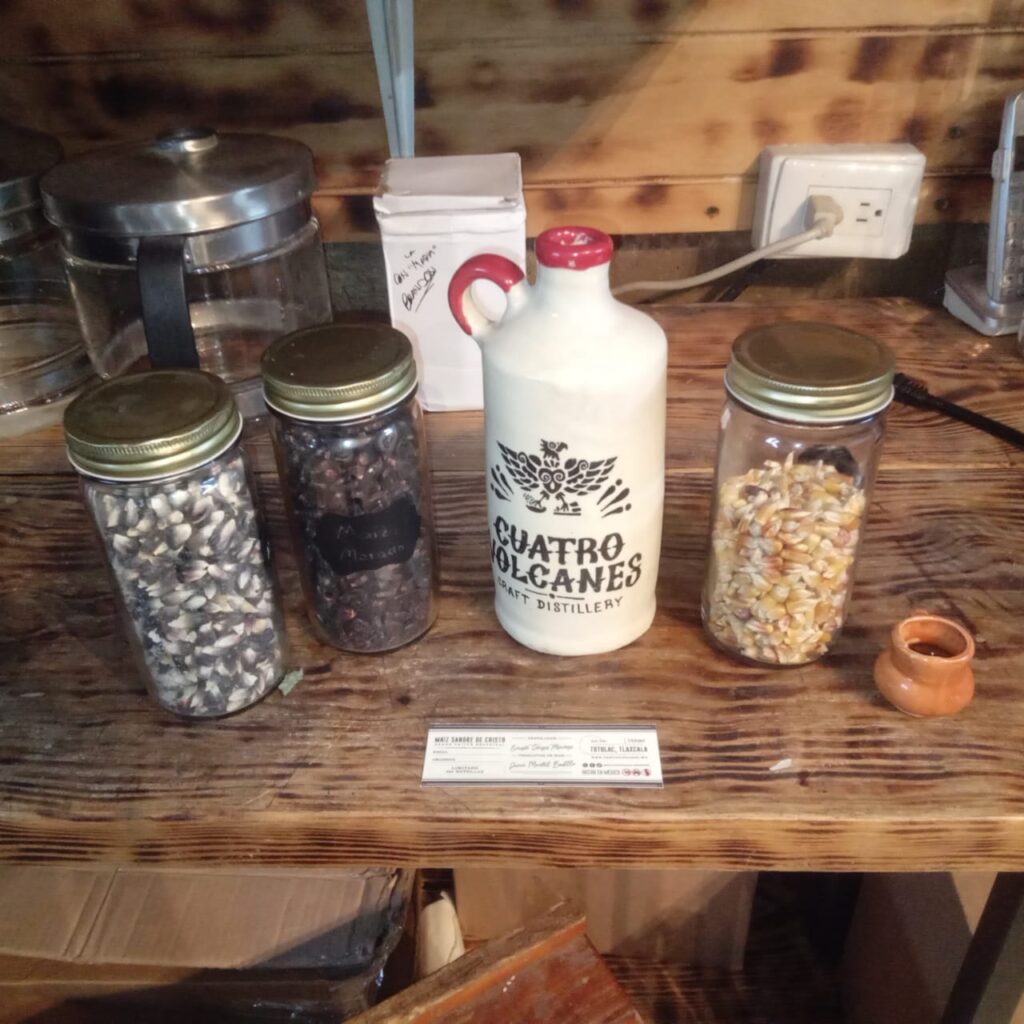
This whisky is now available on the distillery’s website here, while supplies last.
Vargas Mendoza finds the limited edition model very useful in supporting its continued experimentation with new creations. Future editions will depend on season and collaborations with people and organizations that share the distillery’s vision.
Developing rural economies through whiskey
But pride is not the only reason why he focuses on Tlaxcalan corn. Living in a very rural state, Vargas Mendoza is well aware of the difficulties that traditional farmers face. “The reality is that the Mexican farmworker is very abused. The work pays very badly, and most want to pay very cheap prices for corn. Projects like Cuatro Volcanes exist to revalue the work that these families do.”
The reevaluation is possible in part because whiskey, especially fine whiskey, commands higher prices. This allows Cuatro Volcanes to offer farmers much better prices and they also buy direct. This is particularly important to families whose livelihood depends on corn, allowing them to maintain their traditional way of life.
Cutting out the middleman makes sense in various ways, but it also has another upside. Cuatro Volcanes develops long-term commitments with farmers like José Montie in San Juan Quetzalcoapan and Juan Aguilar of Atlangatepec, becoming part of their communities’ lives and economies. At first, it wasn’t easy to identify exactly who produced what, but today, his procurement system is sophisticated enough that he can credit the farmers on the bottles.
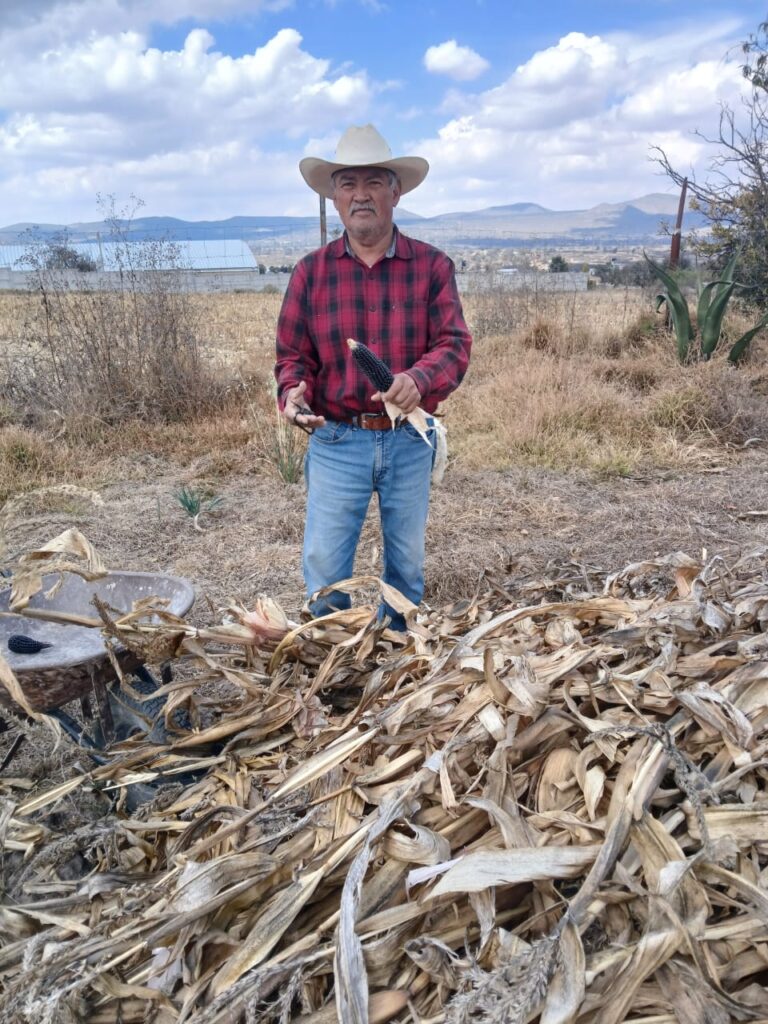
Direct involvement allows Vargas Mendoza to work with farmers to improve quality and yield, as he often buys their entire harvest. Collaboration with various communities allows them to participate in local festivals, and organize seed exchanges to conserve corn varieties that are in danger of disappearing. Cuatro Volcanes learns about the cooking and other traditions of these rural communities, and then promotes the stories of producers and their families. They believe this is important because often the women and children who do much of the work are even more ignored than the head of household .
“One of the best things about Cuatro Volcanes is that we tell stories that have never been told before. It is a new way to share what Tlaxcala has to offer through its corn varieties–as really, its corn did not attract so much attention before.”
The benefit to Cuatro Volcanes was inspiration and a strong appreciation of the corn. “When we began to work with the community of Santa Cruz, they began to talk about their traditional cooks and this conversation led us to focus on criollo corn and those endemic to Tlaxcala, because many of their recipes use these types of ingredients that are not talked about in any other way.”
Beyond whiskey
Vargas Mendoza’s commitment to buying locally extends beyond corn, but for products like rum, gin, and brandy, he is more flexible. Tlaxcala’s colder climate doesn’t produce all the key ingredients. For example, the base for their gin is made with 100% Tlaxcala corn, but sugar for rum (in the form of traditionally made piloncillo) is sourced from the neighboring state of Puebla, where Vargas Mendoza’s grandfather had a farm. For his mole gin, not all the ingredients are from Tlaxcala, but they are all traditionally used in Tlaxcalan moles. He has even taken some cues from as far away as Oaxaca, where chicken breast can be used to flavor mezcal. He has used turkey and rabbit, common meats in Tlaxcala, to a similar end.
Cuatro Volcanos’ brandies do not use grapes (which can be grown only in a tiny part of the state), but rather fruits that are abundant here and in Puebla. One variety is made with the prickly pear fruit (tuna), which grows readily in rocky dry soils. It is not easy to convince people that such fruits can yield quality brandies but Vargas Mendoza has not given up.
Other materials and preparations in the experimental stage include amaranth (widely grown in Tlaxcala), distilled local agave, pulque, and absinthe.
Making Tlaxcala “exist” through quality beverages
Cuatro Volcanes is still a small home-based operation, making about 100 liters a week. Work by small enterprises like this is important because Tlaxcala has no visibility in Mexico’s massive tourism industry and its connectivity to the rest of Mexico is somewhat limited. Whiskeys and other distillates provide an accessible way to showcase the state’s agricultural heritage over long distances.
Cuatro Volcanes has done this by participating in various national and international competitions (often at their own expense), winning silver and gold for various products at events such as Mexico Selection (sponsored by Concours Mondial de Bruxelles), World Spirits in San Francisco, and the National Spirits Competition in Guanajuato, along with recognitions from Revista Cava and promotion from Fundación Tortilla in Mexico. Oddly enough, it has not received any significant support from Tlaxcalan authorities.
Vargas Mendoza believes that time has come for Mexican whiskey and other craft spirits. He says Cuatro Volcanes has “hit the lottery.” The business now employs the family, who participate in various aspects including a chef who keeps whiskey and other local products in mind as he designs the menu.
Although a little off the beaten path, even for Tlaxcala, the distillery and restaurant/bar has no problem attracting customers, even visiting school groups. However, if you are in Mexico and unable to visit, their products can be found in upscale markets in Mexico City, Mérida, Oaxaca, and other cities. You can also buy their products online.
“We distill with tradition, and bottle with Tlaxcalan pride. For us, if there is no Tlaxcalan corn, there is no Tlaxcalan whiskey.” insists Vargas Mendoza. “Therefore, what we want is to close the cycle of (corn’s reputation) to make it more valuable–so that whatever whiskey made with corn has the same value of any distilled in Scotland, Ireland or anywhere else in the world.”






Leave a Comment